Showing posts with label Television. Show all posts

Sunday, April 08, 2007

Sometimes in April

2005, US, directed by Raoul Peck

Made for HBO television, Raoul Peck's examination of the 1994 Rwandan genocide is a powerful piece of work that goes well beyond the rather sanitised version of events presented by Terry George's undoubtedly worthy but finally uneven Hotel Rwanda; Peck's television film has proved controversial enough that releasing the film, in any venue, in France has thus far been problematic, with continuing investigations into the actions of the French military during the genocide. Peck, though, tends to focus more explicitly on the failings of the US, with several sequences depicting the inter-institutional debates between the Pentagon, State Department, and White House that led nowhere (as one character notes, the lack of action proved that the "system worked", a comment also made by a Clinton administration official); the film opens, pointedly, with an apology from President Clinton, an apology that sounds especially hollow when heard in a Rwandan classroom (references to France are much less explicit, though there's a brief shot with a portrait of François Mitterrand that appears at a crucial point in the film).


Unlike Hotel Rwanda, Peck broadens the focus beyond one worthy man, telling multiple stories that frequently leave the main characters - a pair of brothers, one a moderate Hutu, the other a journalist on Radio Mille Collines, one of the main sources of genocidal propaganda - behind for long stretches of time, though the use of the device of the two brothers also proves a useful method of contrasting the two sides in what was ultimately the most vicious of civil conflicts. Peck doesn't shirk from depicting some of the atrocities that were routinised over the course of three terrifyingly brutal months (and makes clear that one of the most dreadful experiences of all was the immense task of cleaning up after the killers had moved on); it's also not hard to see the film as a commentary on lesser episodes of hate in other countries, including his own native Haiti. Peck shows a particular interest in issues of reconciliation, both at the level of the International Criminal Tribunal for Rwanda (in Arusha, Tanzania), and especially the Gacaca, the community justice courts developed to deal with the tens of thousands of people accused of "lesser" crimes; the scenes which show the operation of these courts are especially effective, as the country tries to come to terms with the immensity and consequences of events barely a decade in the past.

Monday, January 15, 2007

Haughey

2005, Ireland, produced/directed by Niamh Sammon for RTE

A four-part documentary made for RTE, Haughey is an essential addition to the growing body of work concerning this most divisive of public figures, the dominant figure in Irish political life since the late 1960s. Although the series was screened a year before Charles J. Haughey's death, it has the air of a blunt obituary, particularly given that the former Taoiseach is not interviewed. As with any decent obit, it's a balanced account, making clear his accomplishments in a number of areas (especially while Minister for Finance, from 1966-1970, and during his third and final stint as Taoiseach from 1987-1992, when the country finally grappled with its crippling debt burden, and took real steps towards peace in the North), but pulling no punches on his overweening ambitions and the constant questions about his lifestyle and finances that ultimately led to his downfall and utter disgrace (though not his impoverishment; indeed, the end of his career in public life was also the beginning of a life of true wealth given how he was able to profit from the property boom in Ireland).

While the entire series is absorbing, there are particular highlights: the 1982 GUBU period, inevitably, given the serial skulduggery that punctuated Haughey's brief term as Taoiseach in that year; the breathtaking 1990 betrayal of loyal supporter and friend Brian Lenihan in the presidential election controversy (some of the roughly contemporaneous footage of the sickly Lenihan is genuinely disturbing); and the 1992 events that led to Haughey's resignation. In contrast to all of the shenanigans, there are moments of courage, too; though you're never supposed to like a Minister for Finance, even a former one, Charlie McCreevy won my grudging admiration for his 1982 backbench revolt.

The format is standard for episodic TV documentary, with a strictly chronological approach that blends voiceover narration with contemporary footage, radio and television snippets, and dozens of talking heads. The gallery includes family members, businessmen (few improving their public images), government officials, politicians (in addition to the aforementioned McCreevy, Desmond O'Malley and Mary O'Rourke are especially good), journalists, and academics. For his part, longtime adviser and confidant (and driver) P.J. Mara does nothing to throw off the vaguely sinister image fixed in amber by Dermot Morgan's legendary turn as Haughey on the Scrap Saturday radio show, whereas Pádraig Flynn is, on camera at least, a surprising hatchet man; he comes across as somewhat frightening in the third installment, but looks marginally better by the conclusion despite pocketing a donation from a businessman who 'said he liked me'.

Haughey's dominance of his era and his misbehaviour are by now well-known, so perhaps the key achievement of the series is the manner in which it pins down his divisiveness, especially within his own party, which was almost torn asunder (that Haughey's successor as leader of Fianna Fáil, Albert Reynolds is reduced, on camera, to tears when recounting old events speaks volumes about the passions raised). That polarising effect is undoubtedly critical to the continued fascination his life (private and public) exerts.

Monday, June 19, 2006

The Best of Youth

2003, Italy, directed by Marco Tullio Giordana (original title: La Meglio gioventù)

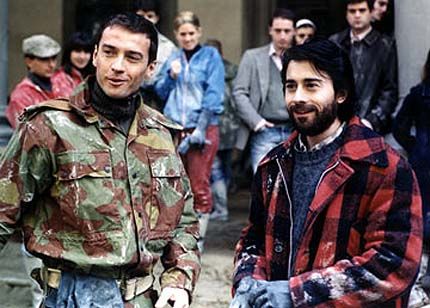
Originally conceived as a mini-series for Italian television, and then given a theatrical release instead, The Best of Youth is a remarkable family saga set against the changes in Italy over the period from 1966 to 2003. While the factual backdrop - the 1966 Florence floods, 1970's student activisim in Turin, the Red Brigades, the assassination of Judge Falcone in Sicily, and so on - is fascinating, the film is ultimately more interested in domestic affairs, most specifically in the portrait of two brothers, Nicola and Matteo, and their divergent careers and outlooks. It's an exceptionally warm, generous piece of work: generous in running time, but also in its view of its main characters, who are given the time and latitude to make mistakes, without ever losing their essential dignity. Over the course of six hours, those characters are so appealing that it's hard to immediately accept the film's most shocking moment: I wasn't able to process that development for several seconds, so jarring was its effect. As with most family dramas, there are inevitable moments of soap opera given the need for continual plot development, while the ending isn't all that hard to predict, but those are minor quibbles given the overall skill and care with which the story is told; the direction has all the hallmarks of old-fashioned craftsmanship. For the most part, the acting, too, is excellent (although some of the actors are a little too fresh-faced to entirely convince in the later stages), while the rich vein of humour conveys the bonds of family and friendship in deeply rewarding fashion.

Tuesday, June 28, 2005

Danger UXB

1979, UK, Thames Television

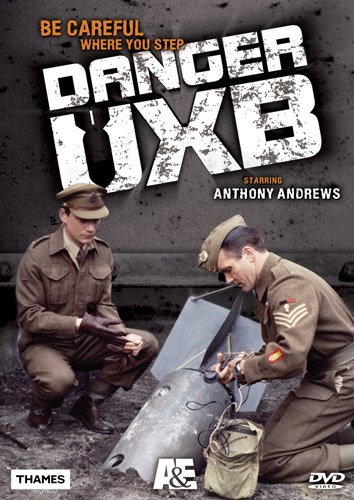
A British television classic that somehow hasn't quite the reputation of series like Brideshead Revisited or The Jewel in the Crown, both of similar vintage, this is an often superior show, detailing the exploits of an unexploded ordinance disposal team from 1940-1944. The team is based on the home front, in London at the height of the Blitz (at least in the early episodes). Anthony Andrews plays Brian Ash, a freshly-minted lieutenant who is assigned to the bomb squad despite having no relevant experience - or training.

The first few episodes focus almost obsessively on the mechanics of bomb disposal: the members of the bomb squad themselves are only lightly sketched in, but soon the human drama comes to the forefront. Ash is centre-stage, but the writers are at least as interested in the fates of several of the NCOs and enlisted men, with several episodes cross-cutting between Ash - and his growing relationship with Susan, the daughter of one of the scientists who develop methods to combat new types of bomb - and one or other of the men in his squad. One story arc follows Corporal Salt, perennially in trouble, while another trails Mulley, Ash's batman, who falls for the feisty daughter of Ash's landlady.

This being Britain - and perhaps more to the point British television - there's a constant class-consciousness behind much of what's on-screen. Ash's officer colleagues take him for an Oxbridge man at first and are surprised when he turns out to be the product of a much less fashionable institution - although his background is clearly that of the landed gentry. The accumulation of tiny details over the course of the episodes is a fascinating social portrait - both of wartime Britain and a country in the 1970's which was on the verge of profound change (it's very clear we're watching Britain at war here, incidentally, and not just England: the small squad has a Scot and a Welshman, a Cockney and a northern lad).

The army is perhaps uniquely suited to reflections on class, with the aristocratic officer corps, the enlisted men and the reliable NCOs not quite sure of where they stand - having left their humble origins behind, they're still clearly not quite good enough to make the upper-class grade. Ultimately, of course, it's the characters, not the social or political insights, that make Danger UXB so compelling over the course of thirteen episodes - and for that, much credit goes to a fine complement of character actors, with Maurice Roëves (as Sergeant James), Kenneth Cranham (as Corporal Salt), George Innes (Corporal Wilkins) and Gordon Kane (as Mulley) particular standouts. Andrews does a fine job with Ash's character, although Judy Geeson seems rather too strained as Susan, a rare flat note in an otherwise excellent series.

Index

List of all movies

Most of the images here are either studio publicity stills or screen captures I've made myself; if I've taken your image without giving you credit, please let me know.

About Me

Boston, Massachusetts, United States