Showing posts with label Germany. Show all posts

Saturday, June 09, 2018

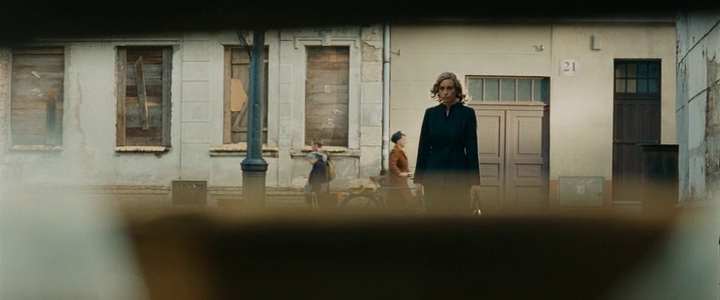
Das letzte Schweigen


2010, Germany, directed by Baran bo Odar


Monday, April 25, 2016

Er ist wieder da


2015, Germany, directed by David Wnendt (aka Look Who's Back)

When I was in Berlin last year, there were posters everywhere for this but I couldn't make my schedule work to take it in; I'd heard of the book, which posits Hitler inexplicably awakening in modern-day Berlin, and read mixed things about the success of the film, though it's certainly worth a look as a curiosity and a muddled commentary on modern German pop culture (as well as the continued efforts of Germans to deal with their country's past). The land of Goethe and Schiller has no equal in its ability to plumb the depths when it comes to reality TV culture, and the film makes a good deal of hay with this, but what's most notable is the exceptional commitment of Oliver Masucci as Hitler, staying in character in the unscripted, public sequences to a quite extraordinary degree. Obviously, there's a debate to be had as to whether you can effectively use Borat-style tactics when you're dealing with an actual historical figure rather than an invented Kazakh lunatic, but there's an unfakeable discomfort that comes from the bizarrely warm embrace with which "Hitler" is met in so many quarters.

Saturday, November 07, 2015

Becks letzter sommer


2015, Germany, directed by Frieder Wittich

A pretty derivative, if fitfully endearing, German dramedy, with very strong echoes of some of Fatih Akin's lighter films (especially Im Juli), as well as every inspirational-teacher/teen-saved-by-music film you've ever seen. Christian Ulmen, the titular Beck, bears a strong resemblance to Paul Giamatti both in terms of facial features and semi-schlubby lovability, and makes it more watchable than it probably deserves. 

Friday, May 01, 2015

Die Koffer des Herrn O.F.


1931, Germany, directed by Alexis Granowsky

A delight from start to finish, funny but also biting in its satire of frenzied speculation, something that must have had quite a resonance for the audience of 1931, after more than a decade of economic turmoil of one kind or another. As a critique of capitalism, it would pair well with Capra's American Madness; the films are quite different in tone but both are very good on the essential craziness of the system as it prevailed then (and now), and the German film makes especially good use of a few fantasy sequences. Lorre is such a distinctive performer, entirely apt for the double-speak of the role of small-town newspaper editor/booster. I was initially distracted by the regular appearance of the word "Verboten" on the print, from German TV, especially because it seemed to crop up at irregular intervals and stay for unpredictable lengths of time. Eventually, though, with the assistance of some reading research, I figured out that this represented the location of the many and varied cuts made by the Nazi regime a year later, so the print in circulation for the rest of the 1930s was radically cut to remove unapproved personnel, songs, and incidents.

Tuesday, April 28, 2015

Phoenix


2014, Germany, directed by Christian Petzold

Christian Petzold's body of work over the last fifteen years or so is among the finest in European cinema, and one of the more remarkable aspects of his past two films is the seamless transition from largely contemporary themes to fine-grained explorations of the past that are nonetheless the polar opposite of most period pieces. There's nothing airless about these films despite the meticulous recreation of setting (though they share with most Petzold films that sense of being quite deliberately under-populated: Berlin is no teeming city here, but rather a specific time and place sketched in with exceptional economy both in narrative and demographic terms). It's no great surprise that a filmmaker as strong as Petzold was eventually going to turn fully toward some of the great historical questions of his society, dealing with the past and its weight -- quite literally in the case of Nelly in this film, but of course construed more broadly by Petzold. 


I was struck, not for the first time, by the director's ability to take material that could appear quite melodramatic and treat it in a non-histrionic way -- it's precisely the refusal to engage in melodramatics here that lends the narrative its power, the quiet accumulation of details that is so neatly and poetically turned on its head in the final, wonderful scene. Nina Hoss is, as ever, quite remarkable, creating a fully-realized person with the most delicate shades of nuance, steadfastly refusing the "big" acting that many others would bring to a part like this. Other notes: the du/Sie nature of German adds a whole other layer to the interactions between Nelly and her former husband, one which the subtitles struggled awkwardly to convey in the early going with the occasional use of "Miss." The sound design is also quite wonderful: the sounds of (different) clocks in each location, the creak of floorboards, the way that sounds which seem so loud at night (like those clocks) fade into the background in the bustle of the day. Impeccable detail and yet all in service of the bigger picture.


Wednesday, April 22, 2015

Die Angst des Tormanns beim Elfmeter


1972, West Germany/Austria, directed by Wim Wenders (aka The Goalkeeper's Fear of the Penalty)

I first saw this in my mid-teens when it played on TV, before I had seen any other Wenders films, and I was pretty nonplussed -- although intrigued enough to stay with it. It's a pretty significant step up from here to Alice in den Städten and yet this film is still an impressive work in terms of Wenders' intent and ability to deliver thereon. I recently watched an interview with Wenders, filmed much more recently, in which he spoke of his youthful sense of an absence of history, or at the very least an absence of the discussion of history, in postwar Germany, with its literally unspeakable acts. I can't help but hear an echo of that broader need for confrontation with the past in this early film: the central character's own terrible act colours everything that comes afterwards and yet he simply goes on living. Of course, that's only one reading of the film -- it's a film that practically invites you to project your own viewpoint, though it's become remarkably hard to see the film these days.

Friday, February 07, 2014

Gespenster


2005, Germany, directed by Christian Petzold

Most of Christian Petzold's work is set in small-town Germany -- even where he uses Wolfsburg as the title for a film, the bulk of the action takes places on the fringes of that town -- but here Berlin has the same depopulated feel as Petzold's provincial locations: there's almost none of the bustle you might associate with the city, and the director prioritizes a sense of sterility, the institutional feel, in almost all of his locations. His characters, too, are often devoid of the range of emotions one might expect -- they struggle to express themselves, or behave unexpectedly, even inappropriately. The title can be taken quite literally in that regard: many of the characters seem to be shadows of normal human beings, seeking connections but failing to establish them in the midst of a plot that would likely descend into melodrama in other hands. Julia Hummer is especially good in the lead role -- a lost waif if ever there was one, spiky and difficult yet still vulnerable.

Saturday, May 25, 2013

Falsche Bewegung


1975, West Germany, directed by Wim Wenders (aka The Wrong Move)

Sandwiched between Alice in the Cities and Kings of the Road, this feels only nominally part of the same road trilogy. It abandons the surprisingly warm black and white of the other films for a damp and chilly colour, and despite the unifying presence of Rüdiger Vogler in all three films, it comes across as an entry from an entirely different filmography -- a Godard film shot across the border with Germany, with an array of literary allusions, strange narrative turns, and that flat affect that's so disconcerting across Godard's films, from Week End to Nouvelle vague. It's a considerably more difficult film as a consequence -- the characters are consciously opaque, struggling with profound questions about their own ennui as well as Germany's history, but with little of the humour that makes the companion films so instantly engaging.

Friday, May 10, 2013

Alice in den Städten


1974, West Germany, directed by Wim Wenders (aka Alice in the Cities)

Thematic similarities abound, unsurprisingly, with the later entries in Wenders' road movie trilogy, but especially with Im Lauf der Zeit. It's not hard to imagine that Rüdiger Vogler is playing literally the same character, notwithstanding the change in name, as though this film's Philip ended a chapter of his meanderings in Bavaria before wandering on as Bruno a couple of years later. The same geniality and willingness to go, for the most part, with the hand dealt are essential to both characters; also present here is the striking warmth of Wenders' take on the world notwithstanding the ennui at the heart of both films.

Like so many films, one of the major themes here is the creation of one's own family -- often unlikely in composition, and yet somehow seen as more authentic than one's inherited family simply because there's a degree of intention rather than accident. Where the American scenes are about the obliteration of anything authentic under a blizzard of soul-destroying advertising and consumerism, the German sections are suffused with a sense of loss of the past, the paving over of places of youth in the interests of progress -- with perhaps small remaining window to change direction before the American way wins out, though by the time of Im Lauf der Zeit Wenders suggests that the American way may have had its subconscious victory already.

Friday, May 03, 2013

Im Lauf der Zeit


1976, West Germany, directed by Wim Wenders

For a film that is in many ways about alienation from modern life, especially modern German life, this is a strikingly warm and often humours piece, in which Wenders weaves big ideas about society and social relations into a portrait of two men on the road. The interaction between character and idea is far more natural here than in later work like Wings of Desire, which never quite worked for me -- it seemed to signal its own perceived importance, notwithstanding individually successful elements.


That's not to say that every scene here comes off: the sequence with the bereaved man and that in which Robert (Hanns Zischler) reunites with his father are both a little on the obvious side, though each has passages that are successful even if the overall execution lacks subtlety. But those scenes hardly set the overall tone, of constant, elegiac movement in which we're always aware of the end of the journey even as it might seem to unspool to infinity.


Wenders provides us with a very different look at Germany: there's little about postwar recovery and economic success, but instead small towns that have seen better days, and the abandoned countryside (in which both central characters are complicit). The film celebrates much that has been lost in Germany's recent history -- whether it's old vehicles or disappearing skills like cinema projection, printing, even rowing across the Rhine (Wenders and Robby Müller show that they've not forgotten much about how to create gorgeous black and white images, though).


The central characters might be expected to embrace the modern given their complicated relationships with their personal histories but they are instead driven to revisit the past in an attempt at understanding. That process of understanding also relates, of course, to understanding where they stand as Germans born after the war -- the the chill, never verbalized, that descends when the Third Reich is mentioned takes the smile off the face of even Bruno (Rüdiger Vogler), that most good-natured of characters.


Wednesday, April 17, 2013

Der Räuber


2009, Austria/Germany, directed by Benjamin Heisenberg (aka The Robber)

Even by the standards of the existential crime film, this is stripped down stuff, never touching on the central character's motivations except to suggest that his compulsions are somehow innate and not subject to any form of self-regulation. He does what he does because he has to, and he does what he does well, though without any obvious pleasure, whether the activity in question is marathon running or robbing banks. The apparent lack of depth, though, is deceptive: it's precisely by the absence of apparent motivations that the viewer is drawn to psychologize and provide explanations where none are offered. There's nuance, too, in the robber's halting relationship with an old friend, their awkward early interactions reinforced by Heisenberg's clever blocking -- much is transmitted just by the ways in which these two people negotiate the same space.

Wednesday, January 02, 2013

Das Leben ist eine Baustelle


1997, Germany, directed by Wolfgang Becker

I lived in Berlin for two years, from 1999 to 2001, and no film better captures the feel of the city as I experienced it, as a place where anything could happen, at any time -- there's a magical realist feel to certain scenes in the film that nonetheless seems entirely grounded in the city of the time. The first weekend I was there, some new acquaintances invited me to an art show in a former butcher's shop. For some reason, someone had filled shallow trenches on the floor with flour, and by the end of the evening everyone's clothes were white up to the knees: little clouds trailed behind us as we walked out into the chilly November night, and yet it was all entirely normal.

One major difference between the film and the city as I experienced it, though, and not a minor one: while I could never quite figure out how some of my friends stitched together a living, they still seemed pretty comfortable, whereas the characters here are visibly more hand to mouth, and much of the film centers around the jobs that they take and the schemes they concoct. For all that, though, there's a verve and a chance-taking about their lives, and a warmth in their fumbling efforts to create a new sense of family. That's not an uncommon cinematic theme, but it's handled convincingly here -- in halting, sometimes ham-fisted steps rather than in any simple progression, such that we learn of the characters' frailties along with them, as it were. In the end, though, it's hard to maintain any critical distance from the film -- the people and the streets feel like part of my own life in some odd way, and I'm overcome with a confused sense of nostalgia and heartache as I watch the characters work through their stories.

Tuesday, June 19, 2012

Offroad

2012, Germany, directed by Elmar Fischer

Further proof, if ever it were needed, that European film industries are perfectly capable of churning out low-grade, pre-fabricated films of their own; there's virtually nothing original or especially charming in Elmar Fischer's film, and certainly no reason to root for the heroine, played by Nora Tschirner. She's apparently one of Germany's more energetic young stars, but this is a poor showcase indeed.

Saturday, June 16, 2012

Barbara


2012, Germany, directed by Christian Petzold

Christian Petzold's previous few films were all set very firmly in modern Germany -- indeed several of them might be read as an indictment of that modernity, at least in terms of what Petzold takes to be the superficial nature of many contemporary interactions and obsessions. Barbara, by contrast, is set in a small town in Eastern Germany in 1980, though it's unmistakably a Petzold film -- an intense character study, extraordinarily observant of small details of both psychology and setting, with much of the communication elided.

As with films like Wolfsburg, the setting of the film is strangely depopulated -- Petzold's towns seem to be barely inhabited, enhancing the claustrophobic sense that one is always likely to run into someone one knows, though not necessarily for the better. It's an idea given a new resonance in Barbara, where the nature of small-town life brings the titular character, an exiled-from-Berlin doctor played by Petzold favourite Nina Hoss, into contact with the local Stasi man as both object of study and potential provider of healthcare. There's no romanticizing of such interactions, however, as in, say, Florian Henckel von Donnersmarck's The Lives of Others (von Donnersmarck's swift decamping for Hollywood comes as no surprise; it's much harder to imagine Petzold making such a transition).

Petzold's characters are frequently rather poor communicators, or at least they don't say a whole lot on occasion, and yet Petzold's own style is crisp and clear -- a shot of that Stasi man in the building where a family member lies ill tells us all we need to know, while the film's final shot similarly manages to compress a great deal of unsaid business between the two main characters, capping this particular onscreen narrative while opening the way to a new, untold story. Petzold also stitches his story together with what seems to be the world beyond his film, having a character recount the story of an actual book, or describing in great detail the story of a painting; the warmth of these sequences, among the more verbose in the film, suggest that the director is using them to share with us some particularly personal pleasures.


Monday, February 13, 2012

The Three Musketeers

2011, Germany/France/UK/USA, directed by Paul W.S. Anderson

I read Dumas's original novel twenty years ago in college and while the years may not necessarily have been kind to my memory, I had no recollection of the zeppelin-like air war that features in the climax of this version. I imagine that any re-telling of a much-filmed tale has to find something in the way of novelty, but changing the core intrigue so completely and tacking on CGI silliness to compensate for often bland actors, didn't work for me even when trapped on a plane with no other entertainment to hand. It really is a pity because there are very occasional hints of a more interesting film: Anderson makes good use of the sumptuous interior spaces of the palaces where much of the film takes place, and the swordplay sequences are for the most part brisk and clear.

Tuesday, September 13, 2011

The Forest for the Trees

2003, Germany, directed by Maren Ade (Original Title: Der Wald vor läuter Baumen)

Maren Ade's film school graduation project, The Forest for the Trees is a challenge to watch: with no histrionics or sentimentality, it charts the disintegration of a personality under what seem like banal strains - a new job, a new town, the struggle to define oneself and to find friends that aid in the endeavour. Technically, there are certainly rough edges, with the video sometimes looking washed out, but the nuanced performances, and Ade's acute observation of interactions between her characters, down to subtleties of tone and choice of words, give the film considerable power. It's rather like watching a show like The Office at times, where the film's ability to gnaw at the viewer stems from the recognizable reality it depicts, particularly the slightly off-key central character, though there's barely a note of humour throughout.

Saturday, January 01, 2011

Soul Kitchen

2009, Germany, directed by Fatih Akin

Soul Kitchen has the same urgency, the almost frenetic pacing, of Fatih Akin's previous work, but where the whirlwind spun in destructive directions in Gegen die Wand, here the energy is positive, with the sense that good things can happen almost overnight. There's a romance, and a winning naivete, that harks back to Akin's earlier romance Im Juli, with here a hint that perhaps multiculturalism still has something to offer for the immigrant in Germany; that's probably placing more weight, though, than really belongs on a film which narrates an ecstatic triumph over the odds.

Thursday, January 07, 2010

Yella

2007, Germany, directed by Christian Petzold

To an even greater degree than Wolfsburg, Christian Petzold's previous film, Yella plunges into the world of modern German business - sleek offices, constant phone conversations, hours spent on the move in cars (vehicles give both films a narrative jump-start) - although where Wolfsburg featured characters from outside the world of commerce, here no other life seems possible. Despite the characters' own references to the thrill of victory at the negotiating table, the film portrays those victories in entirely hollow terms - the excitement evaporates almost instantly, or comes with terrible consequences.

The film plays out in the most sterile of business spaces: anonymous office buildings such as those erected when Hanover's world fair closed its doors, as if to emphasize that the fair itself was all an illusion, or hotels with no personality. Petzold focuses constantly on straight lines, as if nothing can escape the geometric precision of the modern environment: his characters always seem to be trapped in boxes or between lines (during one brief scene, he suggests an alternative set of possibilities, and he uses warmer tones and out of focus images in contrast to the crisp lines of the rest of the film).

There's a very deliberate ambiguity to the film, which seems to hover in a kind of dream world: Yella (Nina Hoss, who's excellent) is shown waking from sleep on several occasions, while doors in the hotel almost never seem to be closed, as if the usual concerns for security are unnecessary. Several shots refer back, either explicitly or implicitly, to a key scene of trauma early on, in which a car goes off a bridge: the reflected lines of the bridge are mirrored almost perfectly in another series of reflections in a pool outside Yella's hotel, a parallel that acquires more significance as the film comes full circle.

Tuesday, February 17, 2009

Wolfsburg


2003, Germany, directed by Christian Petzold


Although Christian Petzold works in a very different tonal register, Wolfsburg is sometimes strikingly reminiscent of Tom Tykwer's 1997 film Winterschläfer in its narrative strategies. Indeed, the two films are both centered around car accidents and unexpected new relationships, and both have carefully constructed outcomes with a measure of poetic justice. The similarities end there, however: where Tykwer, more than in his other films, creates a strikingly warm portrait of small-town life, Petzold is a merciless observer of the surfaces of modern life. The small town, near Wolfsburg, where most of the film takes place seems to have no centre, no stabilizing force, a problem mirrored in the main character's lack of moral centre. Petzold's characters work in a car dealership and a supermarket, at opposite ends of the economic spectrum, and all seem trapped in existences over which they feel little control. Their moments of happiness are illusory, supported by the shakiest of foundations if not by outright lies - just as the new life constructed by the characters in Petzold's earlier film Die innere Sicherheit reveals itself to be a house of cards.

Thursday, November 15, 2007

Requiem

2006, Germany, directed by Hans-Christian Schmid

As with his 2000 feature Crazy, Hans-Christian Schmid displays here his ability to take potentially sensational or mawkish material and treat it with great sensitivity. Requiem focuses on a young Catholic woman who has dealt, apparently, with episodes of epilepsy and leaves her rural West German home for the university town of Tübingen in the mid-1970s. The opening of the film recalls Lars von Trier's Breaking the Waves, in which a devout woman in an isolated community turns to the church in an attempt to deal with forces beyond her control, though Schmid has none of von Trier's characteristic tendency to punish his lead character. He's also adept at creating a sense of the specific provincial background from which this woman emerges, a world that has little to do with the tumultuous political universe of German cities, where Christmas presents are movingly humble, and where a father's gift of a typewriter represents a silent investment of hope in a daughter.

When Michaela (Sandra Hüller) experiences problems at university, she turns to her religious upbringing for an explanation, understanding her difficulties in terms of her faith, and eventually concluding that she has been, in some manner, possessed. Schmid gives a wide berth to the trappings of the exorcism genre, instead casting his film as an examination of a troubled mind, which is unable to understand the realities of its own disintegration. While Schmid's view of the situation may not be that of his protagonist, he invests her character with tremendous dignity, trapped as she is in a situation not of her own making. He's also clear-eyed about the bitter fault-lines in Michaela's home, lines that fracture again as her illness worsens, and outside influences, in the shape of two priests, are brought to bear.

The film is shot with a hand-held camera that occasionally creates striking perspectives, as if we're watching a documentary, the camera roughly changing focus to move closer to Michaela at her desk. There's an extraordinary sequence when Michaela, suddenly moved by what finally seems a liberating spirit, dances, intoxicated, at a party, like the ordinary young woman she desperately aspires to be. The unfamiliar Sandra Hüller delivers a performance of great commitment as Michaela, vividly capturing her disintegration, never more so than in a unnerving sequence in her parents' kitchen. Burghard Klaußner, who also played the father in Crazy, complements her work with an understated turn as Michaela's staunchest protector.

Index

List of all movies

Most of the images here are either studio publicity stills or screen captures I've made myself; if I've taken your image without giving you credit, please let me know.

About Me

Boston, Massachusetts, United States