Showing posts with label Ousmane Sembène. Show all posts

Thursday, January 24, 2013

Ceddo


1977, Senegal, directed by Ousmane Sembène

Like Sembène's earlier Emitaï, this film is focused more on the collective than the individual -- while we become familiar with several specific faces, the director's primary interest is in exploring social forces more generally, and particularly the confrontation between Christianity, Islam and traditional African religion (at some unidentified point in, most likely, the late nineteenth century). The film is structured largely around several extended debates, set pieces of intense rhetorical interaction that foreshadow Abderrahmane Sissako's Bamako.


At least on this occasion, Sembène is much stronger on discussion than on physical action, and I wonder whether the decision to allow those sequences to unspool at such length is something of a tacit admission as to where his strengths lie: it can be very hard to tell what is happening, or where the characters are in relation to one another, in the brief action scenes, but he is capable of extracting great tension from sequences in which only words are exchanged. There's an especially powerful moment late on when one leader asserts his authority by appointing a new person to speak publicly for him; while the previous speaker is clearly upset, he is silenced by the need for absolute obeisance, and moves meekly to his assigned place in the background. Sembène also denies some of his characters any speech -- the European merchant and priest never intervene in the debates, though the latter does intone some portions of the religious service in Latin, even if the camera frequently picks them out as they observe the exchanges between the African characters.


Ceddo is an often angry denunciation of outside influence, in this case religious-political influences, which reminded me of Sembène's tendency to reject outside filmmaking influences as he proposed an authentically African way of making films. It's one of the most problematic aspects of his filmmaking philosophy to me, for it seems to me to forgo the opportunity to insert African cinema in a larger global conversation -- it somehow condemns the continent's cinema to a hermetically sealed space. Whatever the director's views on cinematic influences, he makes clever use of his resources to avoid complex effects, using careful angles to deal with moments of violence without requiring much in the way of fakery, for instance, though there is a very brief and inexplicably sped-up sequence that recalls silent slapstick at a moment when humour surely wasn't intended.


Thursday, April 24, 2008

Emitaï

1971, Senegal, directed by Ousmane Sembène

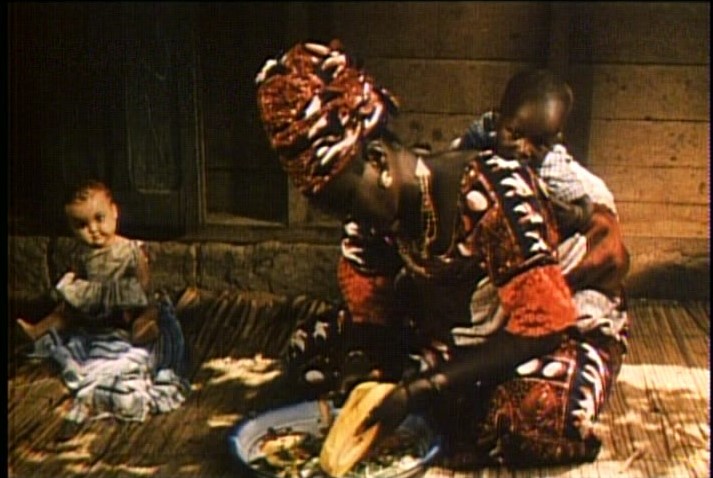
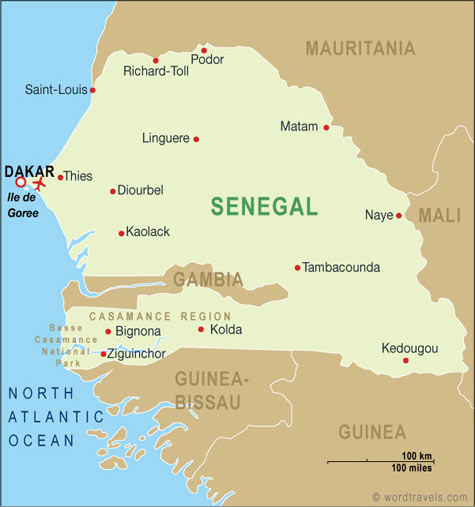
Ousmane Sembène's first historical film, Emitaï focuses on the conscription of African soldiers into the French army during the Second World War, and resistance to that effort in the Casamance region of Senegal (the film was made around Ziguinchor, in Casamance, using many non-professionals). His later Camp de Thiaroye took up the story of soldiers returning from that war, and there's a striking parallel between the conclusions of the films, both of which are partly derived from actual events (the film has links with other entries in Sembène's filmography, with a key actor from La noire de... reappearing as a French officer).


Casamance is a culturally distinct part of Senegal, located south of Gambia and largely cut off from the rest of the country, and Sembène takes great care to depict the unique rhythms of Casamance agricultural life, from fishing to rice planting and coconut gathering, creating a rich portrait of the region (the scenes of tree climbing and field work are carefully integrated with the rest of the film; they don't simply feel like documentary trappings). Rice plays a key part in the film, for the French authorities seek to requisition much of the harvest for the war effort, prompting the villagers to conceal their stock in a beautifully filmed nighttime operation.


Though the tone could not be more different, I was struck by the way in which the idea of the rebellion of one small village against a seemingly omnipotent power has a resonance across cultures: while here the village chafes under French control, French popular mythology has adopted a figure like Astérix, whose village holds out against the Roman army, while a film like Goupi Mains Rouges to some degree dramatises the efforts of one clan to resist any outside interference during wartime (of course, these may also have been responses to the very particular emotions roused by the German occupation and associated accusations of collaboration or complicity).


As in many of Sembène's subsequent films, women represent the greatest source of strength in the African society depicted in Emitaï. They have a critical role in sustaining resistance to the colonial oppressors, and indeed they continue to hold firm after the village's male leaders have begun to discuss compromise; they even assume male cultural roles as needed when the men are either press-ganged or held under threat of force. The scenes of quiet resistance, with the women defiantly sitting in place in the sun, reveal both the women's power and the essential weakness of the colonial regime, reduced to such inhumane tactics. There's also an echo of Rossellini in the scenes where children observe the action, taking in the sometimes brutal attempts to impose control, but for the most part seemingly going about their own parallel business.


It's well known that Sembène turned to the cinema as a means to reach a wider audience, due to low literacy levels in many African countries, with his films consciously conceived as an alternative to Western film production (I don't agree entirely with Sembène's contention, however, that African audiences were served almost exclusively the dregs of the Western film industry (1); the cinema listing information from many West African countries doesn't bear that out, though I accept that he was making a rhetorical point). In the light of his own vision for the cinema, I'm very curious, as a consequence, to know how this film might have prompted a wider discussion about colonialism and African history when screened in Senegal, given the complications of using film as a historical tool, or as a means for historical education.


Whether the film is Emitai or Michael Collins or Gettysburg, it seems to me that the tremendous power of the filmed image, which can sometimes be difficult to dislodge (I recall many articles in the Irish press clarifying that the conclusion of Michael Collins was not necessarily the manner in which Michael Collins met his end), brings a great deal of responsibility if it is to be used as an educational tool. Watching this film in the absence of a wider discussion, I found it hard to disentangle the film's politics from its educational usefulness, though perhaps they are one and the same.


Robert Baum teases out some of the historical issues in Emitaï in his essay in the book Black and White in Color: African History on Screen (2), which to my mind underlines the need to cast Emitai in a wider context: in Baum's account, for instance, the film's depiction of local religious practice reinforces the kinds of visual clichés that we associate with the worst of Hollywood stereotyping (human skulls next to the elders, something that had no basis in local religious practice); that may well have been a reflection of Sembène's own general distrust of organised religion of any kind.


While I do have reservations, then, on the film's usefulness as a historical account, it's a powerful indictment of the petty and large humiliations experienced by the colonised population, and there's no missing the point that French soldiers were no less likely than their German counterparts to misbehave in the name of a uniform and a flag. Indeed, when the film depicts the transition from Pétain to de Gaulle, there's no perceptible difference to the villagers (the film compresses time in this regard, though it's ultimately quite an effective strategy), despite the rhetoric of liberation, and Sembène makes ironic use of the statues erected by France to the memory of African soldiers given French treatment of those same soldiers. It's also a highly unusual depiction of the actions of a collective hero: our attention is focused not on one person - with the exception of one startling closeup in the aftermath of an incident of violence - but rather on the communal defiance of the villagers as a whole.

(1) Film Quarterly, Vol. 26, No. 3, Spring 1973, pp. 36-42.
(2) Vivian Bickford-Smith and Richard Mendelsohn (eds), Black and White in Color: African History on Screen, Athens: Ohio University Press, 2007.

Monday, March 19, 2007

Camp de Thiaroye

1987, Senegal/Tunisia/Algeria, directed by Ousmane Sembène and Thierno Faty Sow

Typically ambitious, Ousmane Sembène's Camp de Thiaroye focuses on a transit camp for demobbed members of the French West African regiments - the tirailleurs sénégalais - in late 1944, where hundreds of men await their final payments and permission to leave for their villages. The film is a work of fiction, but many of the details are drawn from the realities of regimental life (and, perhaps, the many films set in army barracks and prison camps: there are definite genre parallels), while the concluding sequences are based on an actual incident, though Sembène and his co-writer and co-director have taken substantial - and sometimes troubling - liberties with the historical record.

Though the soldiers in the camp have fought for the liberation of France - with some of the (mostly out-and-out racist) French officers assuming this demonstrates loyalty to the French state - their experiences are paradoxically the spur for independent thought, whether by a more politically-minded intellectual NCO, or by the enlisted men, who come to the conclusion that one corpse is about the same as another (the picture of harmonious inter-ethnic relations in the tirailleurs, though, stretches credibility at times, as does the portrayal of the NCO's friendship with a black US army sergeant). Sembène succeeds in giving a powerful sense of the importance of the wartime generation in later independence efforts, while there's also trenchant commentary on the French political scene of 1944 - and the divisions (including, particularly, the fear of communism) that would sweep France shortly thereafter - but historical simplifications and inaccuracies dog the film, making it less nuanced than most of the director's work.

Wednesday, February 07, 2007

Guelwaar

1992, Senegal, directed by Ousmane Sembène

Guelwaar belongs at the very top of Ousmane Sembène's cinematic oeuvre - which makes it all the more extraordinary that the film is almost impossible to find - with the director making sublime use of the artistic means at his disposal (the camerawork and use of colour are especially notable) in a film that covers issues of religious tolerance, tradition versus modernity (a common theme in films from across Africa), and the politics of international aid. The many weighty themes don't for a moment get in the way of the human drama, though, with a plot that revolves around a case of mistaken identity involving two corpses - one of them that of the title character.

One of the most impressive facets of Guelwaar is the manner in which Sembène solves the challenge of marrying political points with a flowing, convincing storyline; one key scene, a flashback focused on a fiery speech, illustrates the elegance of his approach. His re-creation of the titular character, Guelwaar, is also remarkable: he is brought to life through colour-coded flashbacks (in one case uproariously funny) and, in a stunning sequence, through his widow speaking to his empty suit as it is laid out on a bed. The supporting characters are sketched in convincing detail, with Guelwaar's wife, his eldest son, and the local policeman emerging especially strongly. The policeman is notable too in that his profession is rarely seen as trustworthy, whereas here his general good sense and personal tolerance are key to calming the complex situation that emerges when a Christian man is accidentally buried in a Muslim cemetery. Sembène's eye for the details of village and city life has perhaps never been used to better effect in observing the policeman, who shows careful respect for a variety of traditions, obeying the simple rituals that lend daily life much of its rhythm and dignity.

Monday, February 05, 2007

Faat Kiné

2000, Senegal, directed by Ousmane Sembène

Notwithstanding the fact that there's an awful lot going on here - commentary on the status of women in Senegalese society, on that country's post-colonial legacy, on the backdrop of the 2000 elections - Faat Kiné has to count as something of a disappointment by Ousmane Sembène's remarkably high standards. That was my impression in 2001, and if anything that sense is heightened on repeat viewings of the film, which highlight the rather schematic plotting, and some of the less subtle aspects of Sembène's commentary on social issues (it's quite a contrast to his previous film, Guelwaar).

Some of the reviews by well-regarded critics seem to me more than a touch patronising, since they fail to engage with the film properly, heaping the kind of unalloyed but uninformative praise that Sembène himself would no doubt skewer if New York critics were of any interest to him. Unlike many of his previous films, the social commentary sometimes stops the film in its tracks, as if to say, 'now we'll talk about AIDS', for example, rather than being interwoven into the text itself. Although Sembène also makes interesting use of colour (in both locations and costumes), and has an eye for small incidents of street life that give a vivid sense of contemporary Dakar, the film isn't as aesthetically pleasing as most of his work, either; it has the flat feel of a pretty ordinary television soap at times, with several unattractive and distracting zoom shots that are a striking contrast to the smooth camera movements elsewhere in his work.

Tuesday, June 20, 2006

La Noire de...

1966, Senegal/France, directed by Ousmane Sembène

Generally recognized as the first feature film (at just over an hour) made by a black African director, La Noire de... arrives fully formed, with an angry political conscience and ambitions to critique the colonial and post-colonial experience that are, by and large, met. Of course, Ousmane Sembène was hardly a neophyte, having already published several novels that shed light on colonial, and immediate post-independence, African life. The brief tale of a young African woman who travels to the French Riviera to work as a nanny for a French family who had also employed her in Senegal, the film is an outraged coming-to-consciousness tale, as the young woman evaluates her own self-worth in light of the treatment she experiences at the hand of her employer. Although her ultimate fate is perhaps rather extreme, there's nothing unusual, even today, in some of the daily humiliations experienced; if Sembène's vision is disheartening, that's perhaps especially because little has changed in the relationship between colonizer and colonized in the intervening 40 years. Although Sembène received his formal cinematic training in the USSR, the film is shot through with the influence of the early nouvelle vague films, lending the film an immediacy and power that belie its relative technical limitations.

Tuesday, May 30, 2006

Mandabi

1968, Senegal/France, directed by Ousmane Sembène

The first full-length feature from the great Senegalese director Ousmane Sembène, Mandabi gives free rein to his strain of humanism, and his eye for the details of the everyday. While his more recent films - Faat Kiné and Moolaadé - are explicitly about the status of women in Africa, that concern is also clearly in evidence here, and Sembène is quick to credit women with providing the backbone of family - and by extension community - life. The core of this film, though, is a satire on bureaucracy, greed and corruption, a biting indictment of Senegal's post-independence direction (his political commentary was even sharper in 1974's Xala), told through the experiences of a middle-aged man who receives a bank draft from a nephew in Paris. His attempts to cash the draft bring him into the contact with the worst of Senegal's bureaucracy, and not a few thieves; while the lead character is often spiky and sometimes foolish, his inherent decency in the face of continued opportunism gives him a quiet dignity, a value in short supply. Sembène doesn't hector us, though - at elast not until the very end - reminding us, subtly but insistently, that even the opportunists need to make a crust in a society always teetering on the verge of disaster.

Index

List of all movies

Most of the images here are either studio publicity stills or screen captures I've made myself; if I've taken your image without giving you credit, please let me know.

About Me

Boston, Massachusetts, United States