Monday, August 28, 2006

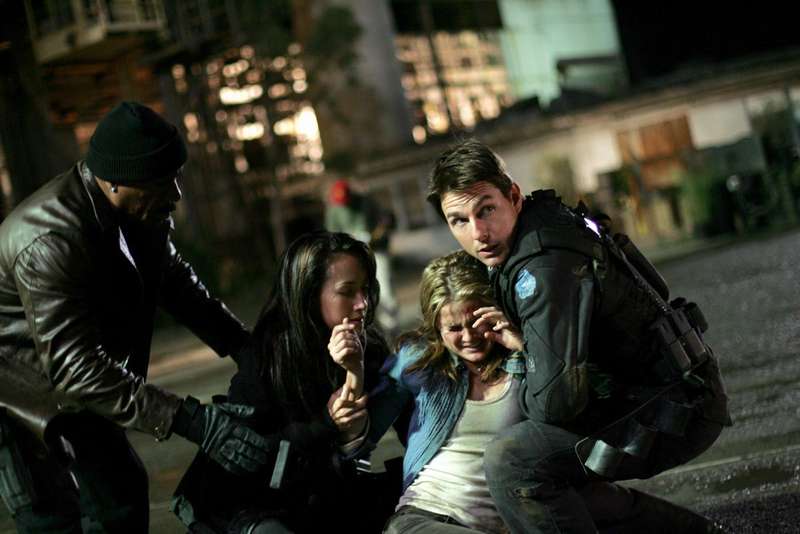
Mission: Impossible III


2006, US, directed by J.J. Abrams

Rating: ***

The third entry in the MI franchise marks a step back up after the silliness of the John Woo-directed second installment; the slow-mo action scenes are mercifully absent, and director J.J. Abrams uses a hand-held camera to capture some of the adrenaline of his TV hits Alias and Lost (his transition to the big screen is pretty successful, too, while his sense of the all-seeing eyes of the CIA-like Impossible Mission Force is of a piece with the mysterious organizations of Alias). This time around, though, the support group is colorless: while Ving Rhames is always enjoyable, his character hasn't developed much from the overgrown teddy bear of previous films, and the remainder of the Tom Cruise-led crew is anonymous. As the villain, Philip Seymour Hoffman has fun, generally refraining from chewing the scenery (it's nice, too, that the film doesn't waste time on a elaborately silly back story; he's bad, and that's about all you need to know).

Saturday, August 12, 2006

From Russia With Love


1963, UK, directed by Terence Young

It didn't take long for the Bond producers to figure out the magic formula, for this second entry in the series is probably the best of all the Bonds. Like its predecessor, it's relatively small in scale: although über-villain Blofeld is introduced, the real threats are in the more down-to-earth forms of Robert Shaw and Lotte Lenya, two of the most memorable henchmen in the 40-year-plus history of the films. Shaw is perfectly cast as a blond ex-army man, credibly suave when required, and equally credibly thuggish when the time comes (especially in a great fight scene in the cramped confines of a train compartment). The exotic location this time around is Istanbul, conjured up with plenty of cinematic charm, and an enjoyable performance from Pedro Armendáriz (in his last film role) as Bond's man on the ground. Although Bond has had just one film to establish his reputation, it's clear that SPECTRE considers him the biggest threat to their activities, and they concoct an elaborate false plot to entrap him -- with Bond happy to take the female bait. The comically over-the-top sets, and even more comical killing methods, of later films are absent here, but Desmond Llewellyn makes his first, brief, appearance as Q, a fixture that is one of the most enjoyably playful aspects of the series.

Friday, August 11, 2006

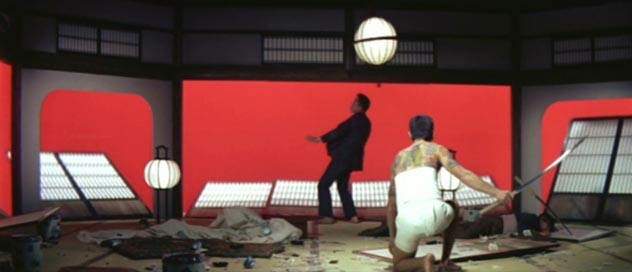
Kanto Wanderer


1963, Japan, directed by Suzuki Seijun

As Tom Mes writes in the DVD liner notes to Kanto Wanderer, this isn't as balls-to-the-wall as some of Seijun Suzuki's later work, but it's a great primer on his subversive experiments within the studio system, experiments that would eventually get him fired from Nikkatsu studios. The core of the film is a pretty conventional story of honor and loyalty among thieves, or more precisely the yakuza. Even as Suzuki throws in some reflection on the changing role of the yakuza in post-war Japanese society, there's no doubt he contributes to the romanticization of the old gangster ways, sympathizing with the old warrior types as they deal with the rise of the oafishly criminal new generation. Suzuki is really more interested, though, in playing with genre form: his lovely widescreen camerawork and brilliant use of interior spaces - most especially in the anti-climactic climax - are the beginnings of a path of consistently playful experimentation. The picture of 1960's Japan, on the cusp of a serious boom, is fascinating; the struggle to retain some of the good of the past, even in the gangster context, is sometimes surprisingly poignant.

Saturday, August 05, 2006

The Nest


2002, France, directed by Florent-Emilio Siri (original title: Nid de guêpes)

Although it's jam-packed full of allusions to other films, The Nest still manages to feel surprisingly fresh, dispensing with the often hackneyed backstories with which action characters are burdened in favour of delivering elaborately choreographed thrills and spills with considerable style (director Florent-Emilio Siri showed similar technical mastery in his American debut, Hostage). Like Hostage, the film's set-up is complex, with intersecting stories, but Siri sketches the details in efficiently; even though the plot depends on a preposterous coincidence, the action is so breakneck that there's no pause for reflection on this at the time. There are obvious reference points in American films like Assault on Precinct 13 and Die Hard, as well as to such Hong Kong actioners as Hard-Boiled (like that film, it does occasionally beggar belief that a small war could take place in an urban location without anyone noticing), although the first 20 minutes are a homage to the masterful French crime flick Du rififi chez les hommes, with its famously silent heist sequence. While it might seem to be something of a bastard child, there's still a definitely local feel to events, with allusions to crimes in the Balkans and the clever use of a Bastille Day background. Though it is, in the end, slick commercial fare, Hollywood could learn a thing or two from this kind of lean performance.

Friday, August 04, 2006

Cure


1997, Japan, directed by Kurosawa Kiyoshi

Like many J-horror movies, Cure is concerned as much with atmosphere as it is with conventional narrative logic. Although it has an obvious affinity with the American film Seven, it lacks that film's ruthlessly unspooling plotline, preferring to concentrate on shadings of mood and background. The who and the how of the film's crimes are revealed early on, with director Kurosawa focusing instead on the far more unsettling 'why?' after a wave of inexplicable murders hits an unnamed Japanese city (the Seven comparison is heightened with the use of an anonymous but grimly run-down location: the decrepit buildings, cold weather and trash-covered beaches are the antithesis of the usual cinematic images of Japan). The agent of the killings comes to see like a kind of urban terrorist, arming new weapons in the most insidious and inexplicable of fashions, such that everyone is suddenly a suspect. Although Cure shares a few too many traits with other J-horror films to be truly original - the pacing and atmosphere are similar to films like Ringu, while there's even a video at the center of the mystery - the chilly camerawork and unsettling use of industrial sounds lift the film well above the standard genre confines, while Kurosawa displays a subversive sense of humor at times, perhaps most notably in his perverse choices of music at certain key moments.

Thursday, August 03, 2006

The Break-Up


2006, US, directed by Peyton Reed

Rating: ***

After seeing The Break-Up I had to go back and watch the trailer again, having formed the impression that this was the usual 90 minutes of problems and all's-well-that-ends-well template; apart from noting that much of the trailer never made it into the movie, it didn't seem like an unreasonable assumption. Instead, this is about as close to the bone as mainstream Hollywood fare gets - and not necessarily the funnybone, although there are some extremely amusing sequences (often of The Office variety: funny and yet painfully embarrassing at the same time). There's real fire and vitriol here as Jennifer Aniston and Vince Vaughn go their separate ways (onscreen) after two years under the same roof, with extended and nasty fights that showcase Aniston's acting skills (already seen in films like The Good Girl and Friends With Money) and Vaughn's ability to deliver astounding chunks of text with nuance and rhythm (part of what made Wedding Crashers so manically funny). There's good support - and consistent fun - from Jon Favreau and Judy Davis (though you'd wish that an actress as fine as Davis had better parts, she has fun with this one), while Vincent D'Onofrio brings his full bag of tics to the part of Vaughn's older brother, and Jason Bateman does well by the role of the one rational friend the pair has left between them. Some fawned over director Peyton Reed's last effort, Down With Love (enjoyable though hardly original: haven't these critics seen the musical episode of Buffy the Vampire Slayer?), but this is much flatter; the script and a bunch of actors who know their stuff do the heavy lifting.

Tuesday, August 01, 2006

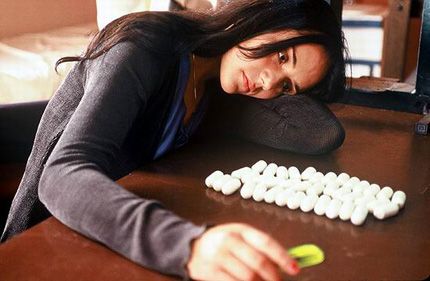
Maria Full of Grace


2004, US/Colombia, directed by Joshua Marston

A stripped-down story of a Colombian woman's experience as a drug mule, Maria Full of Grace is a grimly believable account of the realities of the drug industry at the ground level (we never see beyond those immediately involved with preparing the drug-couriering women). Whether in Colombia or in the US, the film rarely leaves the side of Maria (played with great conviction by newcomer Catalina Sandino Moreno), deftly sketching in small-town Colombian life in the opening stages, and giving an equally vivid picture of Queens's Litte Colombia neighborhood later on. First-time director Joshua Marston has a documentary eye for detail, and it's fascinating to be brought into parts of the world (distant and near) that are usually invisible (the intricacies of the mule's tasks are also conveyed unflinchingly). If the film is lacking in any respect, it's perhaps in its unwillingness to more rigorously reflect on Maria's motivations; the drug-running experience comes to seem like a bizarre kind of self-affirmation, as if the consequences can be shrugged off in the headlong pursuit of the American Dream. That somehow seems like a slap in the face of the truly decent people she encounters.

Thursday, July 27, 2006

Ugetsu Monogatari


1953, Japan, directed by Mizoguchi Kenji

One of those rare films that fully lives up to its advance billing, Ugetsu Monogatari is a unique blend of realism and fantasy, told with great cinematic virtuosity. Set in the 16th century against a backdrop of civil war, the film opens, nonetheless, in a bucolic village, and the first 40 minutes are an exquisite depiction of peasant and family life, focused on tiny details of craftsmanship and family relations; the cooperation between farmer/potter Genjuro and his wife Miyagi is both convincing and deeply moving. Even as her husband senses the opportunities for enrichment created by the still-distant war, Miyagi makes clear her own contentment at her small family's place in the world; Mizoguchi delicately conveys the sense that there's much to lose even in this apparently simple way of life.

The carefully rooted realism of the village sequences ensures that the ensuing developments - as the film departs in directions both mysterious and and tragic - are all the more effectively disturbing. Genjuro's encounter with the mysterious Lady Wakasa (played, to startling effect, by Machiko Kyo) is a wrenching viewing experience; that the depths of Genjuro's betrayal can only be revealed by a fatal obsession says much about Mizoguchi's unsentimental world-view. Visually, the film is a feast, with gorgeously composed shots and a camera that seems constantly on the move, rising high over the action, then prowling at ground level, perhaps never more effectively than in the beautiful shot that accompanies Genjuro's return home, and which perfectly encapsulates the film's otherworldly feel. The Criterion Collection treatment underlines, again, what a shame it is that more of Mizoguchi's films aren't available on DVD [this situation has, happily, improved a good deal since 2006, not least through the efforts of the Criterion Collection].

Tuesday, July 25, 2006

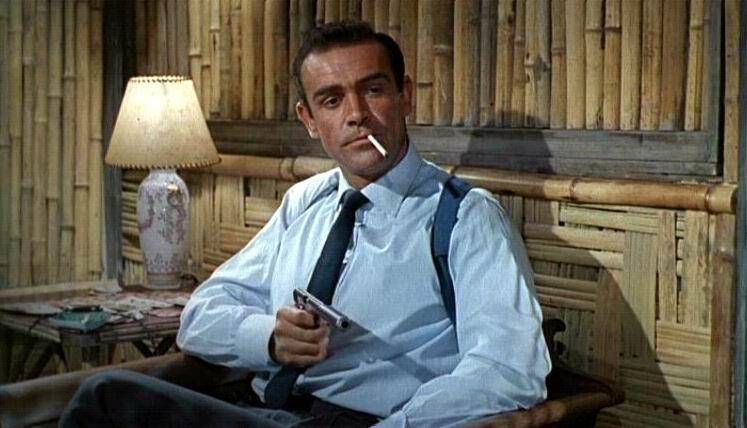
Dr. No


1962, UK, directed by Terence Young

The first Bond movie, despite its exotic trappings, is one of the most restrained in scale: almost all of the action takes place in relatively tiny Jamaica (or on Pinewood sets), rather than the near constant jet-setting that often proved confusing in later movies. While the overall template is already firmly in place - Bond takes on a sinister megalomaniac intent on world domination - many of the flourishes that would later prove so critical to the franchise (Desmond Llewellyn's turns as Q, for instance) have not yet been grafted on.

While the supporting structure is thus not quite as comfortingly familiar, Sean Connery, as Bond, appears to have been born fully formed into the part: from the first moment he appears onscreen, he exudes a charm and assurance that transcends the often rickety plot and the archly incredible villain. Though Ian Fleming's first Bond book had appeared almost a decade previously, Bond seems a perfect 60's hero: he embodies the attractions of the golden age of jet travel, apparently possessed of infinite resources and resourcefulness, and engages in casual sex and even more casual violence in a manner that seems to typify that decade, throwing off the comfortable but dreadfully unexciting 50's with glee. The first 'Bond, James Bond' and the familiar Bond theme remain as stirring as ever, while Ursula Andress's emergence from the sea is one of the franchise's most iconic and enjoyable moments.

Monday, July 17, 2006

Poisson d'avril


1954, France, directed by Gilles Grangier

It’s odd that the disc this film appears on is marketed as part of a collection of films featuring the hugely popular French comic Louis de Funès, since he appears in just two scenes, and his performance, the broadest of caricatures, is hardly his best work. The star of the film is the subtler Bourvil, cast, as so often, in a salt-of-the-earth part; the actors would be reunited a decade later in Le Corniaud and La Grande vadrouille, two of the French box-office’s biggest all-time hits. Although Poisson d'avril is exactly the kind of simple, production-line fare that prompted so much dismissive comment by the nouvelle vague critics and filmmakers (often one and the same) just a few years later, Bourvil’s easygoing charm and the often witty script (with dialogue by the great Michel Audiard, whose phrasing and rhythms cast a long shadow over French popular filmmaking of the 1950’s and 1960’s) ensure that the film remains very watchable. Gilles Grangier, who directed many of Jean Gabin’s later films, gives his actors room to savour the script’s best lines, while there’s a surprising vein of commentary on attitudes to the wartime experience.

Saturday, July 15, 2006

De battre mon coeur s'est arrêté


2005, France, directed by Jacques Audiard (The Beat That My Heart Skipped)

Director Jacques Audiard has carved out one of the most interesting resumes in recent French film, with his own very particular take on noir themes of violence and redemption, and fine skills as both a wordsmith (hardly surprising given that his father was the great dialoguist Michel Audiard) and a director of actors, especially of younger actors like Mathieu Kassowitz, Emmanuelle Devos and, here, Romain Duris. Though Duris has taken on edgy material before, he’s never been more convincing than in this film; the conflict between his professional violence and the calm he seeks in music is brilliantly conveyed in a performance of control mixed with explosive aggression. The plot is taken from James Toback’s 1978 film Fingers, but the adaptation is so seamless that it feels as though it was conceived in the underbelly of Paris, while the addition of a subplot involving a piano tutor who speaks no French is highly effective. Duris's Thomas should be exceptionally unsympathetic, given his unpleasant work in the employ of his slumlord father, but his desire for a better life, and his dedication to what seems like a foolish dream, not to mention the actor’s energy, render the character complex, confusing and appealing. There’s able support, too, from a rumpled Niels Arestrup, the underused Emmanuelle Devos, and Linh Dan Pham (who reveals her own capacity for anger to startling effect) as the piano tutor.

Friday, July 14, 2006

Lola rennt


1998, Germany, directed by Tom Tykwer (Run Lola Run)

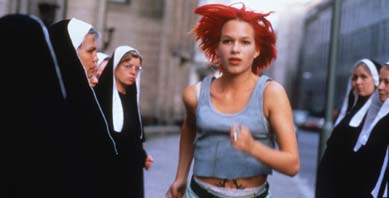
Though it's nowhere near as profound as its philosopophical trappings would like you to believe, this remains one of the most sheerly enjoyable European movies of the 1990's. Director Tom Tykwer's fascination with coincidences, intertwined fates and split-second decisions (all present in earlier work like Winter Sleepers) is given full reign here, where the same tale (of a frantic 20-minute search for 100,000 Deutschmarks) is told three times, with the devil in the minor variations, and three profoundly different outcomes. Each version is separated by a brief interlude that fills in some of the back story between Lola (Franka Potente, who burns up the screen) and Manni (Moritz Bleibtreu), the boyfriend she's attempting to get out of trouble. While the pauses take themselves too seriously, they do help to make Manni, in particular, a more appealing character than his ne'er-do-well behaviour might otherwise allow (Moritz Bleibtreu's reserves of charm also help). Tykwer employs a full bag of cinematic tricks, switching camera styles, throwing in amusing photo-journal montages to outline the fates of minor characters, and adding a dash of split-screen action, all set to a frenetic techno beat. Lola rennt is also an essential Berlin film: although Tykwer's fictionalizes the geography (Lola's route is comical to anyone familiar with the Berlin map), the streetscapes of the post-Wall city are appealingly chronicled.

Tuesday, July 11, 2006

The Matchmaker


1997, UK/US, directed by Mark Joffe

Rating: ***

A hefty slice of cliché, The Matchmaker sends Janeane Garofalo, a political staffer, on a wild-goose chase to Ireland in search of her boss's Irish roots. However, she ends up at a local matchmaking festival (yes, they do exist), thereby enabling the filmmakers to lay on the Paddywhackery and loud Yank stereotypes with the thickest of trowels. Since it's a romantic comedy, though, the plot and realism (the Irish love interest is clearly Scottish) are beside the point: like most of its kind, this survives on the peformances, especially those of the supporting characters. While the US actors have pretty thankless roles (with the exception of Garofalo, whose usual spiky wit keeps things just off-balance), there's a small galaxy of fine Irish talent on hand, with Milo O'Shea and Rosaleen Linehan both enjoyable as rival matchmakers, a succession of nerdy looking men playing, well, nerdy men, and Jimmy Keogh performing some scene thieving of the most enjoyable kind as a wildely eccentric Aran islander.

Monday, July 10, 2006

Jaws


1975, US, directed by Steven Spielberg

More than 30 years on, Jaws remains the reference point for the summer movie: virtually nothing since has managed to marry the film's commercial success with the same level of cinematic virtuosity, and surely no other warm-weather blockbuster has had such a profound impact on the language of cinematic thrills. The fact that the big, bad shark looks like an overgrown bathtub toy (once Spielberg decides to reveal the beast: he's sensibly kept under wraps for most of the film, further ratcheting up the tension) is rendered irrelevant by the sense of panic and fear so expertly created. It's all the more disappointing, then, that too many of Spielberg's subsequent movies are beset with a sense of schmaltz that's almost entirely absent from this film; even the film's domestic scenes have a feeling of realism rather than the sentimental gloss so familiar in his later work. The sequences of macho bravado, too, seem to belong more to the work of Spielberg contemporaries like Scorsese or Coppola; beautifully played by Roy Scheider, Robert Shaw and Richard Dreyfuss, they add great depth to the undersea thrills, while Shaw's speech, scripted by John Milius, about the sinking of the USS Indianapolis remains one of the great movie soliloquies.

Sunday, July 09, 2006

Pirates of the Caribbean: Dead Man's Chest


2006, US, directed by Gore Verbinski

Rating: ***

There was much derisory comment when the first Pirates of the Caribbean movie was announced, given that the film was based on a theme park ride, and much surprise when it actually turned out to be quite a decent blockbuster movie. The sequel returns to the theme park origins, proposing thrills and spills aplenty, but a confusing plot and a laundry list of incidents and characters that's less than coherent. That's almost beside the point, however, since these flaws are brushed aside by the headlong action, and the often spectacular set-pieces (as outraegous as it might be to spend $200 million on a movie, it sure looks as though it all ended up onscreen, with stunning locations, large-scale shipboard battles, and the proverbial cast of thousands); my brain knows it's not good cinema, but the rest of me thinks it's too much fun to bother listening to my brain. While Johnny Depp's take on Captain Jack Sparrow inevitably loses some of its freshness this time around, there's a worthy villain in the shape of Davy Jones. The character is an amalgam of traditional and CGI effects, all wrapped around actor Bill Nighy, and the filmmakers do a remarkable job of preserving Nighy's distinctive, and often hilarious, facial expressions despite all of the makeup. Stellan Skarsgård also turns in a decent performance, as Orlando Bloom's old man, underneath layers of repellent sea-bottom materials.

Thursday, July 06, 2006

The Devil Wears Prada


2006, US, directed by David Frankel

Rating: ***

Behind the chiffon and the heels, this is age-old story of a small-town girl making it big in the city - though not always on her own terms. It's the kind of thing that Hollywood excels at - after all, the entire industry is built on dream-chasing - and The Devil Wears Prada is a worthy addition to the genre. Like most films set in the fashion industry, it does try to have things both ways, ridiculing the culture's self-obsessed denizens, yet delighting in the spectacular outfits. Similarly, while there's much comment on the stick-figure imagery of the fashion magazines, it's occasion for celebration when the already lithe Andy Sachs (Anne Hathaway) drops a dress size. Still, it's impossible to dislike a film that elevates cattiness to such heights, especially in the person of Miranda Priestly, a magazine editor who initially appears to be of Cruella de Vil proportions, played with tremendous gusto by Meryl Streep. Ms. Streep has plenty of fun with the character, pursing her lips and issuing orders with the most dismissive of waves (there's also a beautifully played scene of distress that showcases the actress's subtler side, and which provides a fine commentary on the strains and unreasonable expectations imposed on professional women). Ms. Hathaway does fine with the lead role - she's more than capable with fairytale material like this - while Stanley Tucci gives a lovely performance as Andy's one confidant in the cutthroat magazine business. There's a little too much musical montage - at times, it's like Pretty Woman on steroids - but otherwise this is pretty polished fare from a director who cut his fashion teeth on Sex and the City episodes.

Tuesday, July 04, 2006

This is Spinal Tap


1984, US, directed by Rob Reiner

Rating: **

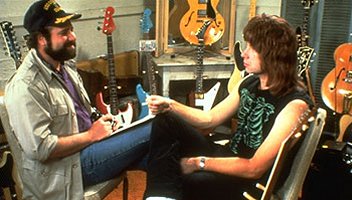
Proof that not everything ages well, This is Spinal Tap these days seems horribly dated and, unfortunately, nowhere near as consistently amusing (never mind flat-out funny) as its reputation might indicate. Even at 82 minutes, it sometimes seems tortuous, especially in the repetitive middle patch (when the semblance of a plot is introduced, late on, things pick up somewhat). The fact that the clichés of rock documentaries are so accurately skewered seems almost beside the point: since they are generally so tedious to start with, the notion of replaying them to comic effect is hardly welcome. There are intermittent moments of brilliance (the scene in which they discuss amplifiers that "go up to eleven" remains as funny as ever, for instance), but the characters (unlike those in Christopher Guest's later mockumentaries) are generally so unsympathetic that it's really an effort to remain in their company. Ultimately, too, the filmmakers aren't quite sure what effect they're looking for: the marriage of po-faced interview spoofery and absurdly puerile song lyrics is less than effective.

Monday, July 03, 2006

Young Törless


1966, West Germany, directed by Volker Schlöndorff (original title: Der Junge Törless)

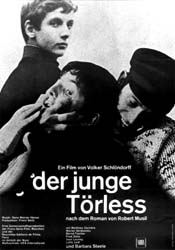
Although it's the film that launched the New German Cinema as a critical movement, Young Törless paradoxically has its deepest roots in French cinema; that owes much to director Volker Schlöndorff's cinematic education on the other side of the Rhine (he studied in Paris and worked on films by Resnais and Malle). The scenes of philosophical discussion are the stuff of many a Parisian drama, although in the context of a story of systematic and disinterested bullying in a conservative Austrian boys' school, there's an unavoidable and immediate reference point in recent German history. While the Third Reich hangs over the film, it doesn't obscure the acute dissection of the social order in schools the world over, and the toxic behaviour therein. As the film progresses, the action takes a back seat to lengthy musings on the reasons behind the bullying, discussions that sometimes seem beyond the years of the boys in question. The philosophizing is open-ended enough that it's hard to decipher whether Schlöndorff is making a brave (in 1966) point about the ability of even the mild-mannered to behave in aberrant ways given the right circumstances, or a rather more controversial point (to say the least) about the abject victims of bullying bringing it on themselves; either way, there's no escaping the power of the latter scenes, in which Törless tries to explain his own reasons for participation in the film's key events, and which compel the viewer to examine how he or she would behave in the same situations.

Thirteen Conversations About One Thing


2003, US, directed by Jill Sprecher

Rating: ***

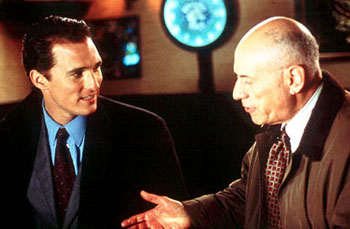
There must be a screenwriting program somewhere that generates movie templates: this film and Crash are cut from remarkably similar interwoven-tales cloth, although the latter film's often coruscating take on race and racism is replaced here with gentler musings on the nature of happiness. Like Crash, the performances raise this film a notch above the ordinary: Alan Arkin, as an often unpleasant cynic, and Matthew McConaughey, who plays that rare beast, the screen lawyer with a conscience, are especially strong, but there is ample support from familiar and unfamiliar players. While the film is interested in exploring what constitutes happiness, there's remarkably little of that emotion on display; indeed, these characters are defined primarily by their ennui and even outright sadness (particularly the character played by John Turturro, whose performance, no doubt prompted by the director, is rather insipid). There's more than a hint of artificiality in the set-up that requires regular interactions between these very different characters, but the pacing is decent and the characterizations generally compelling enough to distract from the credibility issues.

Sunday, July 02, 2006

Ice Age: The Meltdown


2006, US, directed by Carlos Saldanha

Oh, the things you watch when trapped in a plane for four hours. With Pixar setting the bar so high in the age of computer animation, Ice Age: The Meltdown's lack of narrative and visual invention is all the more apparent. The main voice cast is almost completely wasted (why Denis Leary agreed to this sequel is a mystery, since he barely gets a single interesting line), while the funniest sequences in the film generally have little to do with the main action; the running joke about an acorn-obsessed squirrel is far more diverting than the actual plot, while the film only really bursts into life with an inspired vulture-sung rendition of "Food, Glorious Food". Given the success of the Pixar features, it's extraordinary that the Ice Age filmmakers don't make even a cursory effort to ensure their film is interesting to both children and adults, but then again, the near $200 million in box office is dispiriting evidence that they didn't need to bother.

Index

List of all movies

Most of the images here are either studio publicity stills or screen captures I've made myself; if I've taken your image without giving you credit, please let me know.

About Me

Boston, Massachusetts, United States