Wednesday, June 03, 2015

The Passionate Friends


1949, UK, directed by David Lean

I haven't seen any of David Lean's 1940s films for a long time, partly because I took such exception to Brief Encounter the last time I saw it. Indeed, my reaction was so strongly negative that I wonder whether I shouldn't take another look. In any case, although this film, which ploughs some of the same emotional territory, enjoys nothing like the same reputation I found it to be very engaging. It's certainly not perfect -- the flashbacks within flashbacks were a little awkward without adding much -- but there's a degree of emotional subtlety and sincerity that's very affecting. While Claude Rains is very much the supporting player here as you might expect he makes hay with what he has, particularly in a wonderful scene where he is ostensibly reciting the rather dry details of a recent business meeting but in reality is giving expression to his inner turmoil. The mise en scène is often very interesting, too -- at times quite consciously theatrical in some of the sequences set in Rains' home, or in the pairing of two adjoining rooms which you could easily imagine on the stage, but it works very effectively.


Monday, June 01, 2015

Slow West


2015, UK/New Zealand, directed by John Maclean

An absorbing take on the Western, filmed (gorgeously) in New Zealand. John Maclean has clearly absorbed the genre thoroughly and does a good deal of deconstruction/reconstruction while hewing close to a simple quest template. Not all of his decisions work -- some of the absurd interludes are simply that, but other anecdotes help to build the lightly-sketched characters and the set-piece finale is very well handled, expertly constructed and edited. There are also a few moments of humour that almost all hit the mark squarely.

The Clairvoyant


1935, UK, directed by Maurice Elvey


A Gainsborough picture, made back in Britain just after Claude Rains's breakthrough success in The Invisible Man. I'm not at all familiar with Maurice Elvey, an apparently prolific director, though there a few atmospheric sequences and quite interesting use of location and/or stock footage (scenes set at Ascot or in a tunnel under the Humber). As you might expect, Rains is by far the most interesting onscreen performer, although there's not a whole lot he can do with what is at heart a relationship melodrama with unexplained supernatural add-ons (the film doesn't even make a half-hearted attempt to provide some rationale, although I suppose that could be construed as spooky in its own way).

Tuesday, May 26, 2015

La Vérité sur Bébé Donge


1952, France, directed by Henri Decoin

Another fine film from Henri Decoin, an emotionally brutal tale drawn from a Simenon novel, which begins with a man on his deathbed, in full knowledge that his wife has put him there by means of a poisoned cup of coffee. I haven't read the source novel and while other commentators suggest the book was gutted I don't think you have to look very far to find the author's underlying cynicism about human relations, particularly within relationships, in full flower (Maigret's tender relationship with his wife is the obvious exception in the oeuvre). Although Decoin is no Clouzot, he finds some of the same bone-dry spirit here at times and does an especially fine job in suggesting the depths underneath the facades of both Gabin and Darrieux; Gabin's usual charm is smartly upended through the repeated suggestion that he uses his magnetism entirely thoughtlessly for his own gratification. This film marked Darrieux's "turn" toward less admirable characters -- her 1930s films are pretty lightweight, and these days it's her 1950s films that people turn to most often, especially the Ophuls films.

Wednesday, May 20, 2015

Timbuktu


2014, France/Mauritania, directed by Abderrahmane Sissako

Sissako continues his remarkable career at the very forefront of African filmmaking: he's sensitive, honest, unsentimental and possessed of an intense humanity. It takes something quite special to show, however discreetly, the stoning of an alleged adulterous couple but also to leave you with the sense that these were people with complex lives rather than an excuse for a shock effect -- and the same is true of the central death scene in a river, a heartbreaking, Lang-ian moment in which a man makes one ill-advised if quite understandable decision to engage in a confrontation. His action sets in motion an implacable fate, or at least implacable in the particular time and place depicted. The subsequent wide shot of the man's escape from the river, a corpse lying to the right of the screen, is quite breathtaking. Will those who could most engage with and react to the film have a chance to see it, though?


Thursday, May 14, 2015

Buud Yam


1997, Burkina Faso/France, directed by Gaston Kaboré

A sequel of sorts to Wênd Kûuni, the 1982 film that put Gaston Kaboré on the map. He returns to both the characters and the actors from that film and while there are deliberate resonances between the two pictures, including brief flashbacks that are actually footage from Wend Kuuni, this stands on its own as an exploration of pre-colonial Sahel life. It's not entirely historically accurate in terms of the depiction of a rather abundant and largely conflict-free swath of territory and yet it also succeeds in giving a strong sense of the existence of numerous loosely associated societies that often have trouble understanding one another even on the linguistic level (a phenomenon that continues today, and which contributes to the real challenges posed by borders that cut through pre-existing societies). While the storyline is straightforward, narrating the search by Wênd Kûuni for a legendary healer intercut with sequences featuring the young man's ailing sister, it's rich in its generosity of spirit, and very open about suspicions within village life but also the ways in which those suspicions can be healed. Visually some of the landscapes of southern Burkina Faso are lovely, and I also liked the way that Kaboré shot most of the film in medium/long shot so you can really see the interactions between the characters, while there are a few moments of wonderful humour, particularly a sequence in which a group of riverbank kids enjoy observing some clueless newcomers. 

Tuesday, May 12, 2015

Raw Deal


1948, US, directed by Anthony Mann

Although not quite as compressed as 99 River Street this is another against-the-clock plotline, with a convict escaping and trying to make his way south for a payoff and a boat to the tropics. As you might expect from Anthony Mann and John Alton, it looks terrific -- moody and exceptionally atmospheric, with some wonderful compositions (a scene in the prison early on is especially good, as is the later sequence in a kind of crim-friendly guesthouse). Dennis O'Keefe is on roughly the John Payne level in the lead role -- less bland, perhaps, but certainly not a strong actor and the supporting players provide the real interest. Claire Trevor was deep in her glorious late-1940s run of bad girls and she does a terrific voice-over here, suggesting that this story is at least as much hers, certainly true in terms of the not-unexpected downbeat ending. John Ireland is also good as the hands-dirty tough, while Raymond Burr looms (quite literally since he's often shot from below) in the background, dispensing casual sadism.

Monday, May 11, 2015

99 River Street


1953, US, directed by Phil Karlson

A generally punchy film from the generally punchy Phil Karlson, a very solid noir that takes place over the course of a single rather fraught evening in which a former boxer/current cabbie sees his marriage disintegrate and his life disappear down the same plughole. There's one hell of a subplot that stretches credibility a great deal,while nonetheless providing the film with a terrific set piece (the camera angles and use of light/shadow are brilliant). John Payne is a pretty bland leading man but as ever in such films there's plenty of diverting support -- Brad Dexter has one of his earliest roles of substance and he's rather good as the heavy, while Jay Adler is very memorable as the fence despite the obvious stereotyping of the character. 

Friday, May 08, 2015

The Yin and the Yang of Mr. Go


1970, UK/Canada (?), directed by Burgess Meredith

Without a doubt, one of the oddest films I've ever seen, I'm not sure that I have the appropriate vocabulary to capture this viewing experience. A Bad Film on the obvious level of construction, pacing, coherence, acting but absolutely fascinating in terms of its rather prestigious cast and for the unanswerable "what were they thinking?" and "what were they trying to do?" questions. On one level, you could posit the film as an example of the results when you plunk down a bunch of actors and a lot of money in an exotic location, but I do think that Meredith was going for a certain absurdist effect even if he didn't quite pull it off -- the plot is certainly the least of his concerns, though it was hard to decide to what extent some of the humour was intended or not. It sounds as though the producers took things into their own hands when they saw what they had paid for, hence the inexplicable framing appearance of Broderick Crawford, who clearly wasn't filming in the same locations. The very young Jeff Bridges' monologue outlining the various oddball plot points serves as a fitting summation of the film, complete with vaguely stoned look. 

Wednesday, May 06, 2015

We Are the Best!


2013, Sweden/Denmark, directed by Lukas Moodysson (aka Vi är bäst!)

Another fine entry in the long, proud Scandinavian tradition of remarkable child/youth performances (no less than Moodysson's debut feature Fucking Åmål/Show Me Love, though the two actresses there had a some prior screen experience), and a really lovely sense of naturalism that re-creates 1982 Stockholm with economy and a great deal of rueful affection. The film participates in some of the conventions of the music-film genre without ever giving into them, which helps to rein in the sentimentality a good deal, and also ensures that the focus remains on the self-discovery of the central trio, capturing the feel of being around 13, in all its glory and excess.

Friday, May 01, 2015

Die Koffer des Herrn O.F.


1931, Germany, directed by Alexis Granowsky

A delight from start to finish, funny but also biting in its satire of frenzied speculation, something that must have had quite a resonance for the audience of 1931, after more than a decade of economic turmoil of one kind or another. As a critique of capitalism, it would pair well with Capra's American Madness; the films are quite different in tone but both are very good on the essential craziness of the system as it prevailed then (and now), and the German film makes especially good use of a few fantasy sequences. Lorre is such a distinctive performer, entirely apt for the double-speak of the role of small-town newspaper editor/booster. I was initially distracted by the regular appearance of the word "Verboten" on the print, from German TV, especially because it seemed to crop up at irregular intervals and stay for unpredictable lengths of time. Eventually, though, with the assistance of some reading research, I figured out that this represented the location of the many and varied cuts made by the Nazi regime a year later, so the print in circulation for the rest of the 1930s was radically cut to remove unapproved personnel, songs, and incidents.

Thursday, April 30, 2015

Night Train to Munich


1940, UK, directed by Carol Reed

I couldn't recall if I'd ever seen this before: I might have caught it as a teenager on TV, but it's hard to be certain, especially given the thematic, visual and casting overlaps with The Lady Vanishes. A few critical comments come down rather harshly on this for not being the full Hitchcock in its easy transition from comedy to suspense, which seems to me to miss or at least evade the point of this being filmed and released after the war began while the Hitchcock film was released in 1938 (within a week of the Munich Agreement, as it happens, but obviously the film does not speak to that). In other words, the stakes are considerably raised here: there are no notional villains but rather very specific ones, with whom Britain was already at war (the tropes of cinematic Nazi behaviour are in full flight already by 1940, that much is clear), so the film has to serve multiple functions as entertainment and, to at least some degree, wartime propaganda. Within that context, I thought it remarkably well done -- the montage sequences that include documentary footage are chilling, apt, and useful to establish the context, while the performances, particularly from the contrasting duo of Paul (von) Henreid and Rex Harrison, each essentially having to play two characters, are very good indeed. I also enjoyed the re-appearance of the cricket enthusiasts from the Hitchcock film -- perhaps a little broad, and certainly stretching credibility, but also very much to be relished in that "I say, old chap" kind of way.

Tuesday, April 28, 2015

Phoenix


2014, Germany, directed by Christian Petzold

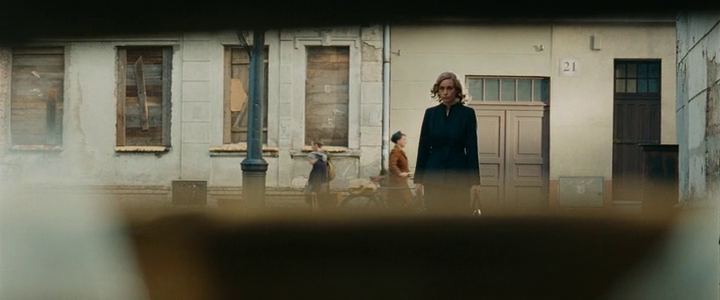
Christian Petzold's body of work over the last fifteen years or so is among the finest in European cinema, and one of the more remarkable aspects of his past two films is the seamless transition from largely contemporary themes to fine-grained explorations of the past that are nonetheless the polar opposite of most period pieces. There's nothing airless about these films despite the meticulous recreation of setting (though they share with most Petzold films that sense of being quite deliberately under-populated: Berlin is no teeming city here, but rather a specific time and place sketched in with exceptional economy both in narrative and demographic terms). It's no great surprise that a filmmaker as strong as Petzold was eventually going to turn fully toward some of the great historical questions of his society, dealing with the past and its weight -- quite literally in the case of Nelly in this film, but of course construed more broadly by Petzold. 


I was struck, not for the first time, by the director's ability to take material that could appear quite melodramatic and treat it in a non-histrionic way -- it's precisely the refusal to engage in melodramatics here that lends the narrative its power, the quiet accumulation of details that is so neatly and poetically turned on its head in the final, wonderful scene. Nina Hoss is, as ever, quite remarkable, creating a fully-realized person with the most delicate shades of nuance, steadfastly refusing the "big" acting that many others would bring to a part like this. Other notes: the du/Sie nature of German adds a whole other layer to the interactions between Nelly and her former husband, one which the subtitles struggled awkwardly to convey in the early going with the occasional use of "Miss." The sound design is also quite wonderful: the sounds of (different) clocks in each location, the creak of floorboards, the way that sounds which seem so loud at night (like those clocks) fade into the background in the bustle of the day. Impeccable detail and yet all in service of the bigger picture.


Friday, April 24, 2015

Hitch


2005, US, directed by Andy Tennant

A com-rom rather than a rom-com, in the sense that the first half is much more focused on the comic setup with the second half squeezing in the hitherto undernourished romantic plotline. The problem is that despite the romantic partners being absolutely charming, they can't hope to compete with the comic chemistry generated between Will Smith and Kevin James, so everything afterwards seems like a bit of a disappointment. Still, there are enough laughs in the first half to just about sustain the momentum when James goes offscreen for an extended period.

Les Reines du ring


2013, France, directed by Jean-Marc Rudnicki

Feather-light, entirely predictable, often very silly and yet also quite agreeable, mostly for its cast. Audrey Fleurot was a touch OTT for my taste, playing what at first seems like a kind of amped-up version of her Engrenages character, although with a good deal more humour, but Nathalie Baye and André Dussollier both had some nice moments and Corinne Masiero made sure she stole a good deal of the show despite being the theoretical support (she too, plays a character not a million miles away from that she essayed in Engrenages). 

Wednesday, April 22, 2015

Die Angst des Tormanns beim Elfmeter


1972, West Germany/Austria, directed by Wim Wenders (aka The Goalkeeper's Fear of the Penalty)

I first saw this in my mid-teens when it played on TV, before I had seen any other Wenders films, and I was pretty nonplussed -- although intrigued enough to stay with it. It's a pretty significant step up from here to Alice in den Städten and yet this film is still an impressive work in terms of Wenders' intent and ability to deliver thereon. I recently watched an interview with Wenders, filmed much more recently, in which he spoke of his youthful sense of an absence of history, or at the very least an absence of the discussion of history, in postwar Germany, with its literally unspeakable acts. I can't help but hear an echo of that broader need for confrontation with the past in this early film: the central character's own terrible act colours everything that comes afterwards and yet he simply goes on living. Of course, that's only one reading of the film -- it's a film that practically invites you to project your own viewpoint, though it's become remarkably hard to see the film these days.

Wednesday, April 15, 2015

La Gueule ouverte


1974, France, directed by Maurice Pialat

The more I watch and re-watch Maurice Pialat's films, the more I'm convinced that he belongs in the very first rank of directors of the past forty years or so. Whether he's working with major stars or non-professionals he extracts performances of a rare conviction and humanity, and his observational skills are peerless. It sounds like his rough cut for this film was far, far longer so the final product is the result of he paring down a tremendous amount of material, including snipping away more or less any reference to Philippe Léotard's professional life (in contrast, say, to the constant references to work in Nous ne vieillirons pas ensemble -- though no-one actually works that much onscreen!). The rhythm of the film is quite similar to its immediate predecessor, constantly moving back and forth toward the central narrative of the decline of a seriously ill parent, and there are other connections with earlier Pialat films, most notably the wonderful final shot taken from a departing car -- clearly referencing one of the best moments in La Maison des bois. Like that film/series and Nous ne viellirons pas ensemble, Pialat spends a great deal of time exploring the deep tension between Paris and the provinces, one of the great oppositions in French life, though here he chooses to make Paris a virtual absence in terms of its onscreen depiction. The image above is from one of the film's most remarkable sequences, an early scene that runs an uninterrupted eight minutes or so: it's a notable technical accomplishment but also provides exceptional insight into the relationships between the film's four central characters and most particularly the mother-son pair. Filmed from a slightly elevated perspective, the two actors never directly face each other yet the scene is a kind of final confrontation as they lay bare their lives together, no subject off limits now that cancer has reared its head. 

Monday, April 13, 2015

The Horse's Mouth


1958, UK, directed by Ronald Neame

A terrific portrayal of the artistic temperament that's surely one of the best films on the creative/destructive potential of art and its makers, and yet one which resists the temptations of cliché. Alec Guinness's characterization of Gulley Jimson is quite wonderful -- apparently the actor had been fascinated by the story for years, and ended up writing the script -- capturing an entirely convincing amalgam of genius and (sometimes inadvertent) rogue. It's not hard to see some of the makings of his later Fagin, either, both in voice and gesture. I found the soliloquies on the meaning of art genuinely moving and the film's ability to transition smoothly between the (sometimes broadly) comic and the profound reminded me of some of the best of Leo McCarey.  

Tuesday, April 07, 2015

La Clé sur la porte


1978, France, directed by Yves Boisset

Though it caught me eye because it features Patrick Dewaere, this is very much Annie Girardot's film -- as enlivening as Dewaere is, he doesn't appear for a good half hour, by which time we're deeply invested in Girardot's character, a lycée teacher who also functions as a kind of de facto youth leader for the various local teens friendly with her daughter. It's a very affecting portrait of a woman trying as hard as she can to create a reasonably sane space for her adolescent charges, whether formal or informal, and the sense of the shared bonds of community is both effectively sketched and quite convincing. Boisset wisely resists the temptation to portray Girardot in saintly terms: she's not immune to the errors of judgment, but she's also grounded by a strong ethical sense, and it makes for an compelling portrait of late-1970s French society, still negotiating between poles of adult authority and youthful liberation.


Wednesday, April 01, 2015

Adieu au langage


2014, France/Switzerland, directed by Jean-Luc Godard

A film that's very much in keeping with later-period Godard: dense, narratively confusing, potentially pretentious/infuriating/illuminating, visually magical (and certainly not populist: I was 50% of the audience for this screening). It certainly resists any easy categorization, and it's not a film that's going to please someone motivated by narrative progression and resolution more than anything else. For me, it's hard not to be impressed by the vitality of an artist constantly trying new things no matter what stage of his career he happens to be at: here, the experimentation is especially obvious on the visual level, with the director make intriguing use of a wide range of cameras. The different equipment generates a strikingly varied set of outcomes, from very grainy, almost lo-fi pictures to crisp and astonishingly detailed close-up shots depending on which camera he chooses. As David Bordwell suggested in a post recently, Godard is interested here in visual texture in a way that seems more familiar from painting, and as such it's no accident that he includes a variety of shots of palettes, brushes and paint (and finds visual equivalents for these in other places, such as the coat of the dog we see throughout the film). Inevitably, Godard also uses 3D in ways that no commercial filmmaker would imagine, most notably when he splits the two cameras required for 3D filmmaking and has each follow a different bit of action (if you close one eye and then the other you can flip back and forth between the two images, editing them in whatever sequence you'd like yourself). The first of those instances was, to my mind, the most successful for a number of reasons: it worked quite naturally with the onscreen action as well as having the element of surprise, and it had me laughing with delight. 

Index

List of all movies

Most of the images here are either studio publicity stills or screen captures I've made myself; if I've taken your image without giving you credit, please let me know.

About Me

Boston, Massachusetts, United States