Monday, June 29, 2015
T-Men
1947, US, directed by Anthony Mann
I don't have near as much time to watch films as I'd like, so brisk films from the high point of the Hollywood era have a great deal of appeal in terms of their running length alone, though directors like Anthony Mann do a lot more than go through the motions. While his strengths are more formal and visual, especially in this period, he's also capable of extracting a solid performance when the material demands it. Dennis O'Keefe, for instance, is a lot more interesting here than in the following year's Raw Deal, playing what is in some senses a dual role as a straight and narrow government agent who goes undercover. As the film progresses, he has to convince both his criminal contacts and the audience that he's a capable and potentially ruthless operator. There's a real tension to the undercover sequences, and a fine appreciation of the personal sacrifices necessary in that line of work. And the photography is just wonderful -- my favourite shot, from a parade of possibilities, looks up at the bottom of a sink as O'Keefe tries to get a key item into his pocket while he's under close watch from his increasingly suspicious confederates.
Thursday, June 18, 2015
Tomboy
2011, France, directed by Céline Sciamma
This one had me from the opening shot, beautiful on both the visual and the emotional levels. Céline Sciamma got a good deal of attention this year with the US release of Bande de filles, and I hoped to see her back catalog from the beginning but couldn't find her début, La Naissance des pieuvres. This film focuses on a youngster dealing with gender identity issues, and Sciamma's method of treating the subject matter, focusing almost entirely on the child and with very little dialogue, is exceptionally effective and often strikingly funny/emotionally rich.
I was also fascinated by her depiction of the relationship between the film's siblings, perhaps because I'm so affected by the growing evidence of a complicity between my children. Although the children have a good deal of latitude in this tale of summer, parents are nonetheless present and often very warm and involved, but this isn't a story from their perspective -- and nor is it, strictly speaking, a coming of age film with a neat developmental arc but rather an ongoing puzzling through, a snapshot in a longer process of self-discovery.
Wednesday, June 17, 2015
Summer With Monika
1953, Sweden, directed by Ingmar Bergman
Quite a surprise, mainly because I had misread the film schedule and thought I was sitting down to watch a film set in nineteenth-century Patagonia rather than one of Bergman's first major successes, although ultimately a pleasure to finally see one of them on the big screen. It's a (deliberately) straightforward film in many ways, but also one of striking insights -- the commentary on the relationship tensions created by parenthood is especially strong without being heavy-handed (it's not a theme that cinema has dealt with in great detail beyond the cliché) and the picture of Stockholm life in the 1950s across social classes is very finely observed (there are also several beguiling shots in the early going).
The Man Who Never Was
1956, US, directed by Ronald Neame
More evidence that suggests Ronald Neame hasn't quite been given his due as a director, without by the same token attempting to elevate him to the pantheon. The film is a reasonably straightforward account of the Second World War Operation Mincemeat, which was designed to deceive Germany about Allied intentions in the Mediterranean. Although made with the blessing/collaboration of some of those involved a decade or so earlier, this isn't wholly faithful to reality, with some elements significantly altered or invented for dramatic purposes as well as out of a desire to preserve some of the secrets at the core of the story. Nonetheless, I found it quite engaging despite the distraction of Clifton Webb's accent -- he doesn't really make much of an attempt to sound like anything other than Clifton Webb, against the usual jolly-good-show backdrop (Gloria Grahame's accent, by contrast, can be explained away by plot mechanics). Neame shows considerable delicacy of touch at times, choosing to allow the camera to linger for extended periods during key scenes either to give us an idea of the methodical work involved in implementing a project of this sensitive nature or to allow particular moments of drama to play out without interruption; the technique gives the film a good deal of additional emotional heft.
Monday, June 15, 2015
Tip Top
2013, France/Belgium, directed by Serge Bozon
As was the case in his previous feature, Serge Bozon brings together unexpected elements, marrying a criminal investigation with a loopy screwball vibe and a vein of political commentary. On this occasion I'm more guarded on his success, although these elements are not all actually in opposition to one another: since the balance is always off-kilter, he's not veering wildly from one tone to another though I'm still not sure the particular and quite consistent tone is wholly suited to the material. There's a vein of quite stringent political commentary -- on Franco-Algerian relations and interactions -- that gets a lost from view at times even though I think Bozon places a good deal of value on this, simply because the comic mode distracts although in the end his point may be more about the overarching context of politico-social absurdity (in the manner of, say, Bong Joon-ho's Memories of Murder). The plot involves Isabelle Huppert and Sandrine Kiberlain investigating the investigation ("la police des police") into the death of a police informer in Lille, though Bozon is at least as interested in the behaviour of his leads, each of whom has a distinctive sexual peccadillo, which is also a matter of narrative interest. Bozon certainly has Huppert and Kiberlain go through the wringer in the service of his film -- if I hadn't seen the earlier film, I might think he had a somewhat unhealthy desire to showcase his female stars in rather humiliating scenarios -- though Huppert is more than game for what she has to do, while Kiberlain's character is quite exquisitely uncomfortable at times. The offbeat tone of the film is often underline by Bozon's visual choices: he likes to play with the setup angles so that the eyeline match is off, a very disconcerting visual trick in one early interrogation scene that helps to destabilize the entire enterprise. He does the same in La France to equally good effect -- there emphasizing the untrustworthiness of a particular character. In both films, too, he does a fair amount of tableau framing -- especially for some of the musical sequences in the earlier film -- and he also has fun in the second film with scenes filmed in cars, where the backdrop doesn't quite match the action. It's certainly quite carefully thought through on the visual level even if the ideas are a bit muddled.
Wednesday, June 10, 2015
La France
2007, France, directed by Serge Bozon
Serge Bozon appeared poised to break out, at least on the critical front, with this film but he hasn't been all that active in the interim despite the strengths on display in this tale of a young woman who goes in search of her husband after she receives a cryptic letter from the front in 1917, disguising herself as a man in order to begin her odyssey and quickly linking up with a small group of soldiers who have been separated from their regiment. The war, obviously, is a constant presence whether it's through the men's accounts of their experiences, their fear of running across spies or enemy soldiers and, from time to time, the rumble of heavy artillery in the distance, but we never see the front lines -- this is a different kind of war story, and one where Bozon quite consciously wants to evoke our imagination of the trenches without depicting them.
To my mind, the strongest French-language analogy is with Maurice Pialat's La Maison des bois, particularly the episode in which a battalion of troops passes through town -- a visible sign of the war but without any direct depiction of the fight. Bozon, like Pialat, is also strong on the bone-weariness of these men, but unlike Pialat he doesn't hew to a strictly realist template, interspersing the film with unusual and anachronistic musical interludes that nonetheless do an effective job of channeling and enhancing the humanity of the men we gradually get to know. I was very impressed by the film, and by the performances -- Testud is excellent as the coltish "boy" while many of the actors playing the soldiers have striking moments in the sun, gifted some fine lines by Bozon.
Thursday, June 04, 2015
Marie-Octobre
1959, France, directed by Julien Duvivier
A quite wonderful cast here: Darrieux, Blier, Ventura, Meurisse, Reggiani and more, and they're all very much up to par even when typecast (Ventura, for example, although the script attempts to add a degree of nuance). The storyline involves a former Resistance network reuniting to deal with accusations that, 15 years before, there was a traitor in their midst: as David Cairns has remarked, casting Darrieux as a Resistance hero was rather daring in itself given her own less-glorious wartime record. That casting choice is one of the aspects that provides a fascinating glimpse into how France was dealing with wartime memory in the late 1950s -- the résistants here are no caricature heroes but in most cases people who had to compromise at one level or another.
The staging, by Duvivier, brings things to another level: the entire film takes place on a single evening in a single location and it's a technical challenge to have the large cast move around as the action reaches its various peaks. Clusters of people move from one place to another, sometimes very theatrically, but Duvivier effectively creates a sense of claustrophobia and also elects to film many of the shots from below, which creates a real sense of disorientation. I was especially intrigued by one unusual device the director employs: the only glimpse of the outside world is a televised wrestling match that parallels the verbal jousts (indeed most of the characters insist on turning the television sound down -- a point of petty contention throughout), and which provides its own kind of absurdist commentary on the film's action.
Wednesday, June 03, 2015
The Passionate Friends
1949, UK, directed by David Lean
I haven't seen any of David Lean's 1940s films for a long time, partly because I took such exception to Brief Encounter the last time I saw it. Indeed, my reaction was so strongly negative that I wonder whether I shouldn't take another look. In any case, although this film, which ploughs some of the same emotional territory, enjoys nothing like the same reputation I found it to be very engaging. It's certainly not perfect -- the flashbacks within flashbacks were a little awkward without adding much -- but there's a degree of emotional subtlety and sincerity that's very affecting. While Claude Rains is very much the supporting player here as you might expect he makes hay with what he has, particularly in a wonderful scene where he is ostensibly reciting the rather dry details of a recent business meeting but in reality is giving expression to his inner turmoil. The mise en scène is often very interesting, too -- at times quite consciously theatrical in some of the sequences set in Rains' home, or in the pairing of two adjoining rooms which you could easily imagine on the stage, but it works very effectively.
Monday, June 01, 2015
Slow West
2015, UK/New Zealand, directed by John Maclean
An absorbing take on the Western, filmed (gorgeously) in New Zealand. John Maclean has clearly absorbed the genre thoroughly and does a good deal of deconstruction/reconstruction while hewing close to a simple quest template. Not all of his decisions work -- some of the absurd interludes are simply that, but other anecdotes help to build the lightly-sketched characters and the set-piece finale is very well handled, expertly constructed and edited. There are also a few moments of humour that almost all hit the mark squarely.
The Clairvoyant
1935, UK, directed by Maurice Elvey
A Gainsborough picture, made back in Britain just after Claude Rains's breakthrough success in The Invisible Man. I'm not at all familiar with Maurice Elvey, an apparently prolific director, though there a few atmospheric sequences and quite interesting use of location and/or stock footage (scenes set at Ascot or in a tunnel under the Humber). As you might expect, Rains is by far the most interesting onscreen performer, although there's not a whole lot he can do with what is at heart a relationship melodrama with unexplained supernatural add-ons (the film doesn't even make a half-hearted attempt to provide some rationale, although I suppose that could be construed as spooky in its own way).
Tuesday, May 26, 2015
La Vérité sur Bébé Donge
1952, France, directed by Henri Decoin
Another fine film from Henri Decoin, an emotionally brutal tale drawn from a Simenon novel, which begins with a man on his deathbed, in full knowledge that his wife has put him there by means of a poisoned cup of coffee. I haven't read the source novel and while other commentators suggest the book was gutted I don't think you have to look very far to find the author's underlying cynicism about human relations, particularly within relationships, in full flower (Maigret's tender relationship with his wife is the obvious exception in the oeuvre). Although Decoin is no Clouzot, he finds some of the same bone-dry spirit here at times and does an especially fine job in suggesting the depths underneath the facades of both Gabin and Darrieux; Gabin's usual charm is smartly upended through the repeated suggestion that he uses his magnetism entirely thoughtlessly for his own gratification. This film marked Darrieux's "turn" toward less admirable characters -- her 1930s films are pretty lightweight, and these days it's her 1950s films that people turn to most often, especially the Ophuls films.
Wednesday, May 20, 2015
Timbuktu
2014, France/Mauritania, directed by Abderrahmane Sissako
Sissako continues his remarkable career at the very forefront of African filmmaking: he's sensitive, honest, unsentimental and possessed of an intense humanity. It takes something quite special to show, however discreetly, the stoning of an alleged adulterous couple but also to leave you with the sense that these were people with complex lives rather than an excuse for a shock effect -- and the same is true of the central death scene in a river, a heartbreaking, Lang-ian moment in which a man makes one ill-advised if quite understandable decision to engage in a confrontation. His action sets in motion an implacable fate, or at least implacable in the particular time and place depicted. The subsequent wide shot of the man's escape from the river, a corpse lying to the right of the screen, is quite breathtaking. Will those who could most engage with and react to the film have a chance to see it, though?
Thursday, May 14, 2015
Buud Yam
1997, Burkina Faso/France, directed by Gaston Kaboré
A sequel of sorts to Wênd Kûuni, the 1982 film that put Gaston Kaboré on the map. He returns to both the characters and the actors from that film and while there are deliberate resonances between the two pictures, including brief flashbacks that are actually footage from Wend Kuuni, this stands on its own as an exploration of pre-colonial Sahel life. It's not entirely historically accurate in terms of the depiction of a rather abundant and largely conflict-free swath of territory and yet it also succeeds in giving a strong sense of the existence of numerous loosely associated societies that often have trouble understanding one another even on the linguistic level (a phenomenon that continues today, and which contributes to the real challenges posed by borders that cut through pre-existing societies). While the storyline is straightforward, narrating the search by Wênd Kûuni for a legendary healer intercut with sequences featuring the young man's ailing sister, it's rich in its generosity of spirit, and very open about suspicions within village life but also the ways in which those suspicions can be healed. Visually some of the landscapes of southern Burkina Faso are lovely, and I also liked the way that Kaboré shot most of the film in medium/long shot so you can really see the interactions between the characters, while there are a few moments of wonderful humour, particularly a sequence in which a group of riverbank kids enjoy observing some clueless newcomers.
Tuesday, May 12, 2015
Raw Deal
1948, US, directed by Anthony Mann
Although not quite as compressed as 99 River Street this is another against-the-clock plotline, with a convict escaping and trying to make his way south for a payoff and a boat to the tropics. As you might expect from Anthony Mann and John Alton, it looks terrific -- moody and exceptionally atmospheric, with some wonderful compositions (a scene in the prison early on is especially good, as is the later sequence in a kind of crim-friendly guesthouse). Dennis O'Keefe is on roughly the John Payne level in the lead role -- less bland, perhaps, but certainly not a strong actor and the supporting players provide the real interest. Claire Trevor was deep in her glorious late-1940s run of bad girls and she does a terrific voice-over here, suggesting that this story is at least as much hers, certainly true in terms of the not-unexpected downbeat ending. John Ireland is also good as the hands-dirty tough, while Raymond Burr looms (quite literally since he's often shot from below) in the background, dispensing casual sadism.
Monday, May 11, 2015
99 River Street
1953, US, directed by Phil Karlson
A generally punchy film from the generally punchy Phil Karlson, a very solid noir that takes place over the course of a single rather fraught evening in which a former boxer/current cabbie sees his marriage disintegrate and his life disappear down the same plughole. There's one hell of a subplot that stretches credibility a great deal,while nonetheless providing the film with a terrific set piece (the camera angles and use of light/shadow are brilliant). John Payne is a pretty bland leading man but as ever in such films there's plenty of diverting support -- Brad Dexter has one of his earliest roles of substance and he's rather good as the heavy, while Jay Adler is very memorable as the fence despite the obvious stereotyping of the character.
Friday, May 08, 2015
The Yin and the Yang of Mr. Go
1970, UK/Canada (?), directed by Burgess Meredith
Without a doubt, one of the oddest films I've ever seen, I'm not sure that I have the appropriate vocabulary to capture this viewing experience. A Bad Film on the obvious level of construction, pacing, coherence, acting but absolutely fascinating in terms of its rather prestigious cast and for the unanswerable "what were they thinking?" and "what were they trying to do?" questions. On one level, you could posit the film as an example of the results when you plunk down a bunch of actors and a lot of money in an exotic location, but I do think that Meredith was going for a certain absurdist effect even if he didn't quite pull it off -- the plot is certainly the least of his concerns, though it was hard to decide to what extent some of the humour was intended or not. It sounds as though the producers took things into their own hands when they saw what they had paid for, hence the inexplicable framing appearance of Broderick Crawford, who clearly wasn't filming in the same locations. The very young Jeff Bridges' monologue outlining the various oddball plot points serves as a fitting summation of the film, complete with vaguely stoned look.
Wednesday, May 06, 2015
We Are the Best!
2013, Sweden/Denmark, directed by Lukas Moodysson (aka Vi är bäst!)
Another fine entry in the long, proud Scandinavian tradition of remarkable child/youth performances (no less than Moodysson's debut feature Fucking Åmål/Show Me Love, though the two actresses there had a some prior screen experience), and a really lovely sense of naturalism that re-creates 1982 Stockholm with economy and a great deal of rueful affection. The film participates in some of the conventions of the music-film genre without ever giving into them, which helps to rein in the sentimentality a good deal, and also ensures that the focus remains on the self-discovery of the central trio, capturing the feel of being around 13, in all its glory and excess.
Friday, May 01, 2015
Die Koffer des Herrn O.F.
1931, Germany, directed by Alexis Granowsky
A delight from start to finish, funny but also biting in its satire of frenzied speculation, something that must have had quite a resonance for the audience of 1931, after more than a decade of economic turmoil of one kind or another. As a critique of capitalism, it would pair well with Capra's American Madness; the films are quite different in tone but both are very good on the essential craziness of the system as it prevailed then (and now), and the German film makes especially good use of a few fantasy sequences. Lorre is such a distinctive performer, entirely apt for the double-speak of the role of small-town newspaper editor/booster. I was initially distracted by the regular appearance of the word "Verboten" on the print, from German TV, especially because it seemed to crop up at irregular intervals and stay for unpredictable lengths of time. Eventually, though, with the assistance of some reading research, I figured out that this represented the location of the many and varied cuts made by the Nazi regime a year later, so the print in circulation for the rest of the 1930s was radically cut to remove unapproved personnel, songs, and incidents.
Thursday, April 30, 2015
Night Train to Munich
1940, UK, directed by Carol Reed
I couldn't recall if I'd ever seen this before: I might have caught it as a teenager on TV, but it's hard to be certain, especially given the thematic, visual and casting overlaps with The Lady Vanishes. A few critical comments come down rather harshly on this for not being the full Hitchcock in its easy transition from comedy to suspense, which seems to me to miss or at least evade the point of this being filmed and released after the war began while the Hitchcock film was released in 1938 (within a week of the Munich Agreement, as it happens, but obviously the film does not speak to that). In other words, the stakes are considerably raised here: there are no notional villains but rather very specific ones, with whom Britain was already at war (the tropes of cinematic Nazi behaviour are in full flight already by 1940, that much is clear), so the film has to serve multiple functions as entertainment and, to at least some degree, wartime propaganda. Within that context, I thought it remarkably well done -- the montage sequences that include documentary footage are chilling, apt, and useful to establish the context, while the performances, particularly from the contrasting duo of Paul (von) Henreid and Rex Harrison, each essentially having to play two characters, are very good indeed. I also enjoyed the re-appearance of the cricket enthusiasts from the Hitchcock film -- perhaps a little broad, and certainly stretching credibility, but also very much to be relished in that "I say, old chap" kind of way.
Tuesday, April 28, 2015
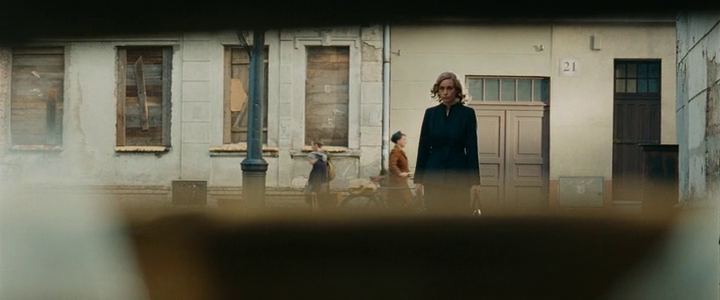
Phoenix
2014, Germany, directed by Christian Petzold
Christian Petzold's body of work over the last fifteen years or so is among the finest in European cinema, and one of the more remarkable aspects of his past two films is the seamless transition from largely contemporary themes to fine-grained explorations of the past that are nonetheless the polar opposite of most period pieces. There's nothing airless about these films despite the meticulous recreation of setting (though they share with most Petzold films that sense of being quite deliberately under-populated: Berlin is no teeming city here, but rather a specific time and place sketched in with exceptional economy both in narrative and demographic terms). It's no great surprise that a filmmaker as strong as Petzold was eventually going to turn fully toward some of the great historical questions of his society, dealing with the past and its weight -- quite literally in the case of Nelly in this film, but of course construed more broadly by Petzold.
I was struck, not for the first time, by the director's ability to take material that could appear quite melodramatic and treat it in a non-histrionic way -- it's precisely the refusal to engage in melodramatics here that lends the narrative its power, the quiet accumulation of details that is so neatly and poetically turned on its head in the final, wonderful scene. Nina Hoss is, as ever, quite remarkable, creating a fully-realized person with the most delicate shades of nuance, steadfastly refusing the "big" acting that many others would bring to a part like this. Other notes: the du/Sie nature of German adds a whole other layer to the interactions between Nelly and her former husband, one which the subtitles struggled awkwardly to convey in the early going with the occasional use of "Miss." The sound design is also quite wonderful: the sounds of (different) clocks in each location, the creak of floorboards, the way that sounds which seem so loud at night (like those clocks) fade into the background in the bustle of the day. Impeccable detail and yet all in service of the bigger picture.
Subscribe to:
Posts (Atom)
Index
List of all movies
Most of the images here are either studio publicity stills or screen captures I've made myself; if I've taken your image without giving you credit, please let me know.
About Me
- Gareth
- Boston, Massachusetts, United States