Wednesday, April 20, 2005

Winter Sleepers

1997, Germany, directed by Tom Tykwer (original title: Winterschläfer)

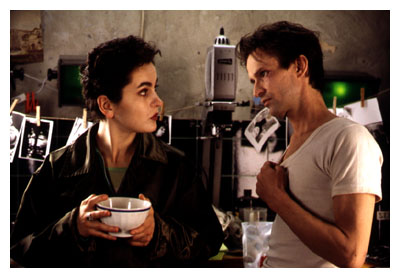
Tom Tykwer's best-known - and best - film, Lola rennt, centers on notions of coincidence and happenstance, and Winterschläfer, along with some of his later films, makes clear that this is an ongoing preoccupation. As the film begins, in a small town in the mountains, the otherwise level-headed Rene spots a fancy car with the keys in the ignition, and decides to take the vehicle for a drive. While out on the road, he's involved in an accident - which he doesn't cause - with a farmer, pulling a horse-trailer behind his car. Rene's car veers off the road, and is embedded in the heavy snow. Shaken, he walks away apparently unharmed, save for the fact that he has no memory of the incident; the car, to all intents and purposes, disappears. The farmer discovers that his daughter has concealed herself in the horse-box. She has been severely injured in the crash, and lapses into a coma. Half-mad with grief and anger, the farmer is convinced that the other driver is to blame. Meanwhile, Rene, aware that he can't remember something, but unsure quite what he may have missed, has begun a tentative love affair with a nurse, Laura, who watches over the injured girl. Laura's roommate, Rebecca, has problems in her own love-life, constantly at odds with her combustible boyfriend Marco - whose car has mysteriously disappeared. 

This complex set-up is sketched in, expertly, in the opening twenty minutes or so of the film: the film does a rather better job of making it all seem plausible (the small-town setting helps). While it's a quieter, more contemplative film than the adrenaline-charged Lola rennt, it's no less involving: once you buy into the film, there's a real interest in the outcome of the characters' lives, while there's a genuine, unpatronising warmth in Tykwer's portrayal of small-town social life. While the conclusion is perhaps a touch contrived, it's hard to imagine an outcome that better, or more satisfyingly, exemplifies the notion of poetic justice. Tykwer is a jack-of-all-trades, co-authoring the script, and also putting an oar in with the music which, as in Lola rennt, cleverly plays with the viewer, heightening the mysterious interconnections between the characters, and creating tension at the most unexpected moments.

Thursday, April 14, 2005

Red Lights

2004, France, directed by Cédric Kahn (original title: Feux rouges)

It's interesting to wonder what Hitchcock might have made of this - although Cédric Kahn shows considerable expertise himself with what the French like to call the drame psychologique. The set-up, from a novel by Simenon, is worthy of the master, with an undercurrent of tension from the first moments of apparently ordinary domesticity, and there's a chilly, beautiful wife for good measure. The film opens as a Parisian couple are about to head towards Bordeaux on their summer holidays: the children have been sent ahead to a camp, and papa et maman get on the road at roughly the same time as the rest of France, which doesn't help their already fractious relations.

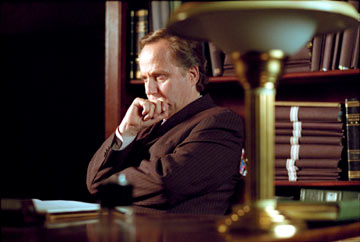
Jean-Pierre Darroussin is exceptional as the aggrieved husband, skewering a certain male insecurity quite perfectly: he's an inadequate man unable to deal with his beautiful wife's professional success, and his attempts to manage his jealousy are largely self-destructive. The couple's constant car-bound arguments eventually lead his wife to continue her journey alone, when the film takes a much darker turn, as Darroussin first acts out his apparent 'liberation' and then realizes he might have bitten off rather more than he expected. As with Hitchcock, most of the frisson is very much inside the viewer's own mind - and it's made the more powerful by the realism of Darroussin's morning-after predicament. There's a fabulous solo scene where he makes a series of increasingly panicked phone calls, the kind of thing where a lesser actor might start to chew the scenery, while the gathering tension is perfectly managed, and manipulated, by director Kahn.

Sunday, April 10, 2005

Fever Pitch


2005, US, directed by Peter Farrelly and Bobby Farrelly

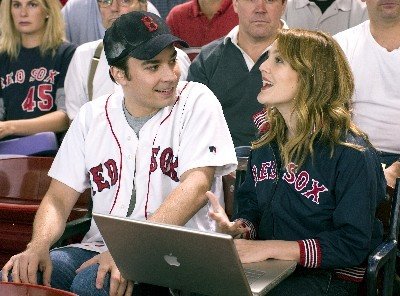
It's hard to be in any sense objective about such an upbeat movie, especially one that's so squarely aimed at making even the most casual Red Sox fan feel fabulous. Adapted from a semi-memoir by the English writer Nick Hornby - which became, in turn, a humdrum British film - the Farrelly Brothers take the original obsession with soccer and convert it into a full-blown psychiatric condition centered on baseball. The book focused on a key real-life season for Arsenal football team, whereas the directors simply used the 2004 Red Sox team as their backdrop, and happened to be monstrously lucky with the outcome of the season.

The movie starts out firmly in chick-flick territory, chronicling the growing romance between the charming Drew Barrymore and the equally charming Jimmy Fallon, and avoiding most of the usual lavatorial Farrelly Brothers touches. Barrymore's gal pals correctly surmise that Fallon has a deep, dark secret - although the average guy will probably argue that in comparison to, say, Norman Bates, Fallon's hidden side is really quite acceptable. Needless to say, the path to true love is littered with slumps, injuries and walk-off home runs, all of them against a Red Sox backcloth that makes you want to head back to the old ballpark as quickly as you can shout 'scalper'. It's interesting to imagine how they might have concluded the film in the absence of such a fairytale end to the actual Red Sox season (the rumored alternate ending never made an appearance on the DVD).

Saturday, April 09, 2005

La Chèvre


1981, France/Mexico, directed by Francis Veber

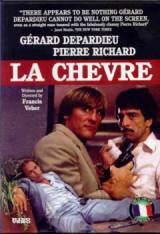
I have a weakness for French comedies - not the arthouse kind that often leave you thinking that 'France' and 'comedy' are two entirely separate notions, but the kind that sets the box office on fire in France. The big domestic comedy hits rarely make it to English-speaking countries - at best, they're remake fodder (this film, which did get a US release, was remade as Pure Luck, with Danny Glover and Martin Short). This was the first of three films starring the tandem of Pierre Richard and Gérard Depardieu, and the biggest hit to boot, one of the most successful of all French comedies. The odd couple are paired up when an industrialist's accident-prone daughter disappears in Mexico and, at the prodding of his company psychologist, he dispatches an equally unlucky employee (Richard) on her trail, along with an old pro PI (Depardieu). The two clash inevitably and incessantly; the (rather repetitive) pratfalls are balanced with more polished wit from the pen of writer-director Veber. The marketing of Depardieu to the English-speaking world from the mid-80's onwards focused on his 'classical' roles in films like Jean de Florette and Cyrano de Bergerac, so it was something of a shock to cinéphiles to see him pop up in trashy Hollywood material later on, but he's balanced low- and high-brow material throughout his French career; the main difference is that Hollywood pays through the nose. Depardieu is fine here: a hulking physical presence with little time to emote. Richard is perfectly cast as the naïf, a character he's played throughout his career to great effect; he gets the lion's share of the laughs, both visual and verbal. The only troubling thing about the whole affair is yet more evidence of Veber's apparent distaste for female characters, also apparent more recently in The Dinner Game (Le Dîner de cons) or Le Placard: women barely appear, and those we do see hardly paint a glorious picture.

Thursday, April 07, 2005

Stage Door


1937, US, directed by Gregory La Cava

A near-perfect example of 1930's comedy, this is a mostly light-as-a-feather backstage affair, set primarily in a boarding house for aspiring, and sometimes declining, Broadway actresses (it must be right around the corner from the theatres, since the players routinely leave for work less than an hour before the curtain comes up). Katharine Hepburn is, in a surprising bit of casting, an upper-crust heiress keen to try her luck on the boards; her entrance into a house full of less polished characters, most notably Ginger Rogers, is the occasion for much biting wit on both sides, although as luck would have it everyone slowly learns to get along. There's an undercurrent of melodrama in the house, which becomes overt towards the end - not entirely successfully. Just as the deus ex machina seems entirely too convenient, the film tries to have it both ways; the 'second ending' seems more honest than the first. Whatever the shortcomings of the structure, the cast, well-served by director La Cava, are top-notch: there's barely a wrong note in the whole film, which establishes the diverse characters with remarkable efficiency, and gives ample time to each of a range of fine actresses (Constance Collier is an especially effective scene-stealer).

Tuesday, April 05, 2005

Sexy Beast


2000, United Kingdom, directed by Jonathan Glazer

Although it sometimes seems like one of those quintessentially American obsessions, gangsters have been as much of a trope in British cinema as in the US, with a particularly persistent renaissance over the past decade, mostly of the Cockney variety. Sexy Beast leaves the Lock, Stock and Two Smoking Barrels flicks in the shade, however, with a fully realized portrait of a gangster desperate to stay retired from the game, no longer interested in either the highs or lows that come with law-breaking. Ray Winstone is in fine form, exhibiting a much softer, more nuanced side than is usually the case; his character's sincere desire for the quiet life and the love of his wife is almost heartbreaking (the film does nonetheless elide the exact nature of his past career: was he a violent criminal or the fabled 'gentleman thief'?). Into his southern Spanish idyll comes Don Logan, a sociopath with a mission to recruit him for one more job. Ben Kingsley plays Logan in an utterly atypical turn: for an actor best known for quiet force, he's adept with Logan's machine-gun speech and hair-trigger temper (not to mention borderline insanity). It's easy to get caught up in his performance, and lose sight both of Winstone's work and the fine direction, reminiscent, in its focus on the details of speech and atmosphere, of Mike Hodges's excellent Croupier.

Thursday, March 31, 2005

I'm Not Scared


2003, Italy, directed by Gabriele Salvatores (original title: Io Non Ho Paura)

I can't help thinking that many of the reviewers of this film felt that they should like it and therefore gave it more raves than it really deserved. After all, it's impeccably crafted, from the almost impossibly gorgeous imagery of a southern Italian summer to the strong acting, from both adults and children. It's got a sterling premise - a ten-year-old boy finds a boy of a similar age imprisoned in a hole near his home - and there's much to think about in the depiction of a certain element of Italian society in the 1970's (while the treatment of the imprisoned boy is not soft-pedalled, the script smartly avoids easy condemnations of his captors). With all that in mind, the film should grip from first frame to last, but in truth things are so wilfully stop-start that the script constantly punctures whatever tension it creates - and there's no shortage in the first 45 minutes. The director never quite makes up his mind between genre thriller, coming-of-age tale, and leisurely depiction of Italian village life, and that, more than anything, kills the pacing, as Salvatores attempts to fulfil the requirements of each option. It's a shame: with better pacing this might have been a minor classic.

Wednesday, March 30, 2005

Rabbit-Proof Fence

2002, Australia, directed by Phillip Noyce

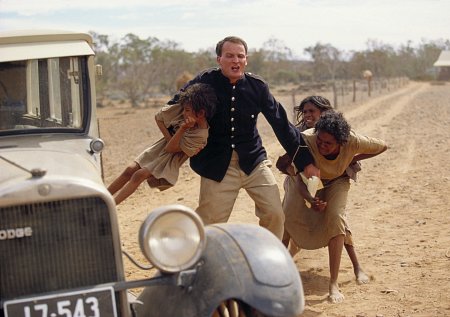
A deceptively simple account of three half-caste Aboriginal girls who run away from an institution of 'training' after they are forcibly removed from their mothers in the early 1930s, Rabbit-Proof Fence is a powerful indictment of white Australian policies of assimilation and 're-education'. The young girls escape from the very low-security Moore River home, and embark on a trek of more than 1,200 miles north to their home territory of Jigalong, navigating their way by following one of the rabbit-proof fences that were erected to protect farmland - and which were later rendered moot by the introduction of myxomatosis. In sharp contrast to the mythology of colonial Australia, the bush here is rarely threatening, despite the difficulties of sustenance occasionally encountered. Phillip Noyce's very mobile camera gives the tale a real urgency at times - the attempted escape from the policeman who captures the girls, and the narration of the girls' flight from Moore River are especially gripping. The conclusion, using a Schindler's List device, though with more power here, is exceptionally moving, a fitting indictment of misguided policies without a trace of hectoring.

Wednesday, March 23, 2005

Steel Magnolias


1989, US, directed by Herbert Ross

Another 80's opus from Herbert Ross - this much more successful than Footloose, mining territory not a million miles from the 80's Kleenex epic Terms of Endearment. As a portrait of Southern charm, it probably bears only a vague resemblance to the truth, but as a showcase for a fine collection of actresses, too many of whom appear only rarely on screen these days, it's a lovably shaggy dog affair. It's the story of the loves and losses of a group of strong, but disparate, Dixie women, whose mutual support network carries them through their various familial trials, with pithy one-liners usually directed at the men in their lives. There are long scenes in the beauty parlor and well-honed speeches that betray the film's stage origins, but that's rarely a handicap: the action moves along smartly, and you're too busy watching the different actresses at work to notice the occasional mechanical creaks. Julia Roberts was on the verge of superstardom here, and she's already adept at eating up the screen. She's in the company of some real scene-stealers in the form of Dolly Parton and Shirley MacLaine, while Sally Field has a fabulous scene late in the film that's a classic weepie moment - a compliment, not a barb. Best seen with a mint julep or a bowl of ice-cream, or perhaps both.

Thursday, March 17, 2005

The Set-Up


1949, US, directed by Robert Wise

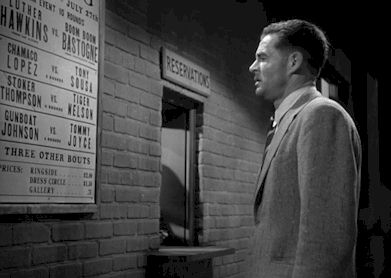
It's hard to believe that the director of The Sound of Music (and Star Trek: The Motion Picture) started out making movies as spare and pitiless as this one (although there is a core of realism in The Sound of Music if you care to look past the whimsy). Robert Ryan does a phenomenal job as the never-made-it-big boxer convinced he can win one fight against a kid who's being set up for a title bout. His manager, however, has made a deal on the side with a local hood, assuming that his washed-up charge will go down without any financial incentive. The action is mostly in the ring: almost half the movie is a literal blow-by-blow account of the fight, with occasional asides as Ryan's wife wanders the streets, miserable at the life she's found herself leading. The dressing-room dialogue and interactions are especially treasurable, with some fine character turns; the other boxers include an unusually rounded black character by the cinematic standards of the time. The movie's a salutary lesson for those who labor under the impression that Raging Bull was somehow sui generis; Scorsese has no difficulties in acknowledging his debt to this standout genre flick, as well he should...

Tuesday, March 15, 2005

Footloose


1984, US, directed by Herbert Ross

Twenty years on, it's a little hard to see why Footloose caused quite the fuss it did - which says as much about the evolution of 'youth' films since 1984 as it does about my memories of the movie from a viewing on video circa 1986. There's no denying the casting magic: Kevin Bacon was poised for a breakout role after several smaller parts in high-profile movies, while Chris Penn and Lori Singer also catch the eye (you wonder why Penn, in particular, didn't go on to headline much better things, but his ballooning weight can't have helped). The story, though, is something of a mess: there are several great individual scenes, whether drama (such as in the meeting of minds between Kevin Bacon's character and the tightly-zipped local minister portrayed by John Lithgow), or dance action, but the film seems to lurch from one scene to the next with no great coherence. I don't demand high realism from popcorn features, but the plotting here seems especially loose; any time things lag, they just pop Kenny Loggins' Footloose on again. That said, it's amazing to note how slow, in a good sense, some of the movie is in comparison to more recent youth hits: Hollywood in 1984 still assumed that a teen audience could deal with scenes of more than 60 seconds, where not that much happened beyond dialogue, and it's something that's sorely missed in the more slam-bang 90's and 00's.

Thursday, January 27, 2005

Zappa


1983, Denmark, directed by Bille August

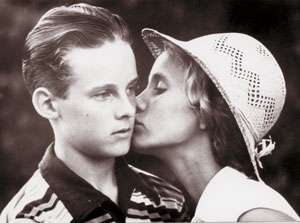
As coming-of-age stories go, Zappa is far more bitter than sweet: it's nothing like the heartwarming Swedish My Life As A Dog, made a year later and set a few years earlier. Zappa follows an odd trio of boys in early 1960s Copenhagen: rich kid Steen, a manipulative bully who has everything but the love of his high bourgeois parents; middle-class Bjorn, with whom we're invited to identify most closely; and good-hearted working-class Mulle, the reliable gag-man. From such unpromisingly clichéd raw materials, Bille August fashions a very affecting series of snapshots, as Bjorn in particular navigates the shoals of adolescence and figures out how best to free himself from the malign influence of Steen. The sense of time and place is perfectly judged, with the class tensions of post-war Europe (even in reputedly egalitarian Denmark) in clear relief. The young actors are spot on, as is so often the case in Scandinavian cinema: from their work, you'd assume they all went on to long careers in the movies, but you'd be mistaken. A little patience is needed to let this movie work its spell, but it's worth the investment.

Thursday, January 20, 2005

Infernal Affairs

2002, Hong Kong, directed by Andrew Lau and Alan Mak

This one is a real find. While Hong Kong cop/robber flicks tend to be wall-to-wall action (not a bad thing if it's well done), Infernal Affairs quickly reveals itself to be a far more interesting creature as it explores the trials and tribulations of two moles, one an undercover cop in the Triads, the other a Triad who kept his nose clean and went through the police academy. If that sounds far-fetched, the directors do a skilful job of making it seem perfectly logical, helped enormously by the quality of the acting, from the stars to the supporting parts (it's a huge improvement on some similar HK flicks, with their inane comedy interludes). The directors have a great eye for detail, whether the planning of a drug trade or a police bust, and there's one fabulous scene that brings cops and crims together for a face-off in the police station. Since this is HK cinema, the bullets still fly now and then, but the plot is the real action here.

Saturday, January 15, 2005

Intimate Strangers


2004, France, directed by Patrice Leconte (original title: Confidences trop intimes)

One of those movies that seemed to split the critics, I was surprised by both the raves and the pans. While Fabrice Luchini hasn't been this good in a long, long time (partly because no-one gives him a decent part), the film does drag in sections. There's a degree of repetition that allows you to reflect too long on the basic unlikeliness of the scenario (a woman walks into an accountant's office under the impression he's a psychologist and once her mistake is discovered, continues to show up for conversations with the nebbish tax expert). Still, as an exercise in style as much as anything else, the movie doesn't really care about suspension of disbelief, for it constructs its own very self-contained world, within which these characters make sense. Sandrine Bonnaire is rather pallid here; she can be fierce at times but here that fire is largely hidden by an underwritten role. Ultimately, a slight sense of disappointment hinges on the fact that Leconte has made at least a half-dozen very fine movies, and this one doesn't quite measure up.

Sunday, January 09, 2005

It All Starts Today


1999, France, directed by Bertrand Tavernier (original title: Ça commence aujourd'hui)

It All Starts Today is the tale of Daniel, a schoolteacher in the northern part of France, an area devastated by decades of economic decline. His little village school struggles under every imaginable strain: lack of resources, grinding poverty, occasionally abusive parents, and an administrative system so dysfunctional it can barely assist with the most fundamental needs of the school. Daniel, however, is almost tirelessly engaged in improving the school, for its teachers and its students, trying everything possible to involve and revive the community. Although parts of the film are quite devastating in their documentary feel (reminiscent of Tavernier's L.627; Didier Bezace, star of that film, pops up in a key small role here), there are rays of hope, too: the film is a kind of cry for help, but it's also one that makes you want to become involved, rather than simply hoping that someone else will deal with the problem. Philippe Torreton is superb in the lead role, and there's no shortage of able support. Bruno Dumont and others have made several deeply depressing movies about this part of France in recent years, and Tavernier's humanist alternative is a refreshing corrective.

Index

List of all movies

Most of the images here are either studio publicity stills or screen captures I've made myself; if I've taken your image without giving you credit, please let me know.

About Me

Boston, Massachusetts, United States