Thursday, October 27, 2005

Kitchen Stories


2003, Norway/Sweden, directed by Bent Hamer (original title: Salmer Fra Kjøkkenet)

Kitchen Stories might function as an object lesson in how to make the most of unpromising - on paper - beginnings, for it's a little gem, poignant and richly detailed, with wonderfully delicate performances and direction. The film follows participants in a 1950's study run by a Swedish institute keen to explore the kitchen habits of single Norwegian men, with the object of designing the perfectly efficient kitchen. The study takes place in a rural area, and each volunteer agrees to allow an observer to sit in his kitchen, on a comically high chair, following, and logging, the daily routine. Interaction between subject and observer is strictly forbidden. The focus is on Isak, an older farmer, and Folke, his observer, two men who, it quickly becomes apparent, are no strangers to loneliness. Isak subverts the process from the very beginning, cooking in his bedroom, and turning out the light in his kitchen to render observation impossible. Slowly, inevitably, however, a bond begins to develop between the two men: the cup of coffee that breaks the silence is almost heart-breaking, and a rich friendship evolves between two fundamentally decent human beings who have lacked the opportunity to express that decency to others. With so little dialogue in the first half of the film, there's a rich vein of visual humour on display, particularly in Isak's mischief, or the brilliant sequence when the observers, each driving a car towing a little caravan, reach the Norwegian border and are forced to switch to other side of the road, since the two countries weren't coordinated at the time. What remains most sharply in the mind, however, are the two deceptively simple lead performances, restrained yet detailed, and the unhurried direction, that allows a series of vignettes to acquire a bracing power.

Sunday, October 23, 2005

In Her Shoes


2005, US, directed by Curtis Hanson

Curtis Hanson and Ron Howard must have a bet going where they're each attempting to direct a film in every genre possible, but even with that in mind, In Her Shoes seems a surprising choice, on the surface, for the director of fare like LA Confidential or Bad Influence. It's a true chick flick - the title sequence underlines the footwear fetish - with three meaty lead performances, plenty of family drama, and more than a few laughs among the tears. Look a little closer at Hanson's record, though, and it's perhaps not so odd to see him turn in a film like this: he's helped revive more than one actress's career - think Rebecca De Mornay in The Hand That Rocked the Cradle or, especially, Kim Basinger in LA Confidential and 8 Mile - and given us unexpected turns from Meryl Streep (in The River Wild) or Katie Holmes in Wonder Boys. While the drama meanders from time to time - a reflection of the two interwoven stories that keep characters offscreen for long periods - Hanson does a fine job working with the three leads, credibly bringing Cameron Diaz from irresponsible party girl to something resembling an adult, and shepherding Toni Collette through an ugly duckling transformation. Shirley Maclaine is surprisingly restrained - her scene-stealing sidekick gets the best lines - and in the process acquires an appropriately grandmotherly dignity. It's not Hanson's most distinctive work, but it's generally well-crafted stuff, with relatably flawed characters and more than a little charm around its rough edges.

Saturday, October 22, 2005

The Twilight Samurai


2002, Japan, directed by Yoji Yamada

Yoji Yamada has directed almost seventy films over the past 40 years - the kind of work ethic that puts even Woody Allen to shame - but only a handful of his movies are known outside Japan. Most of his professional career was spent on the 48 movies in the Tora-San series, which followed the picaresque adventures of the eponymous lovable loser, and which weren't big in the export market. In his own autumn years, he's turned to some more substantive material, none more so than this modest little film, set in the waning years of the samurai era. Before seeing the film, I had formed the impression that the main character, Seibei, was a rather elderly gent, so it was something of a surprise to discover that he's a vigorous fellow, more than capable of wielding a sword, though less and less interested in actually doing so. Seibei is a widow, caring, on a meagre stipend, for two young daughters and an increasingly senile mother. Like many other samurai in his clan, he works as a clerk, although he sets himself apart from his colleagues by his refusal to join them in merrymaking, preferring to care for his family. Events conspire to reveal that he retains much of his skill with a weapon, as he defends a young woman's honor, and he's forced back into action at the behest of his clan. The film ultimately is about the difficulties faced by two independent individuals - Seibei and Tomoe, the young woman who becomes a part of his life - in a society governed by a rigorous set of rules and taboos, but the film doesn't overdo the deeper themes, focusing instead on the details of Seibei's life, whether it be the making of insect boxes, fishing, the ceremonial preparation of weapons and dress, or the eating of food: these small touches rapidly draw us into his very codified world. The performances are strong - and more naturalistic than in some of Kurosawa's historical work, for example - with Hiroyuki Sanada, who appeared in the Japanese Ringu movies, especially effective. The film is let down only by its coda, which is overly sentimental even though it strives for something more clear-eyed.

Friday, October 21, 2005

Cop au vin


1985, France, directed by Claude Chabrol (original title: Poulet au vinaigre)

Despite the film's origin, there's something very English about Poulet au vinaigre: it plays like an especially well-wrought English television mystery, so it's no surprise to discover that Inspector Lavardin's adventures later transitioned to the small screen, nor that Chabrol turned to source material like Ruth Rendell's A Judgement in Stone several years later (that novel was filmed, with great force, as La Cérémonie). Like a P.D. James adaptation, the players are given plenty of time to implicate themselves in all kinds of wickedness before Lavardin (Jean Poiret) turns up to unveil the mysteries (indeed, the film is half over before Lavardin makes much of an impression; in other circumstances that might be a shame, but Chabrol has such an acute eye for small-town foibles that you barely notice his absence).

Like any good English mystery, but unlike the average French policier, except those of Chabrol himself, class is front and centre here, with postman Lucas Belvaux and his mother (a thoroughly de-glamorised Stéphane Audran) fighting off a trio of rapacious property developers (though that's but one strand in the film). While no-one emerges entirely unscathed, Chabrol has an unswerving affection for the little man - allowing a certain measure of poetic, if not literal, justice to come his way. Jean Poiret is best known as a comic actor, but Chabrol's casting was a smart move: like Hitchcock with Cary Grant or James Stewart, Chabrol understands how unsettling it is to see an apparently mild-mannered individual suddenly behave forcefully, even violently. It's not one of the director's most acid films, but Chabrol doesn't do frothy, and there's an air of menace at the most unexpected moments.

Wednesday, October 19, 2005

A Very Long Engagement


2004, France/US, directed by Jean-Pierre Jeunet (original title: Un Long dimanche de fiançailles)

One wonders if, after the enormous international success of Le fabuleux destin d'Amélie Poulain, Jean-Pierre Jeunet wanted to make something, well, important, substituting the First World War for his more usual world of bizarre happenings and brilliantly-constructed, occasionally black whimsy. There are occasional flashes of his old self - the vignettes that introduce a series of characters early on recall, quite explicitly, the various apartments in Delicatessen, for example - but something in Jeunet's approach seems ill-suited to what remains at heart pretty sombre material (and which remains much sharper-edged in Sebastien Japrisot's 1991 source novel, which gave an especially strong sense of the vast scale of the human losses of the Great War in France). While Jeunet doesn't gloss over the realities of trench combat in the Great War - indeed, he brings a rare sense of the myriad physical discomforts that were a constant of trench life, as well as of the horrors of maimed and destroyed bodies - the sepia-tinted main storyline occasionally seems to belong to an entirely different film, with a rather more Hollywood take on life (the story follows Mathilde - Audrey Tautou - as she attempts to track down her fiancé, who disappeared in the trenches in 1917 after being condemned to death for cowardice). There are, nonetheless, pleasures to be had from individual episodes, as well as the formidable cast, many of them Jeunet regulars. Ticky Holgado deploys his charmingly southern accent to great effect once again in his penultimate appearance, while Dominique Pinon has an unusually affable part; in smaller roles, Jeunet has fun with the usual panoply of unusual faces. The centre of the film is, of course, Tautou, whose gamine charms aren't as appealing here as in Amélie, but that's in large measure the fault of her director, who seems more interested in technical trickery than coaxing a strong performance from his leading lady. Jeunet is prey to the technician's flaw of forgetting the human core of the story under the many layers of digital wizardry, something that also marred La Cité des enfants perdus. It's a mistake that's less excusable in telling this particular tale.

Sunday, October 09, 2005

Head-On


Germany/Turkey, 2004, directed by Fatih Akin (original title: Gegen die Wand)

A couple of years ago, Fatih Akin directed a cute little romantic comedy by the name of Im Juli, a creditable variation on the familiar theme of boy meets girl, with a multi-ethnic twist and two appealing lead performances. To say that Gegen die Wand is a little different is rather like saying that milk and kerosene are different: Akin's new film is a ferocious exploration of two messed-up souls, and their place as immigrants/outsiders in today's Germany. The film opens, more or less, in a psychiatric hospital, as Sibel (Sibel Kekilli), a troubled young woman, of Turkish origin, tries to convince Cahit (Birol Ünel), a somewhat older Germanized Turkish man, to marry her - the only way she can see to escape the stifling confines of her family. She's not proposing a conventional arrangement, however, since the marriage is to remain a convenient fiction, for her parents' eyes only. While it's no surprise that events don't unfold as smoothly as she imagines, given the complex histories involved, the performances of Ünel and Kekilli are so thoroughly involving that they render the subsequent events both credible and moving. When a tragic accident sends the story in an entirely unexpected direction the shift is wrenching, for despite, or because of, their flaws, the couple is clearly struggling in the right direction, dealing with grief, loss, and displacement as best they can. The latter third of the action shifts to Istanbul: it's striking that both of Akin's films end up here, as if to suggest that only in the mother country can Turks truly confront their problems. It doesn't paint a rosy picture of multi-cultural Germany that even a successful Turkish-German director feels that true happiness is to be found back on the Bosphorus.

Saturday, October 08, 2005

A History of Violence


2005, US, directed by David Cronenberg

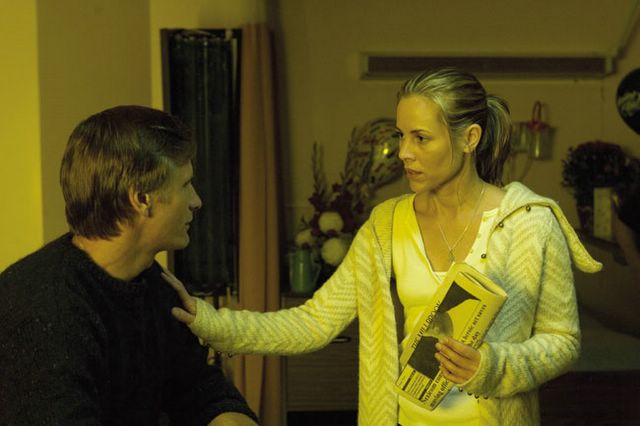
It's not often that you come across a movie that has few truly adequate points of comparison. That's perhaps because Cronenberg does such an extraordinary job of marrying two utterly different kinds of film: a viscerally gripping thriller, and a thought-provoking art movie that forces us to confront just what it is we enjoy about those visceral kicks, making us complicit, in a way, in the violence that shatters events onscreen. A History of Violence is also a brilliant riff on the Hollywood vision of smalll-town American life, the kind of dissection that perhaps only a foreigner - even a Canadian - could pull off. The little town where Tom Stall (Viggo Mortensen) lives is set up as an idyll, peaceful and beautiful, where everyone knows one another. Then men of violence come to town and Tom's method of dealing with them forces at least some people to wonder whether, in fact, they know anything at all about their friend.

Mortensen is perfectly cast, his mask slipping in slow, startling fashion, as the audience, too, attempts to reconcile Tom's salt-of-the-earth present with his dark past; Maria Bello plays his wife with a kind of ferocity that perfectly captures the maelstrom that threatens to engulf her family, while the supporting players are generally on the money, even if William Hurt chews the scenery just a little. Cronenberg's direction is carefully controlled, peeling each layer off the onion quite deliberately. Adapted from a comic book, the film has something of that medium's immediacy: there's no wasted time here, each well-composed shot advancing the action in graphic style; several brief shots evoke comic book art quite explicitly, without proving a distraction. Most of all, A History of Violence is a fully adult movie, which demands reflection, and which refuses to gloss over complex, contradictory emotions.

Thursday, October 06, 2005

Braindead

1992, New Zealand, directed by Peter Jackson (US title: Dead Alive)

Watching Braindead, I couldn't help but wonder how Peter Jackson ever persuaded people to part with another dollar in order to allow him to continue his career - never mind get from here to pre-production on The Lord of the Rings in five short years. Then again, perhaps they figured it was best to keep him occupied with movie-making than have him on the streets. There's no doubting that Jackson was already developing, and confident in, his filmmaking chops, for there's a breakneck pacing in evidence, as well as a creative, mobile camera that would come in handy both on Heavenly Creatures and, more obviously, in committing Tolkien's saga to celluloid.

Since I'm not a committed gore hound, however, the sometimes laughable special effects, constant showers of blood (and other assorted bodily fluids), and wildly over-the-top performances left me a little cold. The plot, for what it's worth, involves a Sumatran rat, whose bite apparently turns people into zombies, who naturally want to chomp on the neighbors, thereby creating more zombies. The action is set in very prim 1950s New Zealand, where a zombiefied mother is something of a social liability, as Lionel, our hero, quickly finds out, particularly when Mum nibbles on her nurse. There are more than a few similarities with Shaun of the Dead, particularly the matter-of-fact attitude of both heroes in dealing with the outlandish events around them, although the latter film deals with the arrival of zombies in polite society with considerably more wit.

Saturday, September 24, 2005

Red Eye


2005, US, directed by Wes Craven

It's nice to know that at least some people in Hollywood realize that there's no shame in turning out a well-made B-picture, rather than an overfed A-lister that fails to satisfy. There's absolutely no fat in Red Eye's 85 minutes, with Wes Craven signalling his intent in the lean, clever credits sequence. The plot swings rapidly into action as Cillian Murphy - so blue-eyed you know he's got to be wicked - bumps into hotel manager Rachel McAdams (on quite a roll after The Notebook and Wedding Crashers) as she's about to board a late-night flight home. After they share a delay-induced drink, he ends up in the seat beside her on the plane - but we're quickly aware that there's no coincidence, as he needs her management talent to assist in a nefarious plot to off a high-ranking official. It doesn't do well to examine some of the plot holes, but then there's rarely time as the film, with more than a few nods to Hitchcock in the on-plane sequences, zips along. McAdams is a credibly spunky heroine - you'll want to cheer her on as things get hairy - and Murphy seems to enjoy himself no end even when his character is being so comprehensively outsmarted. It's nice to see Craven so clearly in control of his material here: the horrors are more mundane, though no less creepy for that, but the old dog has a few tricks left in him yet, after a string of misfires.

Friday, September 23, 2005

Modern Times


1936, US, directed by Charles Chaplin

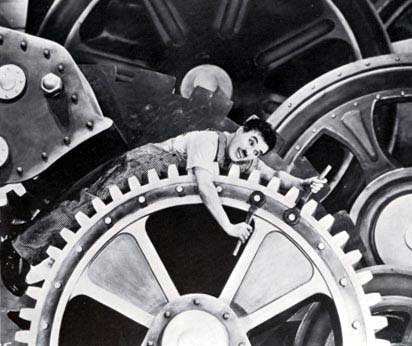
It's hard to watch Chaplin's last silent film without an awareness of almost seventy years of criticism and quotation, not to mention dozens of Chaplin biographies. There's no doubting the work of an artist - nay an auteur, given that Chaplin did more or less everything of note, and probably made the tea, too - but often the sense is of an artist frustrated by the very medium in which he excels. While it's easy to read the film as a commentary on the dehumanizing effects of industry more broadly, Chaplin himself felt very acutely the pressures to mould himself to an inflexible Hollywood system, notwithstanding his own wealth and, for the most part, artistic freedom. In a sense, he was fighting against the very collaborative nature of the film industry - a near production line at the height of the studio era - but also the industry's ceaseless pursuit of the dollar. As to the film, it's inescapably a string of - well-made - two-reelers extended to feature length; the famed sequences in the factory work brilliantly as vignettes, while the scenes with the gamin (sic) change the tone entirely. There's plenty of bite to Chaplin's portrait of the humiliations of factory life, although the buffoonish owner is a cipher, while Chaplin is never entirely sure what he thinks about the unions. The final optimistic title card, while absolutely in tune with the American Dream, seems altogether too naïve in the context of the enormous social turmoil of the Depression. It's a fascinating film as an impetus for debate, a clever piece of cinema which sends a very confused message.

Saturday, September 17, 2005

The Year of Living Dangerously

1982, Australia, directed by Peter Weir

It's hard to know quite what to make of Peter Weir's The Year of Living Dangerously more than twenty years on. There's no doubting the sincerity of the filmmaker's intentions, opening a rare window on to Asian politics with his depiction of events at the tail end of the Sukarno era in mid-1960's Indonesia. However, the realities of life for the Indonesian population generally slip into the background, with the film becoming another tale of (relatively) privileged Westerners in an exotic locale. Guy Hamilton (played by a generally bedraggled Mel Gibson) is an Australian newsman who arrives in Jakarta with a pretty limited grasp of Indonesian politics but perhaps a somewhat greater amount of moral fibre than his colleagues, and he's quickly led to some of the corridors of power by his dwarf asistant, Billy Kwan (the remarkable Linda Hunt), a half-Chinese man devastated by Sukarno's betrayal of the Indonesian population. The core of the film is a tense web of conflicting loyalties, and late-night meetings, which might seem enough on its own, but the film reverts to convention in giving considerable time to the love affair between Guy and a young British Embassy staffer (Sigourney Weaver); their antics at times make light of the very real dangers faced by both westerners and Indonesians as the country unravels. Still, even by comparison with the brilliantly jaundiced The Quiet American (the Phillip Noyce version from 2002), there's much to enjoy here: the plot is as twisted as Indonesia undoubtedly was at the time, with much to say about loyalty and betrayal, and the fine line between the two, all against a suitably sweaty backdrop (with the Philippines standing in for Indonesia).

Tuesday, September 13, 2005

Matchstick Men


2003, US, directed by Ridley Scott

Even after almost thirty years of filmmaking, there's no mistaking Ridley Scott's origins in advertising, nor his continued interest in the visuals of that medium. His Los Angeles is all slick surfaces and bright light, the city's artifice very apparent. Of course, a preoccupation with appearances is perfectly suited to a film about con men. Nicolas Cage and Sam Rockwell play hard-working con men adept at bilking the vulnerable, the gullible, and occasionally the plain greedy, out of their savings, one con at a time. Early in the film, Cage, who suffers from an obsessive-compulsive disorder, discovers that he has a teenage daughter (Alison Lohman) from a relationship that went south years previously, and he attempts to re-connect with her in an effort to add at least some meaning, and perhaps karmic points, to his life. Inevitably, she becomes caught up in some of his scheming, notwithstanding his attempts to keep her at arm's length, and his plans for one last con begin to unravel fast. Cage's part is the kind of thing actors love: the character comes off his meds and exhibits all manner of tics, but director Scott wisely doesn't allow this to become more of a distraction than necessary. Rockwell is all manic energy while Alison Lohman does a fine, lower-key job as the daughter; it's hard to believe she's in her mid-20's. There are plot contrivances aplenty here, but this is a fine bit of genre filmmaking, with performances that were under-appreciated at award time.

Wednesday, September 07, 2005

The Motorcycle Diaries


2004, US/Germany/GB/Argentina/Chile/Peru, directed by Walter Salles (original title: Diarios de motocicleta)

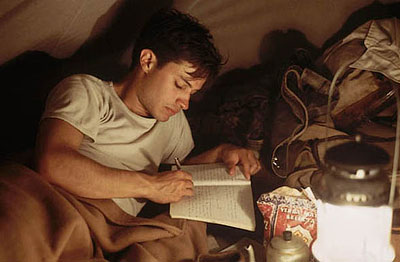
Avoiding the pitfalls of a full-blown biopic, The Motorcycle Diaries focuses more narrowly on Ernesto 'Che' Guevara''s youth, and his first trip outside Argentina, using his own diaries as the basis for the narrative. In 1952, Guevara (played by the fast-rising Gael García Bernal) and a friend, Alberto Granado (Rodrigo de la Serna), decide to take a trip on Alberto's elderly motorcycle, a journey that'll take them from one end of South America to the other. Guevara is a privileged fellow in Buenos Aires, without a whole lot of experience of the world - the fact that he's a rugby-playing medical student gives a rough idea of his social status in Argentina - and the journey functions as his political and social awakening. There's undoubtedly an element of (self-) mythologizing at work here, but the film is generally a highly convincing portrayal of the first stage of Guevara's political development, and his growing awareness of the breadth and depth of inequality and injustice on his continent. It's also a love story of sorts: Guevara becomes deeply, almost mystically attached to some of the places he visits; those feelings are summed up in a speech towards the end of the film, in which he sets forth his vision of a continent without borders, where common heritage and humanity are celebrated. Director Walter Salles doesn't allow things to become too ponderous, however: there are warm and amusing scenes that evoke the pair's less elevated adventures, with narrow escapes from drunken husbands. Bernal is excellent as the nascent Che, as charismatic here as he's ever been, and there's a large cast of wonderful character actors in support. The South American landscapes, gorgeously shot, have a key role, too, underlining the sense that travel is something that requires effort and endurance to yield its many secrets.

Friday, September 02, 2005

The Bad News Bears


1976, US, directed by Michael Ritchie

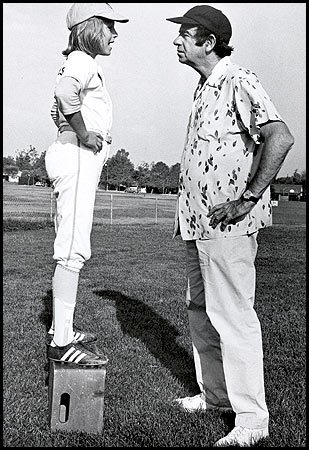
As the Bad News Bears sequels showed, kids drinking beer and swearing might be funny, but you need a skilled curmudgeon as a foil, and they don't come much more skilled, or more curmudgeonly, than Walter Matthau; he doesn't have to do anything at all, and yet he still seems ornery. For a film about, and enjoyed by, kids, it's striking how his flaws are never glossed over. Matthau's Morris Buttermaker has a mean streak almost to the end, and yet he still manages to achieve a kind of redemption not so much by softening his heart but by aligning himself with the kids against the adult world, handing out beers to his Little League team - to parental consternation. It's a kind of Roald Dahl take on the world, where the rest of the adults are dimissed as stuffed shirts or as malevolent presences (the opposing coach, for example, who slaps his own son). Several of the kids - most of whom never really acted again, outside the Bad News Bears series - acquit themselves well, while Tatum O'Neal is pretty convincing as the ballsy, twelve-year-old female version of Matthau (she didn't make many good movies, but she was at her best working opposite an adult actor). Michael Ritchie was reaching the end of a fairly fertile period in 1976, although this film doesn't have the political overtones of his other work: in his professional hands, the movie remains far more coherent than many a juvenile feature, while his directorial reins are still loose enough to allow for amusing comic bits, especially from the feisty, profane second baseman.

Tuesday, August 30, 2005

La Bûche


1999, France, directed by Danièle Thompson

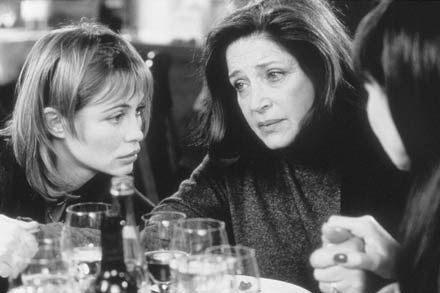
A rather slight affair, this is an unsurprisingly wordy Parisian film centered on a somewhat dysfunctional family (in particular three sisters) in the lead-in to Christmas, as they attempt to negotiate a minefield created by the need to accommodate both of their long-divorced parents at the same dinner table. The conceit of three very different sisters is rather overdone, particularly where one or more tends to be offscreen for lengthy periods since their lives rarely intersect. However, the impeccable cast does a generally good job, with Sabine Azéma outstanding. The older generation, in the form of Claude Rich and Françoise Fabian, is a delight: they have an especially good central sequence in a bar, in which they manage to cover both the events and the emotions of their tumultuous marriage; there's no hiding the delight that writer-director Danièle Thompson, a skilled wordsmith making her directorial debut here, had in writing this scene, as well as those in which her characters address the camera directly. It's tempting, in the face of such wit, to read more into the film than is really there, but, that said, there will undoubtedly be a few winces of recognition at the family oddities on display - Christmas tensions are universal, at least where the festival is celebrated, even in this Jewish Parisian household.

Monday, August 29, 2005

Finding Neverland


2004, US/GB, directed by Marc Forster

Perhaps director Marc Forster found Monster's Ball as exhausting as I did, for this is a startlingly different project, filled with whimsy, and the most chaste of interactions between the main couple. There's a poignant, even tragic, undercurrent, but the core of the film is bright and hopeful, like J.M. Barrie's own key creation, Peter Pan. The film introduces us to Barrie on the eve of his professional nadir, a play that flops badly, leaving him casting about for inspiration, and his main patron calling in financial favours. Into his life comes a ready-made family of fatherless young boys (and their mother, Kate Winslet), a distraction from his own unhappy home life, although his interactions with the boys are anything but conventional. The film briefly raises the spectre of a less pleasant side to Barrie's unusually playful relationship with the four boys, only to dismiss it absolutely (Michael Jackson may wish that he had been so lucky). There's much to like here, not least the acting: Depp is charming, with a light Scottish burr that never distracts, and while Winslet can do this kind of thing in her sleep, she's no less appealing for that. The standout among the children is Freddie Highmore, a startlingly self-possessed 10-year-old when the film was made. As Peter, a child wrapped up in grief for his dead father, he walks away with several difficult scenes (the film plays pretty loose with the historical record on this point, since Peter's father was alive and well when Peter Pan had its premiere). By contrast, there's a rather schematic relationship between reality and artistic inspiration - and certainly little sense of artistic struggle - but then this is fantasy rather than social realism.

Wednesday, August 24, 2005

War of the Worlds


2005, US, directed by Steven Spielberg

Say what you will about Spielberg, but he's rarely ponderous, throwing the viewer into the heart of the story right from the starting gun. War of the Worlds is no exception: the opening segment of the movie is a tour de force of economic, cut-to-the-chase filmmaking, with an exceptional grasp of the mechanics of fear. The early scenes rapidly sketch in Ray Ferrier's (Tom Cruise) place in the world - a blue collar New Jersey worker with a divorce behind him and two kids who live the good life with their stepfather - but we've barely even absorbed this information before the skies darken and a terrifying lightning storm begins. Within minutes, it's clear that this is no ordinary weather event, and the pace ratchets up fast, panic filling the air as no-one can quite grasp what's happened to their city. The 9/11 echo is overt here: inexplicable terror on an otherwise ordinary day, with a devastated population unsure of how to respond (and transportation at a standstill). It's no surprise that the breakneck pace can't be sustained throughout - a dark basement and Tim Robbins slow things down considerably, without adding much to the story - but Ray's gradual ascent, along this journey, to something resembling (belated) adult responsibility is reasonably convincing. The terror outside remains almost entirely unexplained, ultimately unlike 9/11, but the sense of panic of those early post-attack days is both gripping and disturbing.

Wednesday, August 10, 2005

Hard-Boiled


1992, Hong Kong, directed by John Woo

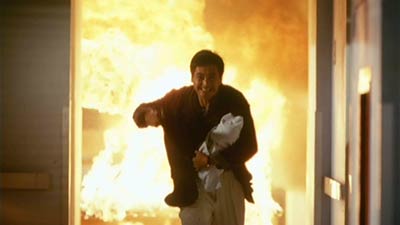
I've come to the conclusion that John Woo made one great movie -- The Killer -- and a whole lot of pictures that don't live up to the hype generated by action-movie nerds. Hard-Boiled is a case in point, particularly given that the (now out-of-print) DVD was given the full Criterion Collection treatment. Like most high-profile Woo movies, Chow Yun-Fat is front and centre here, waving around more artillery than Rambo on a bad-hair day. He plays a trigger-happy cop -- and they say John Woo is original! -- who's usually as much of a danger to his own side as he is to the bad guys; he teams up with an undercover cop (Tony Leung) who works inside the Triads, to take down a gun-running operation. The plot is incredibly disjointed, as befits a film whose only raison d'être is the use of as many bullets as possible. In other Woo films, the action scenes advance the plot to some degree, whereas here they stop things in their tracks: many of the sequences are needlessly protracted and, even by HK standards, wildly over the top. The key scenes, such as a shootout in a hospital, dispense with ridiculous numbers of people (even with the requisite suspension of disbelief, it's impossible to accept that World War III could take place in a hospital without a more robust police/military response in colonial Hong Kong). The obligatory 'quiet moments' are pretty ham-fisted, too, with horribly soft-focus music and clichéd buddy material. Contrasted with a film like Infernal Affairs, this is pretty poor stuff to be getting excited about.

Saturday, August 06, 2005

Wedding Crashers


2005, United States, directed by David Dobkin

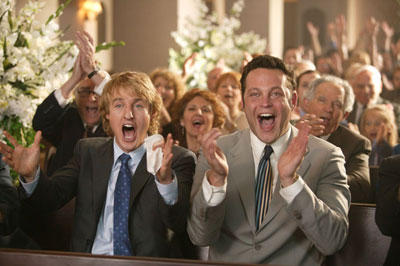
Wedding Crashers was concocted to raise a laugh and more than a few dollars rather than to provide intellectual diversion, and, on those limited terms, it succeeds remarkably well - although it could have done with a more trigger-happy hand in the editing room, especially in its extended central segment. Owen Wilson and Vince Vaughn play a pair of divorce mediators - so garrulous their clients usually reconcile to avoid the torrent of words - who entertain themselves over the summer by crashing as many weddings as they can, doing everything in their power to ensure a good time is had by all, and bedding as many women as possible (the notion that Owen Wilson has a job that requires him to wear a suit indicates the overall level of realism). At the society wedding of the year, featuring the daughter of Treasury Secretary Cleary, however, Wilson's character becomes enamored of one of the bride's sisters, who's sadly unavailable. He convinces his buddy that the two have to break the cardinal rules of wedding crashing, so that they can spend an extended weekend with the wedding party. While the comic misunderstandings are initially very amusing, the 'just one more day' rhythm becomes rather tired, and it's a relief when the action finally leaves the wealthy Cleary family's island home. Wilson and Vaughn are predictably amusing, the former further refining his unflappably stoned persona, with Vaughn's manic energy an effective foil. There's nothing very original about the hang-dog story, but the raucous humor keeps things lively.

Friday, July 01, 2005

Cléo de 5 à 7


1962, France, directed by Agnès Varda

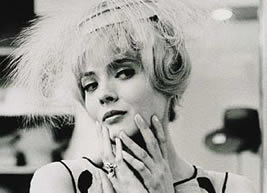
One of the quintessential movies of the nouvelle vague, this is probably also one of those films that only underlines the prejudices of those who dismiss such fare as arthouse claptrap. The set-up is breathtakingly simple: we follow Cléo, a singer with a few hits to her credit, as she wanders Paris for two hours while waiting for the results from an important medical test. She's an astonishingly busy woman, who manages to cram in a visit to a fortune-teller, a walk in the park, some shopping, a visit from her lover, a meeting with her music-men, a drink in a bar, a viewing of a short film and numerous bus and taxi rides in the time we spend with her: titles flash up telling us the length of each element of her peregrinations, and some of the encounters are almost comically short. The film is alternately infuriating and compelling, as befits Cléo's often self-indulgent whims: Michel Legrand's appearance is exceptionally amusing, while the jabbering of a taxi driver is merely distracting, and Cléo's final encounter seems out-of-character. Still, the use of Paris as a movie character has rarely been bettered: the scene in the café is a gem of Parisian street life, while viewers may find themselves trying to locate the gorgeous Hôpital Américain garden which features prominently in the closing scenes.

Index

List of all movies

Most of the images here are either studio publicity stills or screen captures I've made myself; if I've taken your image without giving you credit, please let me know.

About Me

Boston, Massachusetts, United States