Thursday, April 27, 2006

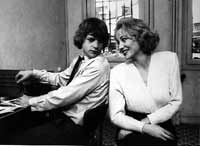
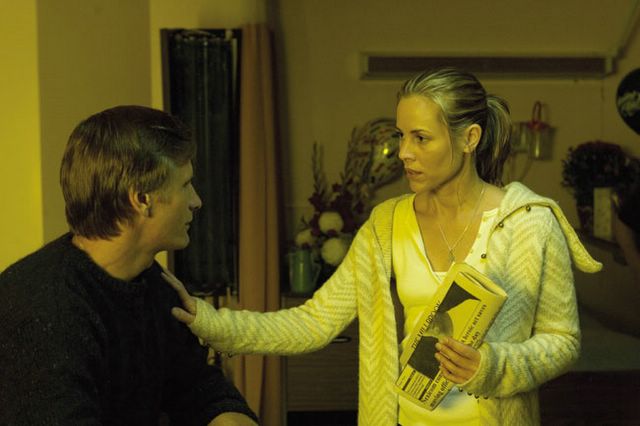
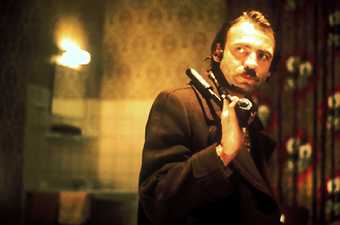
The American Friend


1977, Germany, directed by Wim Wenders (original title: Der Amerikanische Freund)

While The Talented Mr. Ripley gave Patricia Highsmith's character some mainstream cinematic exposure, European directors have had much more fun with Tom Ripley, whether in René Clément's Plein Soleil or here, in Wenders' take on the amoral but really rather entertaining anti-hero. Ripley (played by Dennis Hopper, still clearly recovering from the 1960's) isn't front and center here, though, in this tale of an ailing German picture-framer (Bruno Ganz, terrific) who is drawn into a murky netherworld when a crime boss convinces him that he is actually dying, and promises money to care for his family in exchange for a spot of murder. Ripley plays a kind of go-between, sniffing out especially vulnerable souls, and charming them into performing the most extraordinary crimes; there's a tremendous frisson every time Hopper appears on screen, and yet his Ripley remains utterly beguiling even after the knowledge of his actions. Like many of Wenders's movies, The American Friend spends much time on the move, as if the characters are constantly trying to outrun their own moral inadequacies. Wenders has fun casting his cinematic heroes in small roles (Sam Fuller, Nicholas Ray, Jean Eustache), while the DVD features one of those great 1970's-era Euro-trailers that reveals almost nothing about the movie.

Wednesday, April 26, 2006

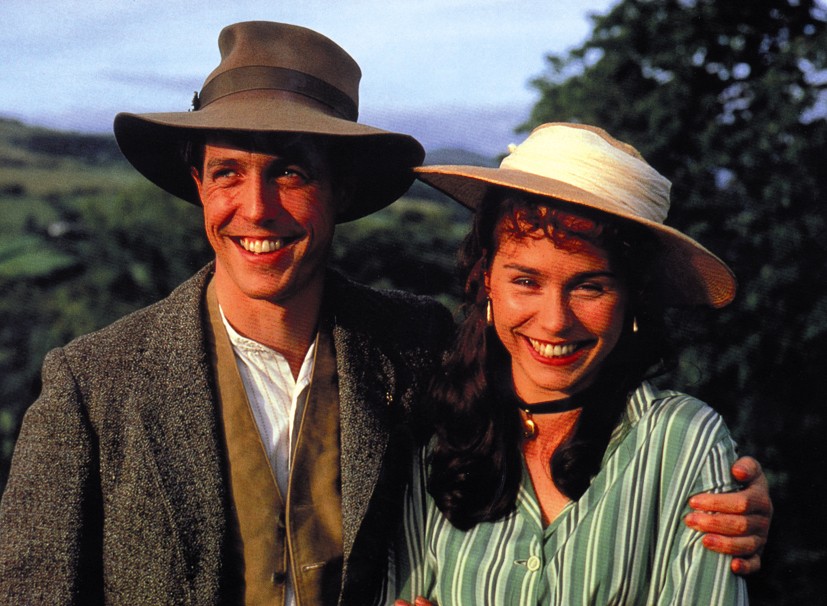
The Englishman Who Went Up a Hill But Came Down a Mountain


1995, UK, directed by Christopher Monger

Part of the post-Four Weddings wave of Hugh Grant films, Englishman is the tale (based on a true story) of a London-based surveying team dispatched to the Welsh border, where they discover that a local 'mountain' is in fact a few feet short of that designation, and is instead a humble hill - news that the locals take great exception to. With a streamlined plot (the villagers hear the bad news and implement a scheme to deal with it), the film's running time is mostly devoted to the local characters (or indeed caricatures): the randy publican; the moralizing reverend; the feisty local lass, and so forth. It's not entirely light-hearted, though, for the film takes place against the backdrop of the First World War, and most of the younger men are absent. The villagers' efforts to reclaim the mountain are with the absent soldiers very much in mind, lending a melancholic note to cut through the whimsy, while the real-life echo in the closing minutes has a surprising power.

Monday, April 24, 2006

The Proposition

2005, Australia, directed by John Hillcoat

It's pretty reductionist simply to pigeonhole The Proposition as an "Australian Western", since it adds layers of local meaning to the usual Western tropes, not least an exploration of the relationship between man and landscape that is a recurring theme in Australian cinema, whether dealing with Aboriginal or white characters. Set in the 1880's, the film tells two parallel stories, one involving a British officer (Ray Winstone) reflecting on the meaning of his job in the sweltering Queensland outback (where he and his wife - Emily Watson - attempt to preserve some measure of civility) and the other centered on two outlaw brothers, player by Guy Pearce and Danny Huston. 

Huston's character is an out-and-out psychopath (quite a contrast to the more insidiously nasty character he played in The Constant Gardener), whose brutality is depicted unflinchingly, as befits a film determined to cast aside any romantic notions of frontier life (most of the actors look absolutely filthy throughout the film). Director Hillcoat expertly cuts between the two stories, relieving the thuggery with cool interludes in the Winstone-Watson home (Watson looks as though she's about to float away most of the time), while effectively raising the tension as we move towards an inevitable final confrontation. The performances are very strong: Pearce is elemental underneath the layers of grime, while Winstone is simply outstanding, conveying a moving sense of his character's innate decency and moral dilemmas. Although Nick Cave's script is pared down to the point of mythology, his dissection of the wilder fringes of the colonial era in Australia rings true; the use of old photos over the credits underlines the sense of realism.

Sunday, April 23, 2006

Brief Encounter


1945, United Kingdom, directed by David Lean

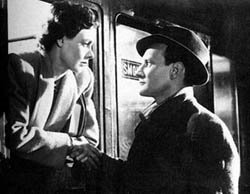
Although much beloved, particularly in England, Brief Encounter is rather wearing 60 years on. A stagy account of a short affair between two married people, it all seems astonishingly passionless. For all the frantic devotions of love, there's little sense of real physical attraction: it's the least appealing side of British stuff upper lip mythology. While there's something appealingly ordinary about Trevor Howard and Celia Johnson, their characters rarely create the sparks that a tale like this requires, while the supporting cast, mostly colourful English 'types', is often quite distracting. The film came out just months after the end of the Second World War, and yet there's little, here, to celebrate about the English way of life; that war, too, is completely, and oddly, absent from any of the conversations around which the film is centered.

Saturday, April 22, 2006

Infamy


2005, US, directed by Doug Pray

While it's nothing special as a contribution to the documentary format - given the subject matter, it's aesthetically disappointing - Infamy does feature some highly entertaining, eloquent graffiti artists and select examples of their work (on walls, railway cars and more or less every urban surface imaginable). It's hard to know how representative these particular artists are of the wider tagging/graffiti milieu - some of them are clearly at the top of the game artistically (like Saber, based in California), while all are effective commentators on their work and motivations - but there's no doubting their (sometimes misguided) devotion to their work. While artists like Saber or Toomer focus on murals - some of them tours de force of skill and impact - others, particularly Earsnot and Claw, seem to have an obsession with self-publicity, writing their names on everything they see like so much visual litter (Claw, too, gives off the impression of a middle-class girl nursing an obsession with the streets). Whatever you think of them, though, director Doug Pray has found some fascinating raconteurs, often witty and occasionally, unexpectedly wise.

Thursday, April 20, 2006

Flightplan


2005, US, directed by Robert Schwentke

Flightplan starts out as a surprisingly spooky, consciously Hitchcockian movie, only to end up as something far more conventional. It's disappointing, really, that script-writers almost never think beyond the obvious resolution: there's an intriguing idea buried in this film, and it's sustained for two-thirds of the film (to its credit, Flightplan doesn't overstay its welcome, with a lean 86-minute running time). Jodie Foster is quite effective as a woman who's just been widowed, and who is travelling back to the US from Germany in the company of her young daughter (one of the spookier moppets to appear on screen of late); she also just happens to be an airplane engineer who helped design the plane she's traveling on. When she falls asleep, her daughter disappears, and the crew and other passengers give the impression that they've never seen the child on board (her name doesn't even appear on the manifest). Foster doesn't tend to play characters who give up easily, though, and she doesn't go quietly here. In support, Peter Sarsgaard has a rather thin role, but Sean Bean is excellent as the captain, while there's a vein of post-9/11 social commentary that's, thankfully, laid on reasonably lightly.
Saturday, April 15, 2006

Return to Me


2000, US, directed by Bonnie Hunt

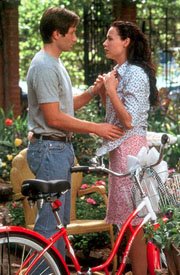
Since the average romantic comedy is chock-full of coincidence and contrivance, it's critical that two things go right: one, make the lead couple appealing, and two, throw in some entertaining supporting characters. Return to Me does both, and the result is a generally charming film, which does a half-decent job of dealing with the more morbid aspects of its initial set-up. Building designer Bob Rueland (David Duchovny) is devastated when his zoologist wife is killed in a traffic accident. It's not until he meets Grace (Minnie Driver) that he begins to take an interest in life again, but Grace just happens to be enjoying her own new lease on life since she received a new heart from Bob's wife. There's no denying the hokey premise, but the performers are so enjoyable to watch that it really doesn't matter. Duchovny and Driver are perfectly serviceable in the lead roles, and the rest of the cast is tremendous. Usually there are two or three key supporting acts, but here there's an entire Greek chorus, with the grumpy old men (including Grace's grandad, played by Carroll O'Connor) especially amusing.

Friday, April 14, 2006

Man on Fire


2005, US, directed by Tony Scott

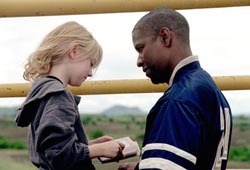
A fearsome revenge flick, Man on Fire is a little like Death Wish for the new millennium, with Denzel Washington as a bloody righter of wrongs. He plays Creasy, a washed-up ex-military security professional whose love affair with the bottle has affected his employment prospects. Down in Mexico, an old friend (Christopher Walken enjoying the good life) sets him up with a job as a bodyguard for the daughter of a young businessman. The daughter, Pita, is played by the precocious Dakota Fanning, who steals pretty much the entire movie despite the presence of Washington, some exceedingly overwrought camerawork, and an arsenal of high-powered weaponry. After a tranquil set-up during which we wonder if Creasy might finally have found peace, Pita is, inevitably, kidnapped and Creasy goes on the rampage to ensure that everyone associated with her abduction pays an appropriately gruesome price, sowing havoc on the streets of Mexico City. The film motors along swiftly enough, particularly once the gunplay starts, but the attempts to portray Creasy as some kind of noble samurai are less than convincing. Washington doesn't do a whole lot apart from looking tired; the noise and chaos around him are, indeed, quite wearing.

Thursday, April 13, 2006

On a Clear Day


2004, UK, directed by Gaby Dellal

An enjoyable entry in that peculiarly British genre that mixes kitchen-sink realism with whimsy, On a Clear Day is a modest film set in working-class Glasgow, with a fine lead performance from Peter Mullan. He plays Frank Redmond, who's been made redundant from his shipyard job after a foreign takeover. Like many a unemployed man (or woman) before him, Frank is lost until he hits on the unlikely plan of swimming the English channel - a plan that he assiduously conceals from his wife (played by Brenda Blethyn) and family. The swim is not simply a means to filling in the days, however, for it's also Frank's awkward way of coming to terms with a long-ago family tragedy and with his own communication problems (Peter Mullan spends much of the film looking silently into the middle distance). While the swim is ultimately loaded with a bit too much psychological meaning to be entirely convincing, there's tremendous pleasure along the way from the able cast: Mullan is surrounded by a host of semi-familiar faces, with Billy Boyd (one of the hobbits from The Lord of the Rings), Sean McGinley and Benedict Wong especially enjoyable as several of Frank's pals. There's something appealingly Rocky-esque about the whole enterprise - but give me a thick Scottish accent over the incomprehensible Stallone any day.

Sunday, April 09, 2006

North Country


2005, US, directed by Niki Caro

Notwithstanding a strong echo of the 1983 film Silkwood, North Country is an engrossing, well-acted account of one woman's wrenching battle against a big company - in this case a mine in rural Minnesota where women are a rarity on the workforce; those few women are subjected to the most extreme of sexual harassment on a daily basis. Charlize Theron plays Josey Aimes, whose response to the catalog of harassment is, ultimately, to file a lawsuit (which becomes a class action). The film is a loose fictionalization of a case that took over a decade to settle (and whose origins go back to the mid-1970's), and it's a powerful indictment of an especially egregious environment of harassment, although the legal decision helped women in thousands of less openly hostile places of employment. Theron does excellent work in the lead role; she's as convincing here as she was in the even lower-rent role that won her an Oscar in Monster, while getting to play someone a whole lot more sympathetic. As is so often the case in depictions of rural America, the supporting cast is outstanding, with great smaller turns from Frances McDormand and Richard Jenkins in particular. New Zealand director Niki Caro shows herself to have a keen sense of the particularities of this slice of American life, too, even though it's a less obviously personal film than her compelling Whale Rider.

Tuesday, April 04, 2006

Bewitched


2005, US, directed by Nora Ephron

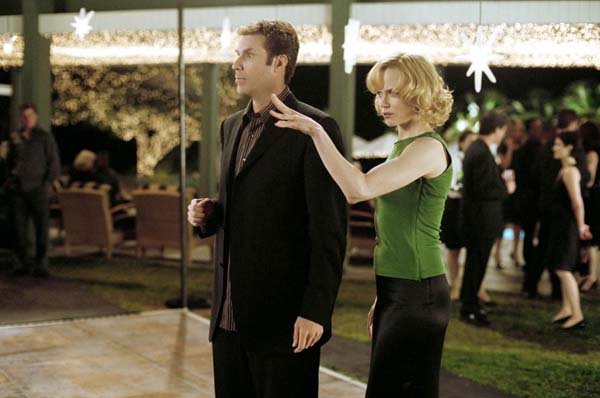
I normally have plenty of time for Jonathan Rosenbaum, the movie critic for The Chicago Reader, though his approach to movies is a whole lot more intellectual than mine. He must have been on crack, though, when writing his review of Bewitched. Rosenbaum opines that director Nora Ephron handles her material "with grace and confidence", whereas I hard a time telling that there was a director involved at all. There's a good idea in here - instead of a straight retread of the show, the plot revolves around the cast of a Bewitched remake - but the resulting script is nowhere near funny enough, the romantic spark between the leads is entirely absent, Will Ferrell is plain annoying, and Nicole Kidman is miscast. The supporting cast does the heavy lifting - Hollywood is blessed with an abundance of acting talent to fill in the gaps - so most of the (minimal) fun to be had comes from Michael Caine, Shirley MacLaine and Jason Schwartzman.

Tuesday, March 28, 2006

In & Out


1997, US, directed by Frank Oz

Kevin Kline plays beloved small-town English teacher Howard Brackett who, just three days before his wedding, finds himself outed on national TV by a former student making his Oscar acceptance speech. Howard's life is, of course, turned upside-down by this 'revelation', as he and everyone else in town tries to figure out whether he is, in fact, gay - and whether it even matters to them (with the exception of his fiancée, for whom it matters more than most). Kline is thoroughly entertaining, all awkward gestures and confusion, while the script sparkles at times (especially in the scenes featuring Howard's students and at his bachelor party, where arguments break out over the Barbra Streisand movies Howard has been showing). The supporting cast, too, is generally strong - although Joan Cusack, as the fiancée, is wearing. As my wife said , though, it's remarkable, given the set up, how completely sexless the story is. In some ways, it's as though the film completely misses the point by avoiding anything remotely sexual - and yet in other ways, that's exactly the point, that it doesn't really matter what someone does, as long as they attempt to be a decent human being.

Friday, March 03, 2006

Domino


2005, US, directed by Tony Scott

While it's not exactly original -- the structure, if not the hyper-kinetic visual style, owes much to Quentin Tarantino -- I'm still surprised that Domino wasn't a bigger box-office hit given the sheer amount of energy with which Domino Harvey's story is (fictionally) told. The movie never, ever slows down (which is lucky, because the details of the central crime spree are well-nigh incomprehensible), Keira Knightley is appealingly and convincingly spunky, and there's a liberal dose of humor, particularly at the expense of two Beverly Hills, 90210 cast members. 


Tony Scott's color scheme and frenzied editing are a bit of a trip at times, but that's the whole point of conveying the lives of three bounty hunters hopped up on adrenaline and nicotine, bending and breaking the law at every turn. The characters at the heart of the movie might be complete moral basket cases, but they sure look like they're having fun, and it's nice to see Mickey Rourke get his teeth into a role again.

Sunday, February 26, 2006

Gandhi


1982, UK, directed by Richard Attenborough

Gandhi is a respectful but unadventurous bit of historical filmmaking, which nonetheless created quite a stir when it was first released. Today it's perhaps most enjoyable for its outstanding central performance, a star-making turn by Ben Kingsley. It's still hard to credit how inexperienced he was when Gandhi went into production (while the film may be lacking as historical commentary, there's no faulting the scale of the enterprise). The real flaw here is how schematic the life of Gandhi becomes in the hands of a stolid director like Richard Attenborough. We lurch from incident to incident with little of the imaginative input a more creative director might have employed. There's an unavoidable element of repetition, too, since the political activism of Gandhi's South African years is reiterated, in more resonant fashion, after his return to India. That said, the film does become more involving as the minutes tick by, mostly by virtue of India's fascinating and tumultuous history. The highly credible transformation of Kingsley from vigorous young lawyer to frail elder statesman helps hugely, while fans of British or Indian actors will have a field day name-checking the supporting cast.

Wednesday, February 22, 2006

Fast Times At Ridgemont High


1982, US, directed by Amy Heckerling

A high school classic, Fast Times at Ridgemont High has no plot to speak of: it's just a collection of vignettes capturing life in a Southern California high school in the early 1980's, before the ubiquity of computers, cell phones, MTV and, on the darker side, the spectre of AIDS. Fast Times reveals that teenagers Like Cars! Have Sex! and Do Drugs! It seems a little quaint after years of media obsession with school violence and hard drug use in the intervening period, but what ensures that the film continues to work is the performances - including that of the casting director, who unearthed an extraordinary variety of young actors on the verge of success: Sean Penn, Jennifer Jason Leigh, Judge Reinhold, Phoebe Cates, Eric Stoltz, Forest Whitaker and, in the blink-and-you'll-miss-'em department, Anthony Edwards and Nicolas Cage (under the name Nicolas Coppola). Most of the talent does a good job with the various high school types, but the undoubted standout is Sean Penn as stoner Spicoli. He's hilarious and endearing - so good that you wonder at the almost complete lack of comic fare in his subsequent resume.

Wednesday, February 15, 2006

Just Like Heaven


2005, US, directed by Mark Waters

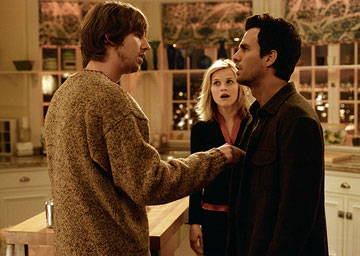
Like any romantic comedy, Just Like Heaven lives or dies on the appeal of its lead actors, and fortunately Reese Witherspoon and Mark Ruffalo have charm to spare. Witherspoon plays Dr Elizabeth Lawrence, a dedicated pro with no time for a private life who is involved in a terrible accident. Months later, dreamy but depressed Mark Ruffalo moves in to her apartment, only to find that the place is haunted by the spirit of the previous resident. As he showed in 13 Going On 30, Ruffalo is extremely adept at the kind of comic tomfoolery required in a situation like this. He's especially amusing when the spirit of the good doctor enters his body to try and reassert some control. Of course, notwithstanding the boundaries between the real and spirit worlds, sparks fly in all senses, although the film steers clear of anything morbid. While Witherspoon and Ruffalo alone are great value, there are also some enjoyable supporting turns, especially from Jon Napoleon Dynamite Heder, who's very amusing as an occult bookstore employee.

Tsotsi

2005, South Africa/UK, directed by Gavin Hood

Tsotsi travels some well-worn ground in presenting the tale of a hoodlum who is given a chance at redemption, but the setting and the performances elevate the film well above the average. 'Tsotsi' means 'gangster' in South African street slang, and the title character, played by newcomer Presley Chweneyagae, comes across as an especially nasty piece of work. Living in Soweto, his life is a fitful mess of drinking and criminality, including murder. Tsotsi's shot at changing his life comes when he carjacks a woman who is trying to get into her high-security home. He escapes with the car, and, as he discovers moments later, a small baby on the back seat. He takes the child in, making ham-fisted attempts to care for the baby before he enlists - at gunpoint - a local mother to assist him. While the story has all the hallmarks of sentiment, the film makes no attempt to gloss over the unpleasant realities of life in Soweto and the final scene, as a consequence, has a tremendous power, in which the relative nature of redemption becomes absolutely clear. Chweneyagae delivers a performance of great conviction, as do most of the Soweto crew, conveying the continued hopelessness of the vast black underclass in the new South Africa (the novel on which the film is based, incidentally, was set in apartheid-era South Africa, and Tsotsi escaped with a white woman's child; here the baby is a product of the black upper-middle class, and the only white face in the film is a sympathetic, Zulu-speaking cop).

Monday, February 13, 2006

Crash

2005, US, directed by Paul Haggis

Rating: **

The title of this film is unusually apt: every encounter in seems to have a self-conscious rawness and a violence that mirrors the jarring effects of the various auto incidents that punctuate the action. Writer-director Haggis uses his large cast to explore race relations in contemporary Los Angeles, and the results aren't pretty. At its heart, the film argues that there's a little of the racist in all of us - black, white, Chinese, Iranian, Hispanic - and tries to upset expectations with interweaving storylines that bring the different races together in varying combinations. The stories are uneven and sometimes less than convincing, with Haggis's wordy script coming across as rather stilted, while the overall impression is of something very contrived. It's hard, too, to know whether, in voicing some thoughts usually kept well-concealed, the film really says a whole lot that's new about the problem of race in the US; Haggis certainly seems to think so, but that's not quite the same thing. The film's real resource is its exceptional cast, ranging from the ever-reliable Don Cheadle to Ludacris to Matt Dillon (excellent), Terrence Howard and Sandra Bullock, playing an especially obnoxious Angelena.

Saturday, February 04, 2006

Charlie and the Chocolate Factory


2005, US, directed by Tim Burton

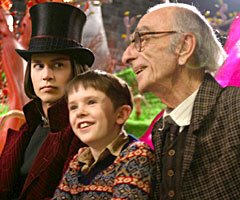
It's hardly original to note that Tim Burton seems more at ease with set design than human emotions, but it's no less true in this film. What's especially striking here is the fact that he doesn't seem incapable of telling an interesting human story. The early scenes, depicting life in the Bucket household before Charlie (played by the precocious Freddie Highmore) finds the Golden Ticket which guarantees him a day in Willy Wonka's factory, are surprisingly warm and tender. Charlie is the least remarkable of the five children who win the chance to visit the factory, but because the others are remarkable entirely in a negative sense the outcome of the tale is hardly in doubt. Roald Dahl's narrative creates great potential for wild and extravagant visuals, and Burton indulges himself as much as any Wonka-bar lover. At times the visuals are genuinely bewitching - especially in the musical sequences - but sometimes they seem like poor copies of the imaginative backdrops for the 1971 film version. As Willy Wonka himself, Johnny Depp is plain weird, even in the context of a surreal fairy tale. By contrast, Freddie Highmore does a creditable job, and it's fun to see veteran Irish actor David Kelly getting some decent screen time as Charlie's grandad.

Monday, January 30, 2006

Syriana


2005, US, directed by Stephen Gaghan

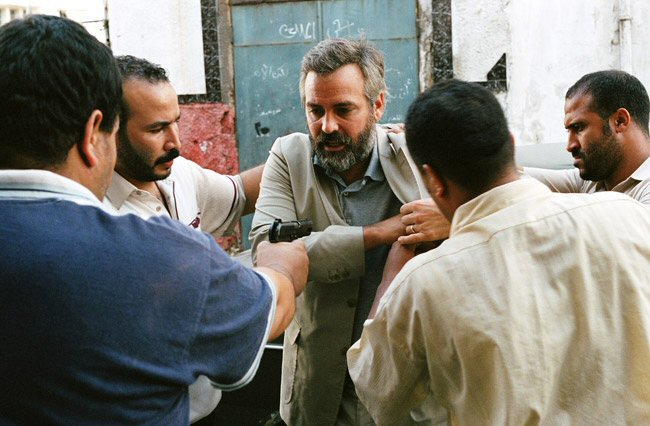
There's not a lot to send you home smiling after a viewing of Syriana, irrespective of your politics. It's hard, though, to dispute the central thesis that the vast sums of money to be made in the oil business create great temptations to bend the rules (not a highly original thought, of course). The focus of this film is squarely on the Middle East, and there are multiple storylines, interweaving boardroom shenanigans with the schemes of Saudi princes, as well as the realities, on the ground, for Middle Eastern oil workers. For good measure, there's a CIA plotline, too, with assassinations and under-the-counter arms sales. If all this sounds like Traffic with oil instead of drugs, it's no accident. Stephen Gaghan scripted that earlier film, too, and clearly picked up a few directorial pointers from Steven Soderbergh. At times, it's clear that Gaghan has bitten off more than he can chew: at least one of the plotlines could profitably have been dropped. It's refreshing, nonetheless, to see a mainstream film grappling with big issues and avoiding happy endings (the film also makes excellent use of its location footage). There are several standouts in the large cast, including Chris Cooper, Jeffrey Wright, and George Clooney. The latter's willingness to look bad on camera, particularly in a truly brutal scene of violence, is part of a convincing attempt to chronicle the impact of an especially dirty war on one individual.

Sunday, January 29, 2006

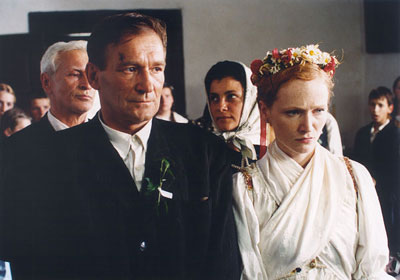
Želary


2003, Czech Republic/Slovakia/Austria, directed by Ondrej Trojan

Although it frequently flirts with predictability in its plotting, there's much to be enjoyed in this portrait of rural Czechoslvakia during World War II: there's a kind of well-worn charm that goes down very easily, belying the film's two-and-a-half-hour running time. The film opens in 1943 Prague, where medical student Eliska (Anna Geislerová) is involved in resistance activities. When her network is discovered she is ordered to depart for the countryside, in the company of a mill worker, Joza (György Cserhalmi), who lives in the middle of nowhere. Eliska is told that she must marry him in order to remain above suspicion (she's also changed her name to Hana) - as well as to be accepted by the villagers of Želary. She, of course, has no affection whatsoever for this burly stranger. The two fine central performances add considerable depth to what might otherwise be a rather thin affair, at least in its early stages, while director Trojan has an undeniable feel for the rhythms and intersecting personalities of the village. The camerawork throughout is excellent, with the gorgeous rural locations cast in the handsomest of lights. Incidentally, Želary seems to be the latest in a series of films (the best known, though not necessarily the best, being Dark Blue World) in which Czechs examine - or re-examine - their country's role in World War II; it's genuinely interesting to see how the country is portrayed onscreen against the wartime backdrop.

Saturday, January 21, 2006

Munich


2005, US, directed by Steven Spielberg

As a piece of filmmaking, Munich is technically extraordinary. That Spielberg began filming in June 2005 and had a completed film of this level of accomplishment on movie screens by December is nothing short of astonishing; it speaks volumes for his ability to envision completed scenes prior to rolling the cameras. As a genre film - steeped in the methods and moral ambiguities of ultra-secret services and spies - it's top-notch, with crescendoes of tension and a fine portrait of the intelligence netherworld. However, as a commentary on the events and aftermath of Munich - and on terrorism more generally - the report card is, perhaps inevitably, more mixed. While Spielberg re-creates the events of the Munich Olympics in often brutal detail, the bulk of the film follows a secret Israeli revenge team, assigned to kill eleven Palestinian representatives scattered across Europe. Eric Bana plays Avner, the leader of the team, and through him we see the physical and psychological toll the work takes on the men. It's reductionist to see the film exclusively in terms of the Israeli-Palestinian conflict, for Spielberg clearly aspires to a more universal resonance, a commentary not just on the Middle East, but on the manner in which values of civilization and humanity are compromised through the pursuit of vengeance. It's hardly an original theme - an eye for an eye leaving everyone blind - but there's a real power to the depiction of the growing moral mess in which Avner finds himself implicated. Even with its imperfections, and lingering questions over the actual historical existence of the revenge squads, Munich remains a thoughtful piece of work, one of Spielberg's most intelligent films (while unparalleled as a showman he's often undervalued as a thinker). It also boasts a series of excellent performances, most notably from Eric Bana, who is outstanding, as well as from the Israeli actress Ayelet Zorer as Avner's wife, Daphna.

Monday, January 16, 2006

Infernal Affairs III


2003, Hong Kong, directed by Andrew Lau and Alan Mak

A disappointing conclusion to the Infernal Affairs trilogy: the drop-off from the creditable second installment is precipitous despite the return of the key actors from the first film. The taut action scenes and narrative economy are replaced here by an interminable series of scenes designed to add 'surprises' to the original plot, with some of the developments just plain confusing, even by the standards of this complex series. The greater sins, however, are the insistence on punctuating what minimal tension is created by constantly cutting between plots (skipping months and even years in the process), as well as leaving outstanding supporting players like Anthony Wong and Eric Tsang with so little to do this time around. The slick style of the picture outweighs the much more acute sense of the bustle and drama of Hong Kong that was such an integral part of the first two movies.

Sunday, January 15, 2006

Match Point


2005, UK, directed by Woody Allen

Woody Allen removes himself from New York and delivers his best film in a decade. It's also one of his least 'Woody Allen' films, playing like a thriller and although it's still wordy, Allen wastes no time in plunging the audience straight to the heart of the action. Chris Wilton, an Irish tennis pro (Jonathan Rhys-Meyers), befriends upper-class Brit Tom Hewett (Matthew Goode), and is drawn into a life of opportunity and luxury. When Chris becomes involved with Tom's sister Chloe, the paterfamilias (Brian Cox) opens professional doors, and before you know it, Chris has a lucrative role in the family business. However, Chris also involves himself with Tom's fiancée, a struggling American actress (Scarlett Johansson at her most breathy), and complications ensue as Chris tries to balance his passions - for women, wealth and status. While the twists and turns of the plot are satisfyingly labyrinthine, the character of Chris Wilton isn't fully convincing. There's no explanation for the choices he makes (at least Tom Ripley is consistently sociopathic), and Rhys-Meyers isn't given a whole lot to do apart from looking alternately pretty and tortured. That said, watching the dissection of the foibles of the British upper class is always enjoyable - they're not, in the end, a million miles from the kind of wealthy New York types more familiar in Allen's films.

Saturday, January 07, 2006

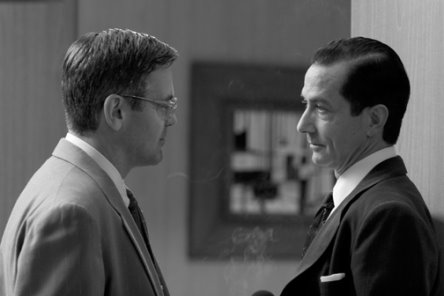
Good Night, and Good Luck


2005, US, directed by George Clooney

Good Night, and Good Luck is a fine chamber piece, tightly focused on a specific aspect of the McCarthy era, namely the efforts of Edward R. Murrow (superbly played by David Strathairn) and his production team to cast the Communist witch-hunts of "the junior senator from Wisconsin's" in the harshest of lights. Murrow - through his CBS show See It Now - took McCarthy on towards the end of his reign, although at a time when the senator still retained his ability to smear reputations with no regard for the facts. The film, like Murrow's show, uses McCarthy to hang himself, choosing his more outré on-camera moments to maximize the unsympathetic portrait of this least sympathetic of American politicians (McCarthy's clear discomfort in front of the camera also helped to change, perhaps less positively, the rules for future elected representatives, with telegenic qualities often overriding experience). Clooney very successfully re-creates the sense of alarm so skilfully manipulated by McCarthy for a time - with a clear nod to contemporary American politics - as well as the claustrophobic atmosphere of the television studio (there are brief hints of unseen domesticity, while CBS founder William Paley is seen wandering into the empty studio late at night, as if he has no other life). The carefully re-created debates on how to approach the explosive McCarthy issue recall the smoky White House deliberations of Cuban-missile drama Thirteen Days; both films also boast fine ensemble casts. There's not an ounce of fat in the film, which makes its editorial points with considerable skill without ever overstaying its welcome, while the smooth black and white photography gives a surprising immediacy to the skilful 1950's re-creation.

Sunday, January 01, 2006

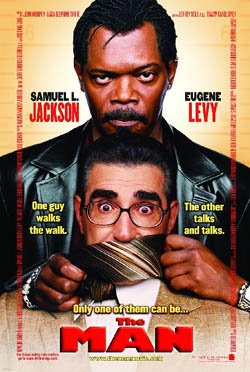
The Man


2005, US, directed by Les Mayfield

I have lots of time for Samuel L. Jackson, but you have to wonder about the state of his finances when he pops up in movies like this, which re-cycles old ideas for the hundredth time. Then again, the plot is entirely subsidiary to the chemistry between out-of-town dental technology salesman Andy Fiddler (Eugene Levy) and street-smart Detroit ATF agent Derrick Vann (Jackson), whose paths cross in unlikely fashion when Levy is mistaken for a gun buyer during the course of a sting. Vann more or less abducts Fiddler as he attempts to sort out the mess, which is further complicated by Fiddler's tendency to never keep his mouth shut for more than a second or two. We're seen it all before: it's both the blessing and the curse of Hollywood that even fare such as this passes the time (at least while trapped on a plane) quite capably, while actors of the caliber of Jackson and Levy can't fail to raise occasional laughs, even with weak material. Neither is acting outside his comfort zone, but they do this kind of shtick so well that the often incoherent plot doesn't really matter.

Thursday, December 29, 2005

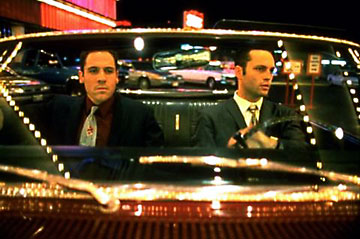
Swingers


1996, US, directed by Doug Liman

Nearly ten years on, Swingers remains remarkably fresh for a film that seemed to be very much of the male-bonding zeitgeist, a mixture of terminally hip rat-pack posturing and distinctly uncool relationship angst, mostly from the perspective of Mikey (Jon Favreau, who also wrote the script), who straddles the uncomfortable border between depression and obsession six months after a break-up with his long-time girlfriend. He's a recent arrival in Los Angeles, plumbing the lower depths of the comedy business, in the company of fellow East Coast transplant Rob (Ron Livingston) and budding producer/self-styled player Trent (Vince Vaughn, who seemed poised for instant stardom after this film, rather than the half-decade of wheel-spinning that followed), among other hangers-on. It's not surprising that Mike's rise to the top is less than meteoric: his daily routine alternates between bouts of self-pity and nights on the town chasing down the hippest spots. Favreau's script skewers male vanities and self-deceptions remarkably well (although Mike's more irrational tendencies are mildly alarming), while Vaughn, in particular, makes excellent use of some memorable lines: 'You're so money and you don't even know it!' It's fun, too, to see the film send up other indie hits like Reservoir Dogs with both affection and purpose, while there's a sort of bitter-sweet affection for Los Angeles that surely springs from the writer's own experiences on the fringes of 'The Business'.

Friday, December 23, 2005

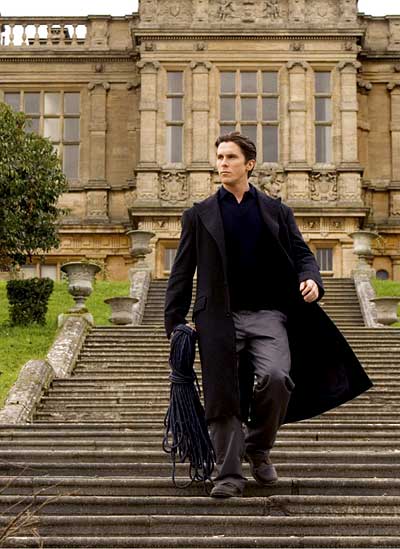
Batman Begins

2005, US, directed by Christopher Nolan

Proof that it is possible to make an intelligent movie about a comic book hero: the key to the franchise renaissance is the surprising emphasis on relative realism. Batman Begins carefully grounds the powers of its hero in a reasonably credible version of the world, rather than ascribing them to more standard science fiction sources, as in, for instance, the recent Spiderman movies. In narrating Batman's rise from the troubled psyche of the rich, rudderless Bruce Wayne, director Nolan also has some genre-blending fun: Wayne's physical skills are learned in a kind of shaolin temple, with all the ninja-kicking action that implies, while his accoutrements mostly come from the secret labs of a trusted employee of his dead father, one Lucius Fox (Morgan Freeman having a lucrative good time), a clone of James Bond's good friend Q if ever there was one.

Nolan develops an aesthetic entirely different from that invented by Tim Burton for the 1989 film that set the series in motion: this new Gotham drips with menace and thwarted potential, with no hint of (deliberate) camp. It's a dystopia more like that of a film like Seven than the average comic book backdrop, and it's that sense of very real threat that gives the film much of its bite. The film is also anchored firmly in the post-9/11 world: the central villain is motivated by belief rather than by the more traditional dreams of vast wealth or untrammelled power; it's rather bracing to be confronted by such themes in the context of a film like this. Batman/Bruce Wayne is played with great conviction by Christian Bale but there are also several excellent supporting turns, not least from Michael Caine, who does much with the part of the Wayne family's beloved butler.

Tuesday, December 20, 2005

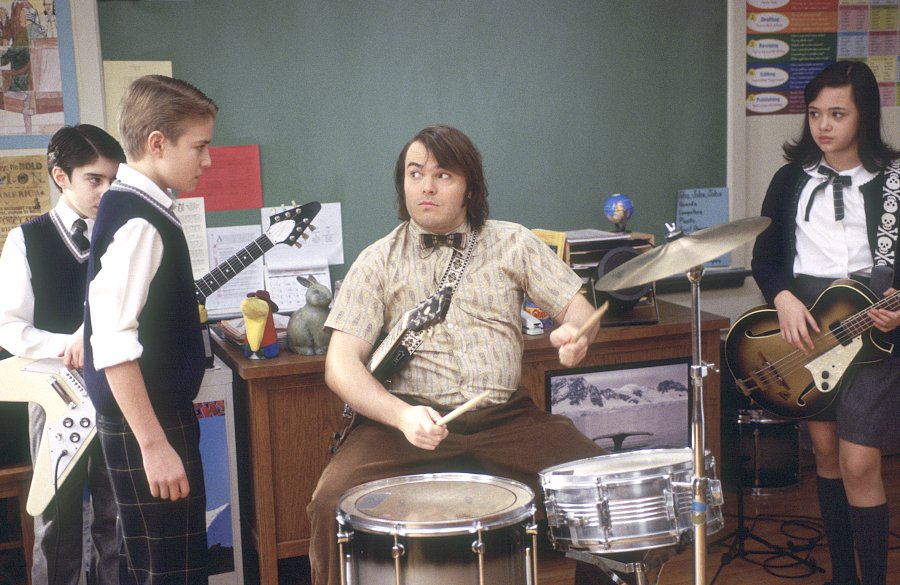
The School of Rock


2003, US, directed by Richard Linklater

The School of Rock was conceived as a vehicle for Jack Black, and it works well, channelling his energies to highly entertaining effect. He plays Dewey Finn, a musician perpetually on the verge of abject failure, whose desperate need for rent money impels him to pose as his roommate when the phone rings with a job offer at a prestigious local academy (realism is not high on the agenda). The children in the academy are suffering under the weight of rules, parental expectations, and classical music classes, and the free-spirited Dewey is convinced that they can release their true selves through rock and roll, and sets up a secretive class project, 'Rock Band'. The storyline is patently absurb, of course, but Black's exuberant performance and the excellent ensemble of youthful actors (all talented musicians) drives the film; the often very witty script helps, too. Director Richard Linklater must take much credit for reining in Black's wildest tendencies (ensuring that Dewey Finn stays on the right side of obnoxious), and for coaxing a string of likeable turns from the younger generation, who had little to no experience before the camera. Part of me can't help thinking it's a shame to see one more independent cinematic mind co-opted by the studio system, but at least The School of Rock has more vigor, and considerably more charm, than most Hollywood pap.

Sunday, December 18, 2005

Infernal Affairs II


2003, Hong Kong, Andrew Lau and Alan Mak

While Hong Kong films are best known for their gunplay, this one engages the brain, too, if only to keep track of the serpentine plot developments. A worthy prequel to the 2002 smash hit, the second part fills in much of the background, adding layers of intrigue as we navigate the years from 1991-1997 (and the impending handover to Chinese control). The film interweaves the experiences of Yan, a police mole in the triads, with those of Lau, a gang member who has infiltrated the police, and who has begun to work his way up the ladder. There are multiple cross-cutting plotlines and revelations, shedding new light on the events of the first film, although it can be quite a challenge to keep the various characters straight, particularly given the 'double mole' plot at the heart of the film. The young actors who play the youthful Yan and Lau do a fine job, although the real enjoyment comes from watching veterans like Anthony Wong and Eric Tsang, while several of the smaller roles, especially on the gangland side, are also well-played. While this sequel isn't quite as slick as its predecessor, co-directors Lau and Mak are absolutely at home with the mechanics of film tension, and ratchet things up to extremely enjoyable effect in several bravura sequences, with cross-cutting action as the various plot strands unfold in parallel; their camerawork is as polished and mobile as before. For a franchise film, there's also a surprisingly vivid sense of place, whether it be the homes of wealthy gangsters, or the back alleys of Hong Kong, filled with small restaurants and shops.

Friday, December 09, 2005

A Lot Like Love


2005, US, directed by Nigel Cole

An Ashton Kutcher movie that's let down by the script and not the star? While Kutcher isn't my cup of tea, despite the occasional amusing moment in That 70's Show, here he's surprisingly charming, as is co-star Amanda Peet. However, neither of them can do much with a script and a director so indulgent with the running time (which could have lost 20 minutes and subplots to spare). The two seem to have real chemistry, but the plot advances so fitfully that the character development never convinces. Set over a six-year span, the film tells the tale - with multi-year gaps - of the mostly off-again attraction between two 20-somethings, but so much of the story transpires offscreen that the abrupt changes in the characters' lives after each hiatus rarely convince. No matter the obstacles thrown their way, there's never even a hint of doubt at the outcome - with the old-school red-herring at the end visible a mile off.

Tuesday, December 06, 2005

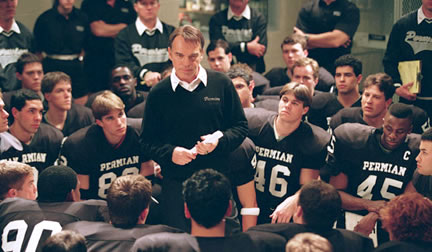
Friday Night Lights


2004, US, directed by Peter Berg

Like many sports movies, this is less about the on-field action than it is about Life, particularly since the many football plays are often compressed into rapid-fire montages, with the exception of the last game, which occupies the final quarter of the film. Life, in this case, is more particularly life in hard-scrabble Odessa, west Texas, a part of the US that takes its football very seriously indeed (the H.G. Bissinger book on which the film is based is as much social study as sporting history). As Odessa's economic fortunes have declined, the town has concentrated ever-more of its energies on the fortunes of the high school football team, with the seniors, in particular, under immense pressure from virtually everyone in town (these folks put the fan in fanatic). The film follows the real-life 1988 season, where great expectations appear to be dashed early on with the injury of a key player (played, with great verve, by Derek Luke). Since football dominates the routines of the players almost to the exclusion of all else - we never see them set foot in a classroom - it's inevitable that their life-lessons are acquired through the prism of sports. Their coach, Gary Gaines (Billy Bob Thornton, perfectly cast), is the prime adult presence in their lives, shielding them from much of the circus that surrounds them, but also imparting what wisdom he can in the pressure-cooker atmosphere. While sports movies are generally about triumph over adversity, there's a bittersweet air over everything here, a sad sense that nothing in life is ever going to have quite the same electric charge as a senior year of high school football. Director Peter Berg has an excellent eye for the details of Odessa's football obsession, and an affection for his mostly unknown cast, who acquit themselves well; his occasionally hyperactive camera is the only unwelcome distraction.

Sunday, December 04, 2005

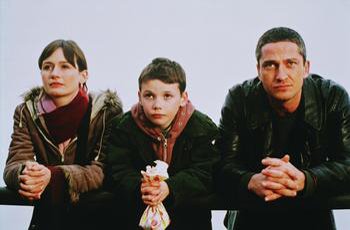
Dear Frankie


2004, United Kingdom, directed by Shona Auerbach

Dear Frankie is a sweet-natured little fable in the middle of a typically British kitchen-sink setting - in this case, working class Glasgow. Frankie is a deaf nine-year-old who lives with his mother and grandmother, and who believes that his father is a sailor on a merchant ship by the name of the Accra. He writes letters to his absent dad, and receives replies filled with exotic details and carefully-chosen stamps. The wrinkle, however, is that the letters are written by his mother, who is unwilling to share the truth, that Frankie's dad is a rotten piece of work, whom she fears. Inevitably, the real Accra eventually shows up in Glasgow and, in a panic, Frankie's mum has to hire a stranger to play the part of a father for a day. The story suffers from a few too many holes - even in the circumstances, it's hard to understand why Frankie's mum sustains the fiction for as long as she does, nor does Frankie's deafness serve much more than a symbolic purpose - but there is considerable charm in the details of Glasgow life, which appears to centre on the chipper and the pub, and in an array of fine, nuanced performances, from Emily Mortimer (as Frankie's mother), Mary Riggans (as the grandmother) and the charming Gerard Butler, as the one-day dad, to single out only the most prominent (Jack McElhone is fine as Frankie, although he mostly just has to look appealing, since he has but one line). Director Shona Auerbach keeps the film grounded enough to avoid an excess of sweetness, with an ending that, plot quibbles aside, seems true and satisfying.

Saturday, December 03, 2005

The Constant Gardener


2005, UK, directed by Fernando Meirelles

Someone clearly forgot to give Fernando Meirelles the standard movie playbook on the adventures of white folk in tropical locations, for he's crafted an arrestingly original film from John Le Carré's book; only Graham Greene provides an adequately acid precursor, particularly in the form of Phillip Noyce's 2002 version of The Quiet American. This is bang-up-to-date tale of drug-testing by Western pharmacutical companies in Kenya, with minimal regard to medical ethics. Ralph Fiennes plays Justin Quayle, a minor British diplomat in Nairobi, recently married to a vibrant young woman (Tessa, played with great commitment by Rachel Weisz), who quickly involves herself in local health politics and upsets more than a few people in the process. The film opens, more or less, with Tessa's death, in suspicious circumstances, and the remainder of the action cross-cuts scenes from her marriage (Justin and Tessa marry so quickly that their marriage is more the tale of their getting to know one another) with Justin's attempts to find out the truth about her. In the process, he displays a far more steely streak than we - or perhaps he - imagined him to possess. Unlike many films set in exotic locales, Africa is anything but a backdrop: Meirelles shoots in some of Nairobi's grittiest slums, and there's a grim, absolutely unsentimental realism to everything we see (hardly surprising from the (co?) director of City of God). Ralph Fiennes is perfectly cast as the increasingly dogged Justin, and he's surrounded by a cast of fine character actors, particularly Danny Huston, Bill Nighy and Gerard McSorley, all of whose characters have their hands dirty to varying degrees; Huston, in particular, is outstandingly unsettling. This is a rare piece of genuinely political filmmaking: deliberately unsettling, with a grimly unhappy conclusion that underlines at least some of the realities of the West's relationship with Africa.

Wednesday, November 30, 2005

Philadelphia


1993, US, directed by Jonathan Demme

It's striking that twelve years after Philadelphia was released, the notion of a perfectly ordinary man who simply happens to be gay is something that the movies still haven't come to terms with: while Andrew Beckett's (Tom Hanks) sexuality is critical to this story, in another sense the fact that he happens to have a male lover (Antonio Banderas) is portrayed as purely incidental, something that's as natural as breathing, whereas in most movies it's still framed as an 'issue'. The story is familiar: Andy Beckett is fired from his job, apparently because he is both gay and HIV positive, and the only lawyer in town who'll take on his case is Joe Miller (Denzel Washington), a former adversary and a homophobe to boot. On its own terms - major Hollywood movie tackling a genuinely emotive subject - Philadelphia does a decent job: it's simply unrealistic to expect a major studio to plunge millions of dollars into a movie like this and have the stars go to bed with each other. Soft-peddled it may have been, but it also got people talking in ways that they weren't accustomed to, and that, perhaps, is enough to expect from the entertainment industry. Tom Hanks handles his part with skill, and he makes the point, unmistakably, that one's sexuality and one's common decency are two entirely separate things (and not mutually exclusive); Denzel Washington is also solid, conveying some of the feelings of prejudice that even the most apparently open-minded among us occasionally mull over. Perhaps the most striking aspect of Philadelphia as an 'AIDS film' more than a decade on is the way in which AIDS is now a disease which is seen as an international - and especially African - public health issue, rather than simply as a 'gay plague' that carries a rapid death sentence (something that is less and less true in the West).

Saturday, November 26, 2005

Walk the Line


2005, US, directed by James Mangold

It's hardly a surprise to see this film compared to last year's Ray, what with the similarities in raw material, at least as presented onscreen: two dirt-poor southerners who have faced tragedies of one kind or another head out on their own, and break into the music business in semi-miraculous fashion. Their rise to stardom is fuelled by substance abuse and infidelity - followed by redemption and elevation to the status of national icons. That, at least, is the Hollywood version of things, although the movie format doesn't allow for much in the way of biographical nuance in two hours, even where the focus has been reduced to a fifteen-year span of Cash's life, childhood scenes apart. Given the constraints of the form, this a creditable bit of pseudo-biography, filling in the major incidents of Cash's rise to fame, especially the long flirtation, and eventual relationship, with June Carter. They first met when both were married - not something that cramped Cash's style anyway - and the film does a decent job of sketching in the emotional complexities of their relationship, without excusing them overly. In this, the film is greatly helped by its stars: Joaquin Phoenix is exceptional as Cash, inhabiting the character in convincing fashion, his face showing the wear and tear of hard living as the film progresses, while Reese Witherspoon, after years of froth, looks as though she's finally fulfilling some of the dramatic promise she showed as a teenage actress. Both actors do their own singing, imitating Cash and Carter with considerable accuracy (Jamie Foxx did a fine job of channelling Ray Charles's tics and twitches, but Phoenix and Witherspoon lend real fire to proceedings with their own energetic renditions of the greatest hits), and there's an unmistakeable chemistry between the two. It's no surprise to see Cash 'saved' from himself by the love of a good woman - Carter - but there's a twist, in that her relationship with Cash is clearly a form of redemption, too, after years of unhappiness: in many ways, this is a biopic of a couple rather than an individual, as befits the bond the two shared.

Friday, November 25, 2005

Hostage


2005, US, directed by Florent Emilio Siri

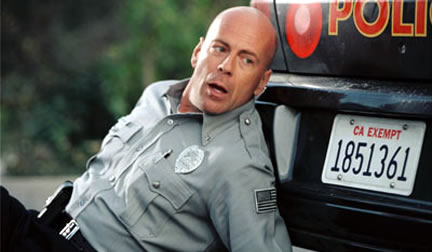
Hostage reminds me of Wes Craven's Red Eye: a B-movie set-up played with great conviction and given an injection of directorial panache for a satisfyingly twisted payoff (although the action isn't as pared-down here as it is in Red Eye). Bruce Willis - who could do this kind of thing in his sleep but instead looks as though his life depended on it - plays an LA hostage negotiator who retreats to small-town California after a standoff goes terribly awry. As any alert movie-goer knows, the calm won't last long, although Bruce's bucolic existence is punctured in especially jarring fashion: three miscreant teens (one of them a standard-issue homicidal nutcase) end up under siege in the high-security house of a wealthy, but morally bankrupt, local citizen, and the man's underworld connections (who appear to have near unlimited resources) become involved in order to recuperate an incriminating DVD. There are multiple plot strands at work here, which would be fatal in the hands of a less accomplished director, but Siri, making his US debut, ably juggles the competing storylines to ratchet up the tension, making effective use of his star, who (happily) looks as though he wandered in from the set of Die Hard. The core of the film is the siege of the house, and the multiple attempts to break in - with no regard whatsoever for standard police practice, naturally. Siri employs a highly mobile camera - prowling, swooping and swishing its way along roads, over houses and along corridors - to great effect, although the colour scheme, all ochre and orange, is a little over the top. There's a great opening credits sequence that comes as a surprise in a film like this, and which sets the scene rather effectively for the bravura tone of what's to come.

Thursday, November 24, 2005

Anchorman

2004, US, directed by Adam McKay

Rating: *.5

I may be doomed never to fully appreciate the comic talents of Will Ferrell, but it's a burden with which I can live. Ferrell was amusing in Elf, although credit should also be given to a half-decent script, but in other fare, like Wedding Crashers, he's invariably the least amusing element of the film (I'm glad no-one was tempted to give him a 'surprise' cameo in The 40-Year-Old Virgin). As writer and star of Anchorman, he should take the lion's share of the blame for the unfunny shenanigans: the first 30 minutes are flat-out painful, with cast and director apparently convinced their set-up is uproariously funny in and of itself, whereas it's really a pretty tired recycling of 70's pastiche (even the weak film version of Starsky and Hutch did it better). Like so many movies from the Saturday Night Live crew, even when individual scenes amuse the whole film barely hangs together; there are many extraneous bits that, no doubt, proved wildly amusing to the makers while constituting an endurance test for audiences. Fortunately, there are several excellent supporting performances, most notably from Fred Willard and Steve Carell, both of whom are consistently hilarious, while one or two scenes - the epic fight between competing news teams, for example - raise the humour level several notches.

Wednesday, November 16, 2005

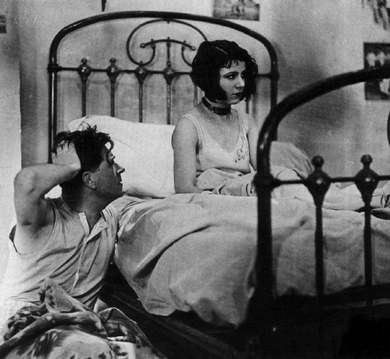
Sous les toits de Paris

1930, France, directed by René Clair


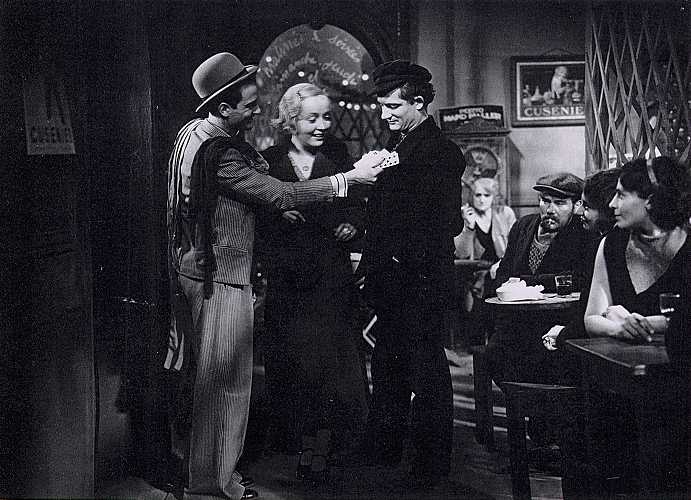
Like many films at the beginning of the 1930s, Sous les toits de Paris still has one foot firmly in the silent days, something that inevitably dates the picture for modern audiences. Many scenes, even those in which the actors are clearly speaking to each other, have a musical accompaniment alone, while the dialogue is not especially memorable (a few years later, Jacques Prévert and others would ensure that snappy dialogue became a cornerstone of French filmmaking). The performances, too, are reminiscent of silent days: the actors' movements are frequently exaggerated and wide-eyed, in contrast to the more naturalistic acting style that developed later, particularly once the possibilities of dialogue were better exploited. However, notwithstanding these limitations - which have as much to do with the modern audience perspective as with the film itself - Sous les toits de Paris retains great charm, from the elegant opening shot (filmed in a studio, and paired with a similarly graceful parting shot) which takes us down to street level, and into a crowd singing the title song, as a young man (Albert Préjean) attempts to sell sheet music. Préjean's character is, like everyone else, a creature of the streets, hard-scrabble but honest, living in an attic-room (hence the film's title), and hoping for a little cash and love. The story is very slight, and director Clair is indulgent with the running time, but there's no denying the director's affection for his characters: as poetic realism goes, he certainly errs on the side of the poetic, to mostly enjoyable effect (and the theme song will remain in your head for days afterwards).

Saturday, November 12, 2005

Osama

2003, Afghanistan/Iran/Japan, directed by Siddiq Barmak

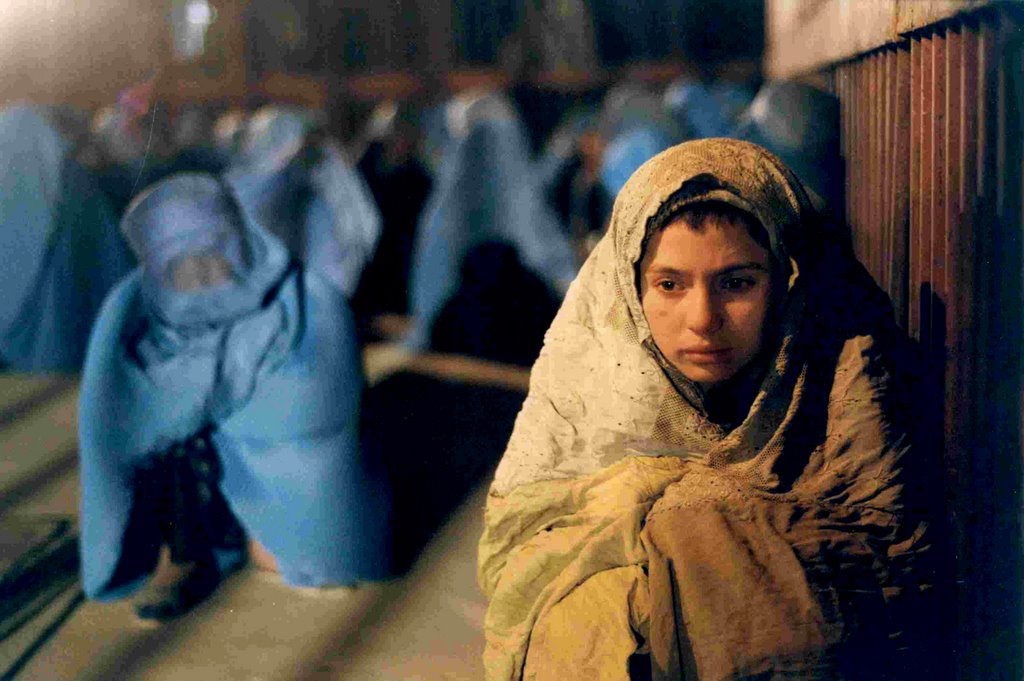
When Osama was released, most of the focus was on the simple fact that it was the first film made in Afghanistan since the fall of the Taliban (not that the pre-Taliban list of films was long; there was never a movie industry to speak of in Afghanistan, unlike in neighboring Iran or Pakistan), but it also happens to be a fine bit of filmmaking, a carefully crafted miniature of considerable power. Like several key recent films from Iran, Osama adopts a child's perspective to reveal the wider society, in this case following a young girl whose mother compels her to dress as a boy in order to gain employment (the mother, who is a medical professional, is restricted to her house under Taliban rule: as a widow, she doesn't have a man to accompany her anywhere). The decision seems a good one initially but once the girl - re-baptised Osama - is removed from her place of work by the local mullahs in order to attend a madrassa, things spiral out of control. Director Siddiq Barmak keeps the action absolutely pared down, rarely straying from the main story, yet using background detail to develop a rich portrait of an astonishingly controlled society (with women the most visibly, and most brutally, repressed victims). It's a society from which the Taliban has leached almost all of the joy, in which even small acts of childish exuberance become dangerous. The non-professional actors are, for the most part, excellent, while the visuals are accomplished, with striking images throughout - the young girl skipping in prison, or the rows of covered women, not even their eyes visible. To paraphrase a friend, Osama is one of those worthy films that also happens to be good, which shouldn't be too much to ask.

Friday, November 11, 2005

L'Atalante


1934, France, directed by Jean Vigo

Vigo's second and final film was so under-appreciated on release that the producers cut 25 minutes from the running time and gave it a new title, and it wasn't until years later, and more than a decade after his early death, that his critical reputation was born. It's ironic, then, that the passage of more years hasn't been kind to L'Atalante, which appears very dated in parts, and whose underlying slightness is ever more apparent. It's a romance, following the early wedded months of a barge captain and his new bride on the canals; the barge's wildly eccentric mate, played by Michel Simon, is a key figure in both their lives. More than most talking pictures, the link with silent days is very apparent: it's not hard to imagine the film without dialogue, particularly in the scenes between the married couple, whose acting style is as wide-eyed as in many a silent. For the most part, their story is rather routine: the film comes alive when Simon (one of the least handsome actors ever to achieve stardom) is on-screen, despite the fact that his gruff line readings are almost incomprehensible at times. His character's colourful personal history is rendered in vivid, amusing detail. While the plot is of the thinnest variety, it is nonetheless possible to discern something of what made Vigo unique in his time: there's a rawness that's the opposite of all that establishment cinema of the time stood for, and a willingness to experiment formally that inevitably impressed itself on the filmmakers of the nouvelle vague in the late 1950's. There's also a frank eroticism in several scenes that remains startling even today.

Monday, November 07, 2005

Claire's Knee

1970, France, directed by Eric Rohmer (original title: Le Genou de Claire)

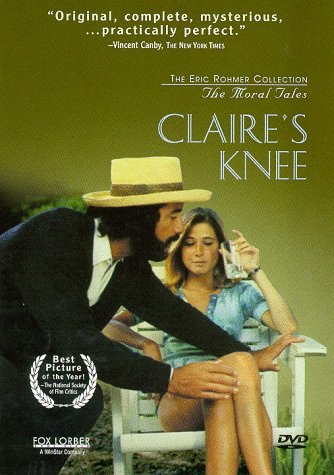
One of Rohmer's best-known films, Le Genou de Claire exemplifies in many ways both the strengths and weaknesses of his approach to filmmaking. It's an especially garrulous talk-fest - the characters do little else - which is capable of considerable insight and occasional wit, but Rohmer's films are often set in an especially insular world (like the Manhattan of Woody Allen movies), which of its nature is intellectually exclusive, while it's often difficult to suspend one's disbelief at the blatantly artificial set-up. Jean-Claude Brialy plays a diplomat spending the month prior to his marriage on holiday alone - there's a scenario drawn from reality! - and while relaxing he catches up with an old friend, perhaps a former lover, who's a novelist. He spends his days 'befriending' a teenage girl and, later, becoming somewhat infatuated with her willowy, slightly older sister. His every move is recounted for the benefit of his writer friend, who goads him to more action (something the viewer might well appreciate, since his moves consist mostly of lengthy conversations). While there are scenes when, unexpectedly, all this hangs together and becomes quite compelling, Rohmer seems remarkably tolerant of some pretty poor acting, with lines delivered as if they're being read from cue cards (which wouldn't be surprising, given the large chunks of text the characters are required to deliver). As a director, he's clearly fascinated by cinema as a narrative medium, but has relatively little interest in the purely visual aspect of storytelling: the story is reminiscent of an epistolary novel, set in a very hermetic world, where other Rohmer films are a little more expansive, and considerably more charming.

Thursday, October 27, 2005

Kitchen Stories


2003, Norway/Sweden, directed by Bent Hamer (original title: Salmer Fra Kjøkkenet)

Kitchen Stories might function as an object lesson in how to make the most of unpromising - on paper - beginnings, for it's a little gem, poignant and richly detailed, with wonderfully delicate performances and direction. The film follows participants in a 1950's study run by a Swedish institute keen to explore the kitchen habits of single Norwegian men, with the object of designing the perfectly efficient kitchen. The study takes place in a rural area, and each volunteer agrees to allow an observer to sit in his kitchen, on a comically high chair, following, and logging, the daily routine. Interaction between subject and observer is strictly forbidden. The focus is on Isak, an older farmer, and Folke, his observer, two men who, it quickly becomes apparent, are no strangers to loneliness. Isak subverts the process from the very beginning, cooking in his bedroom, and turning out the light in his kitchen to render observation impossible. Slowly, inevitably, however, a bond begins to develop between the two men: the cup of coffee that breaks the silence is almost heart-breaking, and a rich friendship evolves between two fundamentally decent human beings who have lacked the opportunity to express that decency to others. With so little dialogue in the first half of the film, there's a rich vein of visual humour on display, particularly in Isak's mischief, or the brilliant sequence when the observers, each driving a car towing a little caravan, reach the Norwegian border and are forced to switch to other side of the road, since the two countries weren't coordinated at the time. What remains most sharply in the mind, however, are the two deceptively simple lead performances, restrained yet detailed, and the unhurried direction, that allows a series of vignettes to acquire a bracing power.

Sunday, October 23, 2005

In Her Shoes


2005, US, directed by Curtis Hanson

Curtis Hanson and Ron Howard must have a bet going where they're each attempting to direct a film in every genre possible, but even with that in mind, In Her Shoes seems a surprising choice, on the surface, for the director of fare like LA Confidential or Bad Influence. It's a true chick flick - the title sequence underlines the footwear fetish - with three meaty lead performances, plenty of family drama, and more than a few laughs among the tears. Look a little closer at Hanson's record, though, and it's perhaps not so odd to see him turn in a film like this: he's helped revive more than one actress's career - think Rebecca De Mornay in The Hand That Rocked the Cradle or, especially, Kim Basinger in LA Confidential and 8 Mile - and given us unexpected turns from Meryl Streep (in The River Wild) or Katie Holmes in Wonder Boys. While the drama meanders from time to time - a reflection of the two interwoven stories that keep characters offscreen for long periods - Hanson does a fine job working with the three leads, credibly bringing Cameron Diaz from irresponsible party girl to something resembling an adult, and shepherding Toni Collette through an ugly duckling transformation. Shirley Maclaine is surprisingly restrained - her scene-stealing sidekick gets the best lines - and in the process acquires an appropriately grandmotherly dignity. It's not Hanson's most distinctive work, but it's generally well-crafted stuff, with relatably flawed characters and more than a little charm around its rough edges.

Saturday, October 22, 2005

The Twilight Samurai


2002, Japan, directed by Yoji Yamada

Yoji Yamada has directed almost seventy films over the past 40 years - the kind of work ethic that puts even Woody Allen to shame - but only a handful of his movies are known outside Japan. Most of his professional career was spent on the 48 movies in the Tora-San series, which followed the picaresque adventures of the eponymous lovable loser, and which weren't big in the export market. In his own autumn years, he's turned to some more substantive material, none more so than this modest little film, set in the waning years of the samurai era. Before seeing the film, I had formed the impression that the main character, Seibei, was a rather elderly gent, so it was something of a surprise to discover that he's a vigorous fellow, more than capable of wielding a sword, though less and less interested in actually doing so. Seibei is a widow, caring, on a meagre stipend, for two young daughters and an increasingly senile mother. Like many other samurai in his clan, he works as a clerk, although he sets himself apart from his colleagues by his refusal to join them in merrymaking, preferring to care for his family. Events conspire to reveal that he retains much of his skill with a weapon, as he defends a young woman's honor, and he's forced back into action at the behest of his clan. The film ultimately is about the difficulties faced by two independent individuals - Seibei and Tomoe, the young woman who becomes a part of his life - in a society governed by a rigorous set of rules and taboos, but the film doesn't overdo the deeper themes, focusing instead on the details of Seibei's life, whether it be the making of insect boxes, fishing, the ceremonial preparation of weapons and dress, or the eating of food: these small touches rapidly draw us into his very codified world. The performances are strong - and more naturalistic than in some of Kurosawa's historical work, for example - with Hiroyuki Sanada, who appeared in the Japanese Ringu movies, especially effective. The film is let down only by its coda, which is overly sentimental even though it strives for something more clear-eyed.

Friday, October 21, 2005

Cop au vin


1985, France, directed by Claude Chabrol (original title: Poulet au vinaigre)

Despite the film's origin, there's something very English about Poulet au vinaigre: it plays like an especially well-wrought English television mystery, so it's no surprise to discover that Inspector Lavardin's adventures later transitioned to the small screen, nor that Chabrol turned to source material like Ruth Rendell's A Judgement in Stone several years later (that novel was filmed, with great force, as La Cérémonie). Like a P.D. James adaptation, the players are given plenty of time to implicate themselves in all kinds of wickedness before Lavardin (Jean Poiret) turns up to unveil the mysteries (indeed, the film is half over before Lavardin makes much of an impression; in other circumstances that might be a shame, but Chabrol has such an acute eye for small-town foibles that you barely notice his absence).

Like any good English mystery, but unlike the average French policier, except those of Chabrol himself, class is front and centre here, with postman Lucas Belvaux and his mother (a thoroughly de-glamorised Stéphane Audran) fighting off a trio of rapacious property developers (though that's but one strand in the film). While no-one emerges entirely unscathed, Chabrol has an unswerving affection for the little man - allowing a certain measure of poetic, if not literal, justice to come his way. Jean Poiret is best known as a comic actor, but Chabrol's casting was a smart move: like Hitchcock with Cary Grant or James Stewart, Chabrol understands how unsettling it is to see an apparently mild-mannered individual suddenly behave forcefully, even violently. It's not one of the director's most acid films, but Chabrol doesn't do frothy, and there's an air of menace at the most unexpected moments.

Wednesday, October 19, 2005

A Very Long Engagement


2004, France/US, directed by Jean-Pierre Jeunet (original title: Un Long dimanche de fiançailles)

One wonders if, after the enormous international success of Le fabuleux destin d'Amélie Poulain, Jean-Pierre Jeunet wanted to make something, well, important, substituting the First World War for his more usual world of bizarre happenings and brilliantly-constructed, occasionally black whimsy. There are occasional flashes of his old self - the vignettes that introduce a series of characters early on recall, quite explicitly, the various apartments in Delicatessen, for example - but something in Jeunet's approach seems ill-suited to what remains at heart pretty sombre material (and which remains much sharper-edged in Sebastien Japrisot's 1991 source novel, which gave an especially strong sense of the vast scale of the human losses of the Great War in France). While Jeunet doesn't gloss over the realities of trench combat in the Great War - indeed, he brings a rare sense of the myriad physical discomforts that were a constant of trench life, as well as of the horrors of maimed and destroyed bodies - the sepia-tinted main storyline occasionally seems to belong to an entirely different film, with a rather more Hollywood take on life (the story follows Mathilde - Audrey Tautou - as she attempts to track down her fiancé, who disappeared in the trenches in 1917 after being condemned to death for cowardice). There are, nonetheless, pleasures to be had from individual episodes, as well as the formidable cast, many of them Jeunet regulars. Ticky Holgado deploys his charmingly southern accent to great effect once again in his penultimate appearance, while Dominique Pinon has an unusually affable part; in smaller roles, Jeunet has fun with the usual panoply of unusual faces. The centre of the film is, of course, Tautou, whose gamine charms aren't as appealing here as in Amélie, but that's in large measure the fault of her director, who seems more interested in technical trickery than coaxing a strong performance from his leading lady. Jeunet is prey to the technician's flaw of forgetting the human core of the story under the many layers of digital wizardry, something that also marred La Cité des enfants perdus. It's a mistake that's less excusable in telling this particular tale.

Sunday, October 09, 2005

Head-On


Germany/Turkey, 2004, directed by Fatih Akin (original title: Gegen die Wand)

A couple of years ago, Fatih Akin directed a cute little romantic comedy by the name of Im Juli, a creditable variation on the familiar theme of boy meets girl, with a multi-ethnic twist and two appealing lead performances. To say that Gegen die Wand is a little different is rather like saying that milk and kerosene are different: Akin's new film is a ferocious exploration of two messed-up souls, and their place as immigrants/outsiders in today's Germany. The film opens, more or less, in a psychiatric hospital, as Sibel (Sibel Kekilli), a troubled young woman, of Turkish origin, tries to convince Cahit (Birol Ünel), a somewhat older Germanized Turkish man, to marry her - the only way she can see to escape the stifling confines of her family. She's not proposing a conventional arrangement, however, since the marriage is to remain a convenient fiction, for her parents' eyes only. While it's no surprise that events don't unfold as smoothly as she imagines, given the complex histories involved, the performances of Ünel and Kekilli are so thoroughly involving that they render the subsequent events both credible and moving. When a tragic accident sends the story in an entirely unexpected direction the shift is wrenching, for despite, or because of, their flaws, the couple is clearly struggling in the right direction, dealing with grief, loss, and displacement as best they can. The latter third of the action shifts to Istanbul: it's striking that both of Akin's films end up here, as if to suggest that only in the mother country can Turks truly confront their problems. It doesn't paint a rosy picture of multi-cultural Germany that even a successful Turkish-German director feels that true happiness is to be found back on the Bosphorus.

Saturday, October 08, 2005

A History of Violence


2005, US, directed by David Cronenberg

It's not often that you come across a movie that has few truly adequate points of comparison. That's perhaps because Cronenberg does such an extraordinary job of marrying two utterly different kinds of film: a viscerally gripping thriller, and a thought-provoking art movie that forces us to confront just what it is we enjoy about those visceral kicks, making us complicit, in a way, in the violence that shatters events onscreen. A History of Violence is also a brilliant riff on the Hollywood vision of smalll-town American life, the kind of dissection that perhaps only a foreigner - even a Canadian - could pull off. The little town where Tom Stall (Viggo Mortensen) lives is set up as an idyll, peaceful and beautiful, where everyone knows one another. Then men of violence come to town and Tom's method of dealing with them forces at least some people to wonder whether, in fact, they know anything at all about their friend.

Mortensen is perfectly cast, his mask slipping in slow, startling fashion, as the audience, too, attempts to reconcile Tom's salt-of-the-earth present with his dark past; Maria Bello plays his wife with a kind of ferocity that perfectly captures the maelstrom that threatens to engulf her family, while the supporting players are generally on the money, even if William Hurt chews the scenery just a little. Cronenberg's direction is carefully controlled, peeling each layer off the onion quite deliberately. Adapted from a comic book, the film has something of that medium's immediacy: there's no wasted time here, each well-composed shot advancing the action in graphic style; several brief shots evoke comic book art quite explicitly, without proving a distraction. Most of all, A History of Violence is a fully adult movie, which demands reflection, and which refuses to gloss over complex, contradictory emotions.

Thursday, October 06, 2005

Braindead

1992, New Zealand, directed by Peter Jackson (US title: Dead Alive)

Watching Braindead, I couldn't help but wonder how Peter Jackson ever persuaded people to part with another dollar in order to allow him to continue his career - never mind get from here to pre-production on The Lord of the Rings in five short years. Then again, perhaps they figured it was best to keep him occupied with movie-making than have him on the streets. There's no doubting that Jackson was already developing, and confident in, his filmmaking chops, for there's a breakneck pacing in evidence, as well as a creative, mobile camera that would come in handy both on Heavenly Creatures and, more obviously, in committing Tolkien's saga to celluloid.

Since I'm not a committed gore hound, however, the sometimes laughable special effects, constant showers of blood (and other assorted bodily fluids), and wildly over-the-top performances left me a little cold. The plot, for what it's worth, involves a Sumatran rat, whose bite apparently turns people into zombies, who naturally want to chomp on the neighbors, thereby creating more zombies. The action is set in very prim 1950s New Zealand, where a zombiefied mother is something of a social liability, as Lionel, our hero, quickly finds out, particularly when Mum nibbles on her nurse. There are more than a few similarities with Shaun of the Dead, particularly the matter-of-fact attitude of both heroes in dealing with the outlandish events around them, although the latter film deals with the arrival of zombies in polite society with considerably more wit.

Index

List of all movies

Most of the images here are either studio publicity stills or screen captures I've made myself; if I've taken your image without giving you credit, please let me know.

About Me

Boston, Massachusetts, United States