Monday, January 01, 2007

You, Me and Dupree

2006, US, directed by Anthony and Joe Russo

I quite enjoyed the Russo brothers' previous outing, Welcome to Collinwood; although it wasn't overwhelmingly original, the vein of daffy humour and the gritty sense of their home city, Cleveland, were appealing. Here, though, their run-down version of Cleveland has been exchanged for flat, sunny locations in a nondescript Southern Californian town, and the material is similarly bland. Owen Wilson and Kate Hudson are both likeable performers, in quite different ways, but too often they're trapped in films like this, which pass the time and are then disposed of. Although more obviously comical than The Break-Up, released around the same time, the film shares some of that movie's problematic tone: at times it attempts to be more consciously dramatic but the script isn't up to the task. Large chunks of the running time are spent sketching in Matt Dillon's workplace problems - in many ways, the film isn't about growing up but about reconciling work and life - and that slows the film right down, only for things to perk up again when Wilson or Hudson are onscreen (why Hudson doesn't put the moves on dopey-but-fun Dupree rather than her weak, workaholic hubby is beyond me).

The Curse of the Golden Flower

2006, Hong Kong/China, directed by Zhang Yimou

Zhang Yimou's third historical epic, after Hero and House of the Flying Daggers, first struck me (and many others) as his transposition of Shakespearean themes to a Chinese context, but on reflection it's more John Webster than the Bard, given the insistently bleak view of humanity, and, importantly, the complete absence of any comic relief, which Shakespeare would no doubt have restored in a script polish. Like his previous swordplay films, Zhang is as interested in colour and form as he is in the details of plot, although the interwoven familial betrayals are crucial to the atmosphere of moral collapse in the court of a 10th century Tang dynasty ruler (Chow Yun Fat). The first hour of the film sets up the complex intrigue, focusing particularly on the Empress (played by Gong Li, reunited, onscreen, with Zhang after a ten-year hiatus) and her sons, while the second half sees the chickens come home to roost in spectacular, and bloody, fashion. Like Zhang's previous epics, the film looks astonishing. The sets, costumes and lighting are magnificent, often awash with colour, but it's not empty spectacle: like The Queen, the film uses the trappings of wealth to illustrate the notion of divorce from the people, while the almost hermetic removal from ordinary life has a certain poignancy at times: these characters are trapped in pre-ordained roles, and the film unfolds their tragedies mercilessly. The swordplay is less central than in the previous films, though the action, when it arrives, is brilliantly choreographed (the flying ninjas are especially thrilling).

Sunday, December 31, 2006

A Prairie Home Companion

2006, US, directed by Robert Altman

Although I can't help thinking that A Prairie Home Companion's appearance on many a 2006 "Ten Best" list has more to do with the recent death of Robert Altman than with the film itself, it's still a lovely end to a career, with many treasurable small moments that illustrate the director's great eye - when he's on form - for the details of human foibles. The film is a loose adaptation of writer-presenter Garrison Keillor's long-running radio show, and purports to be the story behind the radio show's final broadcast (the portrait of rapacious capitalism destroying folk culture loses much of its sting, though, in the face of the show's continued real-life health despite its unfashionable style). Though Keillor loves his radio, his script also reveals him as an afficionado of the backstage tale: this is a film by and about show-people, and the actors look as though they're having tremendous fun with the material (though Meryl Streep's character eventually becomes wearing, she does belt out a great tune); it's especially enjoyable to see some of the radio characters given life (Kevin Kline is spot-on as detective Guy Noir). Although the set-up doesn't parallel the real-life history of the radio show, there's an unforced poignancy over the whole film that's utterly convincing and ultimately very moving - and that's inevitably bound up with the knowledge of Altman's own passing.

Tuesday, December 26, 2006

You Only Live Twice

1967, UK, directed by Lewis Gilbert

Watching the Bond films in order of release, it's not really surprising that Sean Connery took a break from Bond after You Only Live Twice: he seems less than inspired in this outing, something which I'm sure contributed to the film's relatively limited commercial success notwithstanding the exotic Japanese location. The film is also considerably less jokey in tone than its immediate predecessor, Thunderball, a film absolutely riddled with throwaway one-liners and a massive box-office hit to boot (the attitude towards women, though, is if anything more unreconstructed here).

You Only Live Twice was one of Roald Dahl's only screenwriting forays, and the results aren't especially happy (though Dahl claimed that much of his work was discarded): the closing stages, though they provided great materials for the Austin Powers spoofs, have a few too many holes even by Bond standards. It's a shame, really, because there are some interesting possibilities: when the film slows down occasionally and pays attention to the details of Japan it's really quite absorbing, while I've always preferred Bond when he reins in the punchlines and tones up the fighting skills (the ninja sequences are especially fun, and notable in that martial arts films had not yet made it big in the West).

Sunday, December 24, 2006

Lucky Number Slevin

2006, US, directed by Paul McGuigan

Although it owes obvious debts to Tarantino and The Usual Suspects, Lucky Number Slevin is still a pleasing jigsaw-puzzle gangster flick, while the eminently guessable resolution isn't a major handicap. Director Paul McGuigan is clearly enjoying himself, using the extreme edges of his widescreen frames so that characters occasionally look as though they're about to bump into the sides of the screen, while the production designers get to have fun with the wacky wallpapers that decorate each interior (and which lend the film a casually retro feel). The pacing is surprisingly slow for this kind of thing: there's a languid atmosphere, in which characters are allowed to take their time to indulge in the telling of tales, but the action, when it occurs, is forceful. Josh Hartnett's face is a little more lived-in, especially around the eyes, than is usually the case (he looks vaguely like Benicio del Toro - though he's a lot more comprehensible than del Toro's character in The Usual Suspects); he, too, reveals his layers slowly, and quite convincingly. Despite the narrative puzzles, the film itself is refreshingly open about its influences - never more so than when Robert Forster pops up, near the conclusion, to reveal the intrigue in Jackie Brown style.

Tuesday, December 19, 2006

Once Upon a Time in China

1991, Hong Kong, directed by Tsui Hark

Like many a Western viewer, I first discovered the Chinese/Hong Kong epic genre through Crouching Tiger, Hidden Dragon. Although exceptionally entertaining, it isn't really representative of the genre as a whole: this 1991 entry gives a much better impression, including with regard to the specifics of Hong Kong filmmaking style (all of the dialogue, for example, has been dubbed in post-production; it's amazing to me that this was still true for high-profile films in 1991, although that changed soon after). The Westernisation of Crouching Tiger, Hidden Dragon is also, in retrospect, obvious in the tightly plotted action and character development, whereas I confess I was occasionally confused by the developments here, especially in the twenty minutes immediately after the opening credits (the pre-credits sequence sets up what sounds suspiciously like a major plotline quite efficiently, but the film then goes in other directions, spiced up by brilliantly choreographed set pieces). The film is a mix of historical commentary (with a nationalistic flavour: plenty of derogatory references to the colonial masters and equally rapacious American traders, and I'm sure better knowledge of Chinese history would have helped me), spectacular sword and kung fu action and, almost improbably, melancholy reflection on the changes occasioned by the modern world. Though the film as a whole is sometimes scattershot, Tsui Hark has an extraordinary gift for filming action sequences: no matter how complicated the action, it's always clear who's doing what to whom, and he makes great use of the acrobatic skills of his performers, most obviously Jet Li at the height of his powers but also, among others, the excellent Biao Yuen.

Saturday, December 16, 2006

Waking Ned

1998, UK/France/US, directed by Kirk Jones

A thick slice of Blarney, Waking Ned manages to transcend a welter of clichés with some charming performances, flashes of morbid wit, and beautiful cinematography. The film centers on the fictional village of Tullymore, where one of the residents has won the Lotto (the Irish national lottery); after some time, it becomes obvious that the winner is the recently deceased Ned Devine, and two of the villagers hatch a plan to claim the winnings in his stead. The opening 30 minutes are quite slow-moving, especially given the lighthearted genre trappings, but things warm up considerably when the deception begins; the two lead characters don't, however, have the mettle to be cute hoors and they re-evaluate their plan mid-way through (in ways that underline their very specific sense of community, though it's hard to reconcile the plan with the realities of modern Ireland). Director Kirk Jones has a good eye for both landscape and village life (even if that vision is somewhat outdated): the film, shot on the Isle of Man rather than in Ireland, verges on the painterly at times, which is a useful distraction from a flat romantic sub-plot. Ian Bannen and, especially, David Kelly are both excellent in rare lead roles, usefully mixing comedy and a touch of pathos, while the wake of the title is surprisingly affecting (and intermingled, Godfather-style, with other happenings, including one incident of the blackest comedy).

Wednesday, December 13, 2006

Days of Being Wild

1991, Hong Kong, directed by Wong Kar-wai

Much of the aesthetic that is familiar from Wong Kar-wai's later films is already present in this, his second feature; although the projected sequel to Days of Being Wild was never made, it's not hard to see In the Mood for Love as a kind of surrogate follow-up, especially given the way that Tony Leung pops up so mysteriously at the end of this film. As in his subsequent work, Wong's control of mood and pace is absolute: he's a master at atmospherics, especially a kind of languid dreaminess that proves almost overpowering for his characters, as if they're perpetually trapped in hot, clammy torpor. Wong uses music especially effectively in establishing and sustaining mood, here employing local versions of various Western classics that underline the period setting (the early 1960s) while keeping the viewer off-balance. It's hard not to see a kind of nostalgia for that period in Wong's work, especially given that he's returned to the era subsequently. The Hong Kong of 1960 comes across as strangely empty - surely at odds with the reality of the time - and is contrasted here with a version of the Philippines which is generally bustling and vibrant, though at least some of the characters carry their anomie with them (as did the players in Happy Together, despite their Buenos Aires setting). The cast is something of a who's-who of Hong Kong cinema of the period: Leslie Cheung, Maggie Cheung, Andy Lau, Carina Lau and Jackie Cheung all get to display a more downbeat side.

Tuesday, December 12, 2006

Journal d'un curé de campagne

1950, France, directed by Robert Bresson

Bresson's great strengths as a filmmaker are underlined, for me, by his ability to make unlikely converts, whether to his exceptionally austere brand of cinema (at least after Les Dames du Bois de Boulogne) or to his intensely personal vision of suffering and redemption. This is the first film in which he fully expressed those cinematic and world views, and it remains one of his most powerful works.

Though Bresson pushes harder than most towards an intense, spare cinema, the film isn't without reference points: I couldn't help but think of Clouzot's Le Corbeau as an ailing young priest (Claude Laydu) experiences a chilly welcome from his demoralised new parishioners, caught up in their own village intrigues. At another moment, when the priest is cared for by a young girl after a fall, I thought, perhaps incongruously, of Frankenstein, where another girl seems to be the one person who understands the monster; given the villagers' attitude towards their curé, the comparison isn't entirely inapt.

Bresson's masterful use of close-ups is a key element of the film's success, whether capturing the anguished features of the priest, or in the startling composition of a young woman's pale face emerging from the darkness of a confessional. Though Bresson would no doubt shudder at the word, there's no doubting the importance, too, of Laydu's performance; his face perfectly captures the priest's physical and spiritual torture, while his expression when experiencing a brief taste of something approaching youthful freedom near the end is heartbreaking.

Comment je me suis disputé... ("ma vie sexuelle")

1996, France, directed by Arnaud Desplechin

Arnaud Desplechin's second feature is a crackling comedy of Parisian manners that also casts itself as a generational anatomy. In that, its most obvious precursor (in both length and breadth) is Jean Eustache's 1973 film La Maman et la putain. It's no particular slur on Desplechin to say that he doesn't quite reach the heights of the earlier film; he's still an exceptionally talented filmmaker, with an especially good ear for dialogue.

In contrast to some of - to give just one French example - Eric Rohmer's films, the many lengthy dialogue sequences here hold up under their own weight; Desplechin's characters are a credibly garrulous lot, interacting with one another rather than trading unwieldy speeches. The real reference point, though, is literary: the film unfolds like a good novel, revealing the characters' foibles and their complex interactions at an unhurried pace, shot through with the director's sometimes oddball sense of humour (as well as some extremely witty lines, many of them handed to his own brother, who appears as a budding priest). The film is also a coming-out party for a whole generation of young actors who were hitting their collective stride in the mid-1990's, and many of whom were already firmly established as members of the Desplechin repertory company. Mathieu Amalric, as the lead, Paul Dedalus (a name with obviously literary forebears), has probably never done better work, while actresses Emmanuelle Devos, Jeanne Balibar and Marianne Denicourt give notice of what is to come.

Monday, December 11, 2006

Les Choristes

2004, France, directed by Christophe Barratier 

A (very) old-fashioned crowd-pleaser, re-using an especially well-worn cinematic chestnut, that of the inspirational teacher. Perhaps school remains a place of negative memories for many people, because the plotline seems to appeal generation after generation, in many different guises (some of them pretty good). On this occasion, though, there's a little too much tugging at the heart-strings and an excess of angelic moppets, while the action is so schematic that the screenwriting devices creak. The film is a remake of an 1945 feature, and the symbolism of the caged birds was probably the more powerful then; here, the analogy to the Resistance is spelled out rather clumsily, while it's not clear why the action has been moved to 1949. On the plus side, the film is a great showcase for Gérard Jugnot, who delivers a nice performance that helps to counter-balance some of the scripted mawkishness. Jugnot is a major star in France, who has worked most often in a broad comic register (he's especially funny in the anarchic films he made with his Splendid theatre buddies, such as Les Bronzés and the Le Père Noël est une ordure) but he's convincing here as the quietly insistent schoolteacher, and elevates the film several notches.

Sunday, December 10, 2006

Capote

2005, US, directed by Bennett Miller

Capote doesn't attempt to be a comprehensive biopic of its title character, focusing almost exclusively on the period of the author's life devoted to the creation of his best-known work, In Cold Blood, which took him away from his familiar New York social element to the flatlands of Kansas. In this telling, the creation of his 'non-fiction novel' extracts a toll so heavy that it explains his later decline as a writer, while the film uses that process to reveal Capote as a manipulative, sometimes outright deceitful, individual who is often incapable of relativising his own problems despite the terrible series of events that he has set out to chronicle. In choosing to focus on Capote's relationship with Perry Smith - a relationship cultivated to assist in the book's creation - the film gives short shrift to the victims of Smith's (and partner Hickok's) crime; indeed, the film goes from killings to sentencing within 35 minutes, and much of the remainder of the running time takes place in various jail cells. That quibble aside, director Miller does a fine job of compressing events without compromising his eye for the finer details, and without ever yielding to the temptations of hagiography inherent in chronicling (part of) the life of a fascinating, conflicted writer; the painterly Midwestern landscapes also function as arresting intertitles. Philip Seymour Hoffman perfectly captures Capote's mannerisms without allowing his performance to become a distraction: within a few minutes, I'd almost forgotten who was playing the lead as he vanished into the character, allowing the author himself, and his manifest failings, to steal the limelight - as was his wont.

Friday, December 08, 2006

Brokeback Mountain

2005, US, directed by Ang Lee

Given the tremendous amount of noise that accompanied Brokeback Mountain's release, it requires an effort to examine the film as 'just' a film rather than a social cause célèbre. There's no mistaking the movie's Oscar credentials: serious subject matter; strong acting; and a stately (often excessively so) pace that cries out Academy Award. However, that's not to say that the film is without interest. For starters, Heath Ledger delivers a remarkable performance as Ennis Del Mar, one of two cowboys (the other played by Jake Gyllenhaal) who conduct an intermittent love affair over twenty years or more; Ledger's depiction of a man unable to convey his emotions is unflinching and often heartbreaking (it's a depiction of male emotional closure that's probably recognisable to most people). Michelle Williams, too, is excellent as Ennis's wife; only Williams's face, of the main actors, fully captures the kind of hard-scrabble existence that circumstances like this surely dictate.

On the down side, the line readings by Gyllenhaal and - especially - Ledger are sometimes so gruff that they border on the distractingly incomprehensible. In addition, for all the filmmakers' evident sincerity, and their respectful adaptation of E. Annie Proulx's source material, there's something very Jerry Maguire about lines like 'I wish I knew how to quit you'. That said, the film's sex scenes - particularly in the early going - have a saltiness that's rare in Hollywood films of any stripe, however tame they may seem in comparison to the work of more independently-minded filmmakers. And Ang Lee again displays a gift for re-creating a very specific American time and place in a manner reminiscent of probably his strongest film to date, The Ice Storm.

Thursday, December 07, 2006

Bande à part

1964, France, directed by Jean-Luc Godard

Shot in just over three weeks, Bande à part has a kind of improvisatory spirit that retains considerable charm: it's constantly on the move, re-inventing itself on the fly with a grab-bag of references (to film, literature, music and the outside world) and occasionally coming unglued as it tries to do a little too much (a problem not uncommon with Godard's films of the mid-1960's). The plot, taken from a pulp novel and centered on a robbery, is of little consequence: the bande à part of the title is composed of three supremely inept burglars (which doesn't prevent the robbery from having a surprisingly brutal streak), who are generally more interested in their own breezy cool than they are in money. Arthur and Franz (Claude Brasseur and Sami Frey) are both constantly at play, acting out their fantasies of gangsters and cowboys; it's no wonder that Odile (Anna Karina) is bemused - as evidenced by her comment directly to the camera - when the boys announce that they need a plan. Needless to say, they are far too distracted by themselves to actually plot things out in any great detail: the meeting to discuss the plan devolves into the film's most beguiling scene, as the trio dances the Madison (with a voiceover from Godard himself making clear that they are as disunited a group as you'll find in cinema, as apart from each other as they are from society more generally). It's interesting that a film which Godard has filled so copiously with reference points has also ended up as one of his own most quotable films, with references popping up in everything from Wong Kar-wai to Ferris Bueller's Day Off; that said, his vision of a wintry, unglamorous Paris, barely developed since the war, is absolutely his own.

Sunday, December 03, 2006

Thunderball

1965, UK, directed by Terence Young

Though it was a massive financial success -- out-grossing, in raw dollars, entries that came years later despite ticket inflation -- Thunderball is an undeniable disappointment given the standards set by the first three films. It's the first Bond movie to break the two-hour bar, and the padding shows particularly in the lengthy, unexciting underwater fight sequences (which are sometimes laughable; director Terence Young was apparently unenthusiastic about the underwater fights, and it's a pity he didn't stand his ground).

The series also shows the first signs of slipping into self-parody, especially in the guise of Adolfo Celi's SPECTRE No.2, while the quota of throwaway one-liners is significantly higher. Sean Connery is absolutely at ease as Bond here, with the character now clearly moving more towards the smooth than the brutal end of the spectrum; he spends a tremendous amount of time in beach-wear chasing women notwithstanding the imminent destruction of a major city, but also finds time to win at cards. The sequences which outline the SPECTRE plot to steal nuclear devices, remain gripping (the scenes on board a NATO plane are especially good), while the SPECTRE board meeting is also enjoyably dry, but overall the extended running time undercuts those early highlights.

Friday, December 01, 2006

Powell and... Dwyer?

I'm departing from the movie diary format today to post a brief entry in Andy Horbal's film criticism blog-a-thon over at No More Marriages. I came to film in quite a different context - and through different critics - than many of those to whom Andy's blog is playing host. As a consequence, I'm taking a personal tack that pays tribute to two newspaper writers who first made me realize that film was something to think about rather than simply watch, even if I've moved on to other writers over the years.

Growing up in Ireland, the first place I turned for writing about film*, in the early 1980's, was Michael Dwyer's Friday review column in The Irish Times. One of my earliest critical memories is of him raving over a film he'd seen at the 1982 Cannes Film Festival, a trifle by the name of E.T. the Extra Terrestrial, which I then had to wait seven long months to see on my ninth birthday (on his ninth birthday, my friend John, who was apparently born with critical faculties already formed, was purchasing a Dead Kennedys LP). The following year, Dwyer wrote from Cannes about Fanny and Alexander; I confess that Bergman's work was not my 1983 birthday movie.

Dwyer's cinematic tastes are canonical for the most part (with a sometimes embarrassing weakness for any film with an Irish connection), but following his work week-by-week before I could see most of the films he wrote about (it wasn't until I was 14 that I moved to Dublin and could contemplate seeing anything beyond the most mainstream releases) already gave me a sense of the possibilities out there, of a world of film that went far beyond what was playing in the smaller towns where I lived. Unable to take in many of the newer releases, I turned to the capsule reviews he and others supplied for the TV listings page and began my education, checking out older movies on weekend afternoons and foreign or offbeat choices at night (while Britain's BBC2 and Channel 4, which we could receive, had the most consistently interesting options, films like Two Lane Blacktop or Ascenseur pour l'échafaud, the Irish channel RTE2 occasionally threw out offerings like Yaaba or Good Morning Babylon, all of it great fodder for a growing teen and, unlike American broadcast TV, presented without cuts).

Sometime in the late 1980's, I also became aware of the weekly capsule reviews in the British newspaper The Sunday Times. At that time, they were being written by the estimable Dilys Powell, a woman who casts a long shadow over mainstream British criticism but who's barely known in the US. Powell was the film critic for The Sunday Times for almost 40 years, from the late 1930's to the mid-1970's. She later worked at Punch magazine, and at The Sunday Times she wrote capsule reviews of movies screening on television right up to her death in 1995. Powell was certainly a product of her upbringing and time but unlike many other critics she remained open-minded throughout her writing life, interested in new films and willing to re-consider her old positions (most famously in her apology - an extreme example of the better late than never variety - to Michael Powell, whose Peeping Tom she and others had so comprehensively trashed in 1960). When I was 15, Ms. Powell's capsule review of My Life as a Dog prompted me to see that film on TV. I was so impressed - hardly a surprise that a coming-of-age film might appeal to a teen - that I wrote to her, thanking her for selecting the film as her weekly capsule. A few months ago, clearing out old things at my parents' home in Dublin, I came across her gracious note of reply, written in a hand spidery with advancing age; she had even taken the time to include a photocopy of the press pack for the film, dating from its original release.

The brief note seems like a small treasure now, but within a couple of years of its receipt, as a callow college student writing on the film page, I felt a vague sense of shame that I had followed the work of anyone so middlebrow; the newspaper crew had a highly-developed sense of its own worth. Such feelings notwithstanding, I was unable to fully conceal the sense of excitement I felt, as a 17-year-old student reviewer, at attending the same screenings as Dwyer and the remainder of the Irish reviewing establishment. My early reviews for the student newspaper reflect as much as anything else the novelty of watching movies for free, and first thing in the morning to boot (unfortunately, they also reflect the tendency displayed by too many critics to re-hash the plot ad nauseum rather than actually attempting anything approaching critical analysis).

In writing about Dwyer and Powell, I'm not attempting to add them to the pantheon (though both warrant more than just cursory mention in their respective national traditions, and for reasons that go beyond their weekly reviews). I am, though, pointing up the value, that hardly needs to be re-emphasized here but seems to be losing traction in the print world, of access, wherever you grow up, to film writers who have a truly broad and deep appreciation of cinema (in Powell's case, of course, acquired through her own longevity as much as anything else; she was writing crisp reviews in her ninety-fourth year), writers who have an appreciation of cinema that goes back beyond their own teenage years.

Perhaps most of all, Dwyer and Powell's work points up the importance of access to writers who are more interested in film - in watching film, and in participating in a dialogue on film - than in the sound of their own voices; neither critic's writing is ever a distraction from the business at hand. Over the past year the conversation in which many of these blogs (written by people more interested by film than in their own wit) participate has refreshed my sense of film as something worthy of analysis and thought in a way that reminds me of the thrill of first disagreeing with Michael Dwyer and Dilys Powell 20 years ago - and knowing why.

* I should note that the reason I turned to any writer at all was the influence of my father, a committed film watcher himself, who allowed me to stay up long past my bedtime on various occasions, as he opened my eyes to black-and-white cinema before my 10th birthday!

Thursday, November 30, 2006

Casino Royale


2006, US/Germany/UK/Czech Republic, directed by Martin Campbell

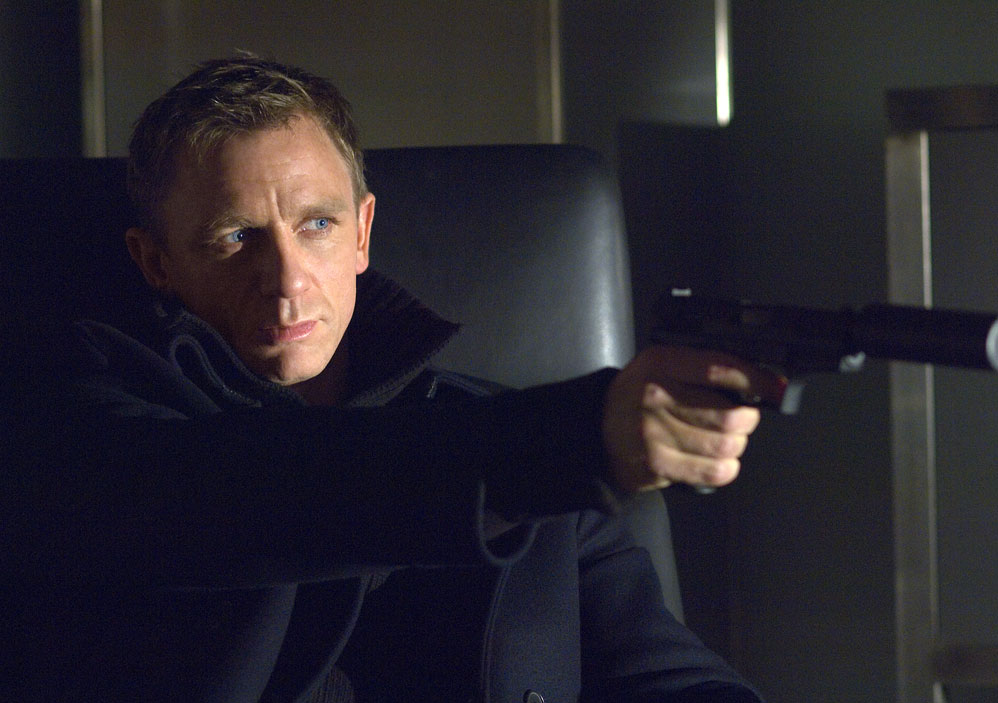
It's no mean task to breathe new life into a franchise that's in its forties, but the producers cannily brought back several of the key personnel (most obviously director Martin Campbell) who dragged Bond into the modern era with 1995's Goldeneye, and give them further freedom to develop a new tone (with another new Bond). Where Pierce Brosnan's Bond played the smooth angle to the hilt (with Brosnan later trashing that image in films like The Matador), Daniel Craig (whose features might have typecast him as a Boer cop) brings back some of the raw thuggery of the first Bond films. The fights here are as brutal as the famous sequence which pitted Connery against Robert Shaw in a cramped train compartment in From Russia With Love and serve as a salutary reminder that violence, even in a Bond movie, shouldn't be taken too lightly. The early going also features some spectacular parkour stunt-work, performed by Sebastien Foucan who, unusually for a stunt player, gets an opening credit for his work.

Just as the violence is a touch more realistic, the plotting focuses on a criminal banker whose interests lie in financial gain rather than the kind of world domination that became so laughably repetitive in previous entries; it's a refreshing return to earth, not least because it eliminates silly sequences in which Bond escapes from elaborately choreographed death and destruction. It takes some time to get used to Daniel Craig as Bond: he's not just new but genuinely different (as my wife commented, it's not hard to imagine that "James Bond" is itself a code name, just like 007, since there's no sense of a past history), but by the end of the film Craig has made the role convincingly his own. He's surrounded by an unusually good group of supporting actors, who are, crucially, given interesting things to do; Eva Green and Mads Mikkelsen are especially strong. The main flaw is length; like many recent Bond entries, Casino Royale overstays its welcome and there's a tacked-on sense to some of the closing sequences, where you constantly expect the closing credits to roll.

Tuesday, November 28, 2006

The Da Vinci Code

2006, US, directed by Ron Howard

After all the baying at the time of The Da Vinci Code's theatrical release, it's no surprise to discover that underneath the noise this is a solidly-told version of the blockbuster book, a tad too respectful of the source material (like the first Harry Potter films), but good, honest fun nonetheless (and it never seems to take the pseudo-religious shenanigans too seriously, unlike some viewers). Director Ron Howard's film choices aren't always inspiring, but he's a more-than-competent Hollywood storyteller, who marshals disparate plotlines with skill; despite what some critics wrote, the narrative is clear, and the visual methods used to convey the various puzzles are sometimes very effective. That said, there's no doubt that it's overlong, mostly as a result of the filmmakers' unwillingness to jettison aspects of the book: the series of puzzles that remains quite intriguing on the page is repetitive onscreen (unlike, say, the boxing matches that punctuate Howard's Cinderella Man). Tom Hanks is fine as Robert Langdon: he's not stretched by any means, but he's well cast as a figure of trust. Audrey Tautou, by contrast, seems less at ease as Sophie Neveu. She's perfectly suited to gamine roles, but she seems out-of-place here, especially when she's weighed down by some clunky dialogue, while it's frustrating that Neveu often defers to Langdon though she's supposed to have abundant smarts of her own. The supporting cast is dependable if not much more; Ian McKellen plays a cinematic version of who we think Ian McKellen to be, which I suppose is fun if you can get paid for it, but he's too good an actor for that kind of thing. A gaggle of familiar French faces also get some screen-time, and presumably fatter-than-usual pay packets.

Sunday, November 26, 2006

Click

2006, US, directed by Frank Coraci

Another of Adam Sandler's attempts to move beyond the infantile comedies of his early career, Click squanders an intriguing concept by failing to decide between drama, sentiment and crass laughs. Sandler plays a workaholic father who acquires a remote control that allows him to control his entire world, an intriguing philosophical dilemma which the film does try to grapple with, but which is constantly undercut by crude humour (not to mention the fact that it's hard to feel all that sorry for a character who uses the device to behave like a bully even at moments when he's supposedly absorbing the Life Lessons that the remote confronts him with). Sandler isn't a dislikeable performer - he was especially good in The Wedding Singer and 50 First Dates with Drew Barrymore as a foil, while Spanglish wasted a good outing - but the supporting characters are given almost nothing interesting to do, and his own familiar shtick is over-extended without the presence of some of his familiar cast-mates. Notwithstanding the inconsistent tone, director Frank Coraci's work is much more polished here than in The Wedding Singer, no doubt partly the result of a bigger budget, though it's still hard to figure out why a film like this costs $75 million or so to get to the screen.

Saturday, November 25, 2006

Déjà Vu

2006, US, directed by Tony Scott

Every 'serious' film fan probably has a few pleasures that will never make the year-end lists at the highbrow movie publications, though usually they're labeled 'guilty'. I have a particular, and guilt-free, fondness for Tony Scott films, which often seem to boil down to boys-with-toys exercises wrapped up in slick, if nonetheless carefully imagined, visual style.

On one level, it seems absurd to see the credit 'A Film By Tony Scott', but at the same time it's hard to ignore the unity of purpose, both aesthetically and with regard to content, that runs through so many of his films. This film, like the increasingly prescient Enemy of the State in particular, returns to the territory of super-secret spy agencies, and although the film has fun with the possibilities therein, it's also uneasy about the consequences of such abilities to penetrate the veil, even where the intentions are good. Here, a government agency has enlisted a group of academics and most of the electricity in the New Orleans area to create a time-travel window that may assist in the investigation of a major terrorist outrage.

Unlike, say, the generally light-hearted consequences of time-travel in Back to the Future, there's a haunting sense of loss over every glimpse into the past, and Scott uses lighting and colour with skill to delineate the different moods (Scott never tires of visual experimentation, perhaps a result of his advertising background, but here the effects serve a purpose, whereas I found them ultimately distracting in his previous collaboration with Denzel Washington, Man on Fire). Past and present come together in an absorbing and original chase sequence that delivers the thrills you'd expect from such fare (along with the often questionable use of major disasters for entertainment purposes), but it's the rich atmosphere that lingers after the credits roll.

Index

List of all movies

Most of the images here are either studio publicity stills or screen captures I've made myself; if I've taken your image without giving you credit, please let me know.

About Me

Boston, Massachusetts, United States