Tuesday, October 17, 2006

Punishment Park


1971, UK/US, directed by Peter Watkins

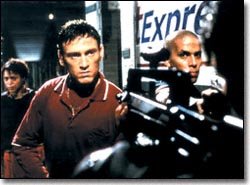
Punishment Park is an odd mixture of the dated and the prescient, capturing both the hysteria that characterized the period during which it was made (the high tide of the Nixon presidency, and the wave of radicalism that parallaled it), as well as the legal shenanigans of the post-September 11 era. The film intercuts a series of quasi-legal tribunals (mostly featuring young "radicals") with scenes from a bizarre form of punishment camp that involves a desert march towards an American flag (perhaps the most thuddingly obvious device in the film), all shot with a single documentary camera (ostensibly from the BBC). While the documentary style works well - the tribunal scenes in particular have the ring of truth - the predictable involvement, later on, of the film crew is less convincing. The acting, mostly by non-professionals, is exceptional. Director Peter Watkins, making his only American film (but by no means his most radical), threw out his script and coaxed improvised performances from his cast, most of whom were no doubt influenced by the stressful conditions of a difficult, compressed shoot; in that, Punishment Park has something of the air of a live-action Stanford Prison Experiment (conducted the summer after the film was made). The film's key point, that governments tend to be quick to throw out legal norms in difficult times, remains, of course, as relevant in 2006 as it was in 1971; the young policeman's retort that international pressure won't change anything is perhaps the most chilling moment of all.

Sunday, October 15, 2006

The Village


2004, US, directed by M. Night Shyamalan

Rating: ***

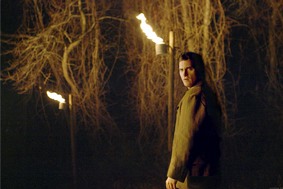
M. Night Shyamalan has painted himself into something of a cinematic corner with his successful exercise in branding: he's expected to deliver a slow, oblique, atmospheric build-up, followed by a twist that turns everything on its head. The setting this time is the late 1890's, in a remote American village, surrounded by forests that house dangerous creatures with whom a truce has been reached (this immediately leads to some questions about how the village engages in trade for building materials, but those matters are never really addressed). The villagers all speak as though they've read too many classic novels, although in one way this is an effective device to underline their lack of any connection with changes in the exterior world. While the cast is strong, they don't always have a whole lot to do; Brendan Gleeson and Sigourney Weaver do a lot of standing around looking tortured and not much more, although William Hurt's distinctive voice is well-employed, while Bryce Dallas Howard is impressive as a tomboyish blind girl who is the agent by which the film's 'shock' is revealed. Although the twist is certainly guessable, it's good enough to get audiences sitting up, and it lingers longer than the overblown 'boo!' moment of The Sixth Sense.

The Queen

2006, UK, directed by Stephen Frears

The busy Stephen Frears's latest film is set during one of the strangest weeks in recent British history, the seven days in late 1997 following the death of (the former) Princess Diana, with a focus on the relationship between the recently-elected Tony Blair (enjoying his Giuliani moment) and the Queen (played with surprising warmth, and consummate skill, by Helen Mirren). While the Boston-area theatre audience enjoyed The Queen as something approaching high comedy, this Irish viewer saw a more serious-minded film.

Based on that audience reaction at the screening I attended, it's not hard to see why the film might be accused of pandering to American viewers, but the behind-the-scenes wrangling will be much more meaningful to a viewer familiar with the Blair political team (especially the now-departed Alistair Campbell). Although the film never reveals whether it's with or against the Queen - at one stage, Blair (who is played with great conviction by Michael Sheen) asks that someone "save these people from themselves", while later he launches a passionate defense of the monarch and all she represents - it's a fascinating imagination of what the interactions between the sovereign and "her" Prime Minister might have been as that bizarre week unfolded. The opening sequences are designed as a criticism of hereditary rather than elected power, but the film's central thesis is that Elizabeth II and Blair are both essentially political animals, clever pragmatists ultimately ready to do what's necessary in the context. Peter Morgan's intelligent script makes clear (though not many critics seem to get the message) that viewing the monarchy as an outdated institution isn't necessarily incompatible with a sympathetic view of a woman who is, to an overwhelming degree, conditioned by her upbringing and age to behave in rigidly prescribed ways.

Saturday, October 14, 2006

Closer

2004, US, directed by Mike Nichols

Rating: **

Despite the presence of four arrestingly attractive actors, Closer is no-one's idea of a date movie - although Todd Solondz might find it amusing. The four leads - the film was written by Patrick Marber, from his own play, and he's made no attempt to open the action up, notwithstanding some chilly London locations - become involved with and betray one another in what is apparently supposed to be some kind of commentary on contemporary mores but which ultimately becomes a rather numbing and sterile exercise. Marber's characters are uniformly disagreeable; there's no real tension in a film where the principals so richly deserve one another, notwithstanding the excuses they attempt to make for their behaviour. It's a shame, really, because director Mike Nichols wastes several solid performances, especially from Clive Owen, who adds a fire that seems at odds with the very mannered dialogue and which occasionally hints at an actual human soul, if not necessarily a very pleasant one.

Tuesday, October 10, 2006

Kicking and Screaming


1995, US, directed by Noah Baumbach

Kicking and Screaming is unavoidably reminiscent of Diner (for the 1990's generation), given the echoes of both plot (a group of mostly male college friends attempting to come to terms with the post-college world) and tone. There's an undenial sadness in the eyes of these young people, sure that their lives will inevitably be somehow less exciting - for better and worse - than those of at least some previous generations (one character wishes he were about to go to war - then thinks better of that and wishes instead he was about to retire after a lifetime of meaningful work; the two seem equally exotic).

There's also that Fitzgeraldian worry that everything post-college will "savour of anti-climax", given the way that the college experience has been framed. Although the film meanders a little in the first twenty minutes before finding its bearings, writer-director Noah Baumbach displays a sure touch with dialogue from the first scene (though there's a mannered air to some of the lines, there's also a warm humour on display). The film acknowledges its own indulgence in triviality in amusing ways, and in between the catty exchanges there's a slow, almost imperceptible accretion of more meaningful commentary on a particular post-80's, pre-Internet generation. Although the performances are uniformly fine (and generally quite brilliantly deadpan), Olivia d'Abo is especially notable: she's never been lovelier, or better, at least on the big screen, and there's a sweet poignancy in her final scene that perhaps defines the overused descriptive 'bittersweet'.

Sunday, October 08, 2006

The Illusionist


2006, US, directed by Neil Burger

An absorbing arthouse/mainstream crossover, The Illusionist is well-acted, beautifully lit and possessed of a rare sense of time and place -- Vienna at the opening of the twentieth century, a place mired in court intrigues. Although the pacing is sometimes languid, Neil Burger never lets the story flag, carefully shading in details of character and allowing the viewer to piece together the central mystery of the film (the fact that it's not hard to guess in no way detracts from the film's interest).

Almost the entire film seems to take place at night, and Burger and his director of photography, Dick Pope, do a fine job playing, literally, with fire, gaslight and shadows. Edward Norton delivers his finest performance since since Spike Lee's 25th Hour as Eisenheim, an illusionist who has mastered the magical arts of East and West, and who discovers a new purpose for his skills on his return to Austria. Norton projects a kind of world-weariness that's mesmerizing in its own way, and that enables Eisenheim to carry off his trickery. Jessica Biel, who plays the object of Eisenheim's affections and, not incidentally, the rumored future crown princess, is luminous, capturing the kind of passion that might well lead a man to sacrifice his career. Paul Giamatti has an interestingly ambiguous role as a compromised police chief in the service of the odious crown prince; although his final scene is perhaps a little obvious, his awakening to the realities of his position is ably sketched.

Saturday, October 07, 2006

Topper


1937, US, directed by Norman Z. McLeod

A featherweight comedy, Topper was a huge hit in its day (though it's a little hard to understand why Depression-era audiences enjoyed the antics of some not-always-sympathetic representatives of the moneyed classes), but it hasn't aged especially well. While there are a few sharp exchanges, and some of the banter-between-the-sexes that characterized the best of the screwball comedies, the very slight plotting and excessive length bog the film down. Cary Grant is adequate, but he's still in the process of developing his onscreen persona, and he's offscreen far too much. By contrast, Roland Young (like Grant, another English transplant) as the eponymous Topper steals most of his scenes, most especially one where he tipsily dances around the room (showcasing, not incidentally, the kind of light stage-comedy skills employed so smoothly by many of the Golden Age's actors). In the smaller roles, Eugene Pallette pops up as a hotel detective (a role much beloved of Old Hollywood that you rarely see these days), while Hedda Hopper appears briefly as a socialite; her gossip-mongering career was taking off around this time, although she had regular acting gigs for another five years. In the unlikely event this one gets a 21st-century remake, you can be sure that there won't be such blithe drunk-driving in the opening scenes.

Sunday, October 01, 2006

The Matador

2005, US, directed by Richard Shepard

Rating: ***

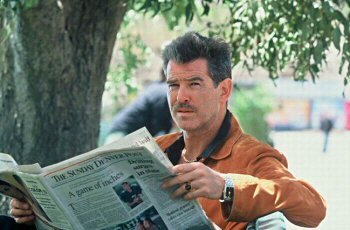
Although it's neither as slick nor as hip as it would like to think, The Matador is lifted well above average by Pierce Brosnan's delightfully rumpled performance as an assassin who's experiencing something of a mid-life crisis. The film's morality doesn't bear much examination - it's queasy at best, and downright tasteless in a montage sequence that outlines Brosnan's global exploits over a six-month period - but there's tremendous fun to be had with Brosnan's characterization of Julian Noble, whose verbal ineptness continually causes offense to those he attempts to befriend. His meeting with the milquetoast Danny Wright (Greg Kinnear) isn't especially convincing but once the two are thrown together, Noble's attempts to come across as a halfway decent human being generate much uncomfortable humour. While John Cusack's similar character in Grosse Pointe Blank was far too cute to be convincing, Brosnan summons up the essential seediness of his chosen profession, turning his Bond and Remington Steele personae on their heads, and showing a considerable grit in the process.

Saturday, September 23, 2006

Memories of Murder

2003, South Korea, directed by Bong Joon-ho


Based on the real-life events surrounding South Korea's first recorded serial killer case in the mid-1980's, Memories of Murder is closer to (very) black comedy than it is to police procedural. While the cops come off pretty well in the average detective film (after all, they usually solve the crime), this movie is unlikely to be a hit even in Korean squadrooms. Any rural police force would be overwhelmed by the events that transpire in the film, but the three detectives at the heart of the case are left to their own devices to a quite remarkable degree, and their investigative methods are, to say the least, unconventional (when not downright incompetent).

There's a strong political point being made here, with broad suggestions that the government of the time was much more interested in suppressing democracy demonstrations than in catching a rapist/killer, but the absence of central investigational oversight is lacking in credibility (and doesn't seem to fit with the facts). That said, the sense of South Korea as a country ill-prepared for its headlong entry into the global economy, and still existing rather pathetically in the shadow of its American benefactor, is powerful, while the portrait of a small town in the grip of fear is generally convincing. Director Bong Joon-ho never quite settles on a unified tone, although he has a knack for atmospherics and off-kilter humour.

Thursday, September 14, 2006

Vera Drake

2004, UK, directed by Mike Leigh

Comfortably Mike Leigh's strongest film since Secrets and Lies, Vera Drake carefully evokes a very specific time in British history - the austere post-war years - as the backdrop for a tale of quiet yet radical rebellion. Imelda Staunton is astonishing, delivering the performance of her career as Vera, a gentle, caring woman who works as a house cleaner and who, in her spare time and in secret, conducts back-street abortions at no charge. Her clear-eyed view of the realities of the world is calculated to sow confusion in the minds of those who disagree with abortion; there's no doubting her integrity and her attempts to restore some kind of dignity to those around her, and her lack of eloquence doesn't prevent her from expressing her views to telling effect. The sense of time and place are brilliantly created through a series of apparently unconnected early vignettes, intermingling scenes of home and workplace life to great effect (one scene where the men discuss 'what kind of war' they had is especially telling); the actors who play Vera's family are uniformly strong, creating a detailed set of character studies. The one downside is Leigh's inability to create rounded middle- or upper-class characters; as in his other films, his class views are so narrow that the upper-class characters, especially, are almost without exception insufferable or unsympathetic. As a consequence, a subplot about a wealthy young woman having an abortion seems heavy-handed, over-emphasizing a point already made subtly throughout the film.

Wednesday, September 13, 2006

Les Dames du bois de Boulogne


1945, France, directed by Robert Bresson

Unlike the austere films that Bresson began to make from 1950 onwards, Les Dames du bois de boulogne drips with the style and melodrama of classical Hollywood (it's not hard to imagine someone like Bette Davis in the role so perfectly played here by María Casares). A tale of very chilly revenge (a society lady takes such exception to the end of her relationship with a rather feckless aristocrat that she engineers his reputation-destroying wedding to a prostitute), the film has dialogue by Jean Cocteau, and it's not hard to see a trace of fairy tale in the conclusion, although it's closer to the redemptive power of the concluding moments of Bresson's own Pickpocket rather than the texture of Cocteau's La Belle et la bête, which was being shot when this film was released. The film's great weakness is the insipid Paul Bernard, who plays the aristocratic lover; Cocteau's occasionally delirious meditations on the turmoils of love fail to convince when uttered by such a bland leading man. It's the same problem that hampers Brief Encounter: the passionate declarations of a passionless individual, but then that, too, isn't entirely uncharacteristic of Bresson, who often favoured remarkably flat performances.

Sisters of the Gion


1936, Japan, directed by Mizoguchi Kenji

A beautiful early feature film from Mizoguchi, which overcame the terribly poor transfer available for viewing [I subsequently saw a restored version], Sisters of Gion is a fascinating portrait of a vanished time in Japanese history, set before the Second World War in Tokyo's geisha district. The film makes clear that this way of life is already disappearing: the two sisters of the title are divided on the proper behaviour expected of a geisha, with one searching for a striving patron, the other loyal to a diminished benefactor. Although the film is bursting with incident - the fate of the two sisters seems to hang in the balance until the final moments - it's shot in a very simple, direct style, with many of the carefully composed long shots, often using frames within frames, for which Mizoguchi is famous. He intersperses that straightforward style with several gorgeous tracking shots, including one that opens the film, which reveal he was already master of the mobile camera. If there's any weakness to the film, it's perhaps the overly didactic ending, which tends to repeat what the director has so eloquently conveyed throughout; it's reminiscent of the conclusion of Sembène's Mandabi, which also crosses the line from account to pamphlet, but in both cases that may be illustrative of filmmakers in the process of finding the voice with which to express their committed social vision.

Sunday, September 10, 2006

Common Wealth


2000, Spain, directed by Alex de la Iglesia (original title: La Comunidad)

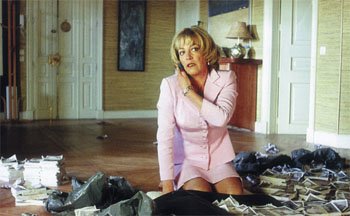
A wacky Hitchcockian riff, Alex de la Iglesia's film is the blackest of comedies, with Carmen Maura as a real estate agent who discovers riches in an old apartment building only to find that the other tenants are determined to get their hands on the money (and they're prepared to take some pretty extreme measures to do so). The opening half-hour, during which the cash is uncovered, is laden with suspense; the direction is taut and the set design is eerily clever. The strange events that follow are amusing but certainly over-extended, straining credibility even in this outlandish genre, though the references to Hitchcock films consistently hit the mark, while de la Iglesia has a devilish sense of humor that pops up at the most unexpected moments. Carmen Maura is a standout in the lead, playing it straight in the midst of a building full of crazies, and clearly enjoying the wild antics; it's great to see that Almodóvar isn't the only Spanish director capable of creating a meaty role for an actress over 50, and a shame that American movies can't follow their lead.

Friday, September 01, 2006

Shark Tale


US, 2004, directed by Bibo Bergeron, Vicky Jenson, Rob Letterman

With the bar set so high by the Pixar films - especially Finding Nemo and The Incredibles - and Dreamworks' own Shrek films, it's hard not to be a little disappointed by Shark Tale: while it zips along nicely, with little wasted time, the basic storyline is a little trite, and the lead character (voiced by Will Smith) is a too hyperactive and self-obsessed to really prove endearing. However, while the overall framework isn't a success (and can't help but suffer when compared to the undersea antics of Finding Nemo) many of the incidental details are extremely enjoyable. Robert de Niro and - especially - Martin Scorsese are entertaining in a Mafia-movie parody (the Scorsese-voiced character has amusingly bushy eyebrows), and even funnier are Ernie and Bernie, a pair of rasta jellyfish, one voiced (for full authenticity) by Ziggy Marley.

Thursday, August 31, 2006

El Bola


2000, Spain, directed by Achero Mañas

Spain's contemporary film production is so dominated, in English-speaking countries at least, by Pedro Almodóvar that it's refreshing to come across a film that eschews his sometimes melodramatic stylings and embraces the gritty realities of a Madrid neighborhood. El Bola (Pellet) is a kid with a rough home life whose friendship with a new kid, Alfredo, seems to offer a form of escape; his friend's unconventional father is especially appealing in comparison to his own authoritarian dad. Although the contrasts between the two homes are occasionally drawn a little too sharply, there's a powerfully humanist impulse behind director Achero Mañas's storytelling, dignifying more than one marginalized character in a manner reminiscent of Benito Zambrano's beautiful 1999 feature Solas. Like that film, El Bola is generally clear-eyed in its view of humanity, steering clear of sentiment while finding a surprising beauty in the small events of everyday life; there's also a powerful critique of the frustrations of ordinary people in their dealings with the irrational workings of officialdom. The performances throughout are excellent: the two young actors who play El Bola and Alfredo are wonderfully natural, and free of the trappings of onscreen cuteness, while Alberto Jiménez is outstanding as Alfredo's father, a part that in less capable hands might well have strained credibility.

Wednesday, August 30, 2006

Fools Rush In


1997, US, directed by Andy Tennant

For every romantic comedy that works, there's are three like this, where it all falls apart: there's no chemistry between the leads, the supporting characters are no fun, and worst of all, it goes on far too long. While Matthew Perry's shtick was enjoyable on Friends, here he's unconvincing as an allegedly hard-charging nightclub designer, while Salma Hayek's performance is awkward; her line delivery is especially distracting, although the clanging script hardly helps (the writers really have a tin ear for the nuances of dialogue at times). The portrait of the intersection of a warm Mexican family and a chilly WASP clan has some potential as it overcomes the initial clichés, but ultimately the film can't do much with the fact that we just don't care about the central pair.

Monday, August 28, 2006

Mission: Impossible III


2006, US, directed by J.J. Abrams

Rating: ***

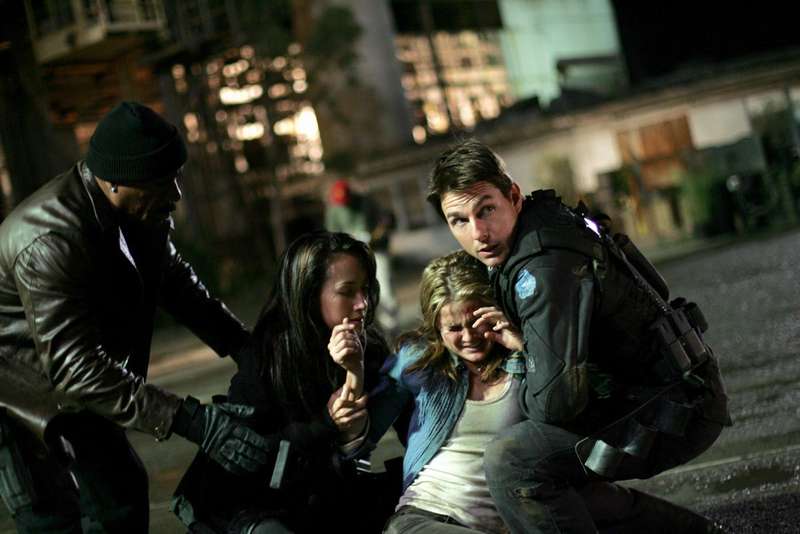
The third entry in the MI franchise marks a step back up after the silliness of the John Woo-directed second installment; the slow-mo action scenes are mercifully absent, and director J.J. Abrams uses a hand-held camera to capture some of the adrenaline of his TV hits Alias and Lost (his transition to the big screen is pretty successful, too, while his sense of the all-seeing eyes of the CIA-like Impossible Mission Force is of a piece with the mysterious organizations of Alias). This time around, though, the support group is colorless: while Ving Rhames is always enjoyable, his character hasn't developed much from the overgrown teddy bear of previous films, and the remainder of the Tom Cruise-led crew is anonymous. As the villain, Philip Seymour Hoffman has fun, generally refraining from chewing the scenery (it's nice, too, that the film doesn't waste time on a elaborately silly back story; he's bad, and that's about all you need to know).

Saturday, August 12, 2006

From Russia With Love


1963, UK, directed by Terence Young

It didn't take long for the Bond producers to figure out the magic formula, for this second entry in the series is probably the best of all the Bonds. Like its predecessor, it's relatively small in scale: although über-villain Blofeld is introduced, the real threats are in the more down-to-earth forms of Robert Shaw and Lotte Lenya, two of the most memorable henchmen in the 40-year-plus history of the films. Shaw is perfectly cast as a blond ex-army man, credibly suave when required, and equally credibly thuggish when the time comes (especially in a great fight scene in the cramped confines of a train compartment). The exotic location this time around is Istanbul, conjured up with plenty of cinematic charm, and an enjoyable performance from Pedro Armendáriz (in his last film role) as Bond's man on the ground. Although Bond has had just one film to establish his reputation, it's clear that SPECTRE considers him the biggest threat to their activities, and they concoct an elaborate false plot to entrap him -- with Bond happy to take the female bait. The comically over-the-top sets, and even more comical killing methods, of later films are absent here, but Desmond Llewellyn makes his first, brief, appearance as Q, a fixture that is one of the most enjoyably playful aspects of the series.

Friday, August 11, 2006

Kanto Wanderer


1963, Japan, directed by Suzuki Seijun

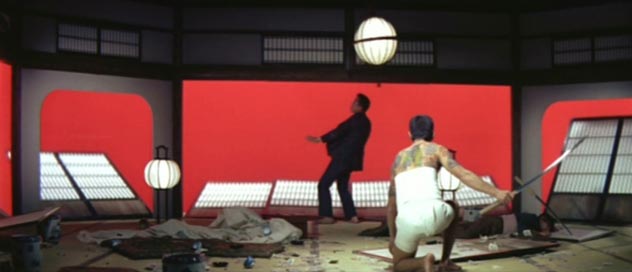
As Tom Mes writes in the DVD liner notes to Kanto Wanderer, this isn't as balls-to-the-wall as some of Seijun Suzuki's later work, but it's a great primer on his subversive experiments within the studio system, experiments that would eventually get him fired from Nikkatsu studios. The core of the film is a pretty conventional story of honor and loyalty among thieves, or more precisely the yakuza. Even as Suzuki throws in some reflection on the changing role of the yakuza in post-war Japanese society, there's no doubt he contributes to the romanticization of the old gangster ways, sympathizing with the old warrior types as they deal with the rise of the oafishly criminal new generation. Suzuki is really more interested, though, in playing with genre form: his lovely widescreen camerawork and brilliant use of interior spaces - most especially in the anti-climactic climax - are the beginnings of a path of consistently playful experimentation. The picture of 1960's Japan, on the cusp of a serious boom, is fascinating; the struggle to retain some of the good of the past, even in the gangster context, is sometimes surprisingly poignant.

Saturday, August 05, 2006

The Nest


2002, France, directed by Florent-Emilio Siri (original title: Nid de guêpes)

Although it's jam-packed full of allusions to other films, The Nest still manages to feel surprisingly fresh, dispensing with the often hackneyed backstories with which action characters are burdened in favour of delivering elaborately choreographed thrills and spills with considerable style (director Florent-Emilio Siri showed similar technical mastery in his American debut, Hostage). Like Hostage, the film's set-up is complex, with intersecting stories, but Siri sketches the details in efficiently; even though the plot depends on a preposterous coincidence, the action is so breakneck that there's no pause for reflection on this at the time. There are obvious reference points in American films like Assault on Precinct 13 and Die Hard, as well as to such Hong Kong actioners as Hard-Boiled (like that film, it does occasionally beggar belief that a small war could take place in an urban location without anyone noticing), although the first 20 minutes are a homage to the masterful French crime flick Du rififi chez les hommes, with its famously silent heist sequence. While it might seem to be something of a bastard child, there's still a definitely local feel to events, with allusions to crimes in the Balkans and the clever use of a Bastille Day background. Though it is, in the end, slick commercial fare, Hollywood could learn a thing or two from this kind of lean performance.

Index

List of all movies

Most of the images here are either studio publicity stills or screen captures I've made myself; if I've taken your image without giving you credit, please let me know.

About Me

Boston, Massachusetts, United States