Wednesday, May 20, 2015

Timbuktu


2014, France/Mauritania, directed by Abderrahmane Sissako

Sissako continues his remarkable career at the very forefront of African filmmaking: he's sensitive, honest, unsentimental and possessed of an intense humanity. It takes something quite special to show, however discreetly, the stoning of an alleged adulterous couple but also to leave you with the sense that these were people with complex lives rather than an excuse for a shock effect -- and the same is true of the central death scene in a river, a heartbreaking, Lang-ian moment in which a man makes one ill-advised if quite understandable decision to engage in a confrontation. His action sets in motion an implacable fate, or at least implacable in the particular time and place depicted. The subsequent wide shot of the man's escape from the river, a corpse lying to the right of the screen, is quite breathtaking. Will those who could most engage with and react to the film have a chance to see it, though?


Thursday, May 14, 2015

Buud Yam


1997, Burkina Faso/France, directed by Gaston Kaboré

A sequel of sorts to Wênd Kûuni, the 1982 film that put Gaston Kaboré on the map. He returns to both the characters and the actors from that film and while there are deliberate resonances between the two pictures, including brief flashbacks that are actually footage from Wend Kuuni, this stands on its own as an exploration of pre-colonial Sahel life. It's not entirely historically accurate in terms of the depiction of a rather abundant and largely conflict-free swath of territory and yet it also succeeds in giving a strong sense of the existence of numerous loosely associated societies that often have trouble understanding one another even on the linguistic level (a phenomenon that continues today, and which contributes to the real challenges posed by borders that cut through pre-existing societies). While the storyline is straightforward, narrating the search by Wênd Kûuni for a legendary healer intercut with sequences featuring the young man's ailing sister, it's rich in its generosity of spirit, and very open about suspicions within village life but also the ways in which those suspicions can be healed. Visually some of the landscapes of southern Burkina Faso are lovely, and I also liked the way that Kaboré shot most of the film in medium/long shot so you can really see the interactions between the characters, while there are a few moments of wonderful humour, particularly a sequence in which a group of riverbank kids enjoy observing some clueless newcomers. 

Tuesday, May 12, 2015

Raw Deal


1948, US, directed by Anthony Mann

Although not quite as compressed as 99 River Street this is another against-the-clock plotline, with a convict escaping and trying to make his way south for a payoff and a boat to the tropics. As you might expect from Anthony Mann and John Alton, it looks terrific -- moody and exceptionally atmospheric, with some wonderful compositions (a scene in the prison early on is especially good, as is the later sequence in a kind of crim-friendly guesthouse). Dennis O'Keefe is on roughly the John Payne level in the lead role -- less bland, perhaps, but certainly not a strong actor and the supporting players provide the real interest. Claire Trevor was deep in her glorious late-1940s run of bad girls and she does a terrific voice-over here, suggesting that this story is at least as much hers, certainly true in terms of the not-unexpected downbeat ending. John Ireland is also good as the hands-dirty tough, while Raymond Burr looms (quite literally since he's often shot from below) in the background, dispensing casual sadism.

Monday, May 11, 2015

99 River Street


1953, US, directed by Phil Karlson

A generally punchy film from the generally punchy Phil Karlson, a very solid noir that takes place over the course of a single rather fraught evening in which a former boxer/current cabbie sees his marriage disintegrate and his life disappear down the same plughole. There's one hell of a subplot that stretches credibility a great deal,while nonetheless providing the film with a terrific set piece (the camera angles and use of light/shadow are brilliant). John Payne is a pretty bland leading man but as ever in such films there's plenty of diverting support -- Brad Dexter has one of his earliest roles of substance and he's rather good as the heavy, while Jay Adler is very memorable as the fence despite the obvious stereotyping of the character. 

Friday, May 08, 2015

The Yin and the Yang of Mr. Go


1970, UK/Canada (?), directed by Burgess Meredith

Without a doubt, one of the oddest films I've ever seen, I'm not sure that I have the appropriate vocabulary to capture this viewing experience. A Bad Film on the obvious level of construction, pacing, coherence, acting but absolutely fascinating in terms of its rather prestigious cast and for the unanswerable "what were they thinking?" and "what were they trying to do?" questions. On one level, you could posit the film as an example of the results when you plunk down a bunch of actors and a lot of money in an exotic location, but I do think that Meredith was going for a certain absurdist effect even if he didn't quite pull it off -- the plot is certainly the least of his concerns, though it was hard to decide to what extent some of the humour was intended or not. It sounds as though the producers took things into their own hands when they saw what they had paid for, hence the inexplicable framing appearance of Broderick Crawford, who clearly wasn't filming in the same locations. The very young Jeff Bridges' monologue outlining the various oddball plot points serves as a fitting summation of the film, complete with vaguely stoned look. 

Wednesday, May 06, 2015

We Are the Best!


2013, Sweden/Denmark, directed by Lukas Moodysson (aka Vi är bäst!)

Another fine entry in the long, proud Scandinavian tradition of remarkable child/youth performances (no less than Moodysson's debut feature Fucking Åmål/Show Me Love, though the two actresses there had a some prior screen experience), and a really lovely sense of naturalism that re-creates 1982 Stockholm with economy and a great deal of rueful affection. The film participates in some of the conventions of the music-film genre without ever giving into them, which helps to rein in the sentimentality a good deal, and also ensures that the focus remains on the self-discovery of the central trio, capturing the feel of being around 13, in all its glory and excess.

Friday, May 01, 2015

Die Koffer des Herrn O.F.


1931, Germany, directed by Alexis Granowsky

A delight from start to finish, funny but also biting in its satire of frenzied speculation, something that must have had quite a resonance for the audience of 1931, after more than a decade of economic turmoil of one kind or another. As a critique of capitalism, it would pair well with Capra's American Madness; the films are quite different in tone but both are very good on the essential craziness of the system as it prevailed then (and now), and the German film makes especially good use of a few fantasy sequences. Lorre is such a distinctive performer, entirely apt for the double-speak of the role of small-town newspaper editor/booster. I was initially distracted by the regular appearance of the word "Verboten" on the print, from German TV, especially because it seemed to crop up at irregular intervals and stay for unpredictable lengths of time. Eventually, though, with the assistance of some reading research, I figured out that this represented the location of the many and varied cuts made by the Nazi regime a year later, so the print in circulation for the rest of the 1930s was radically cut to remove unapproved personnel, songs, and incidents.

Thursday, April 30, 2015

Night Train to Munich


1940, UK, directed by Carol Reed

I couldn't recall if I'd ever seen this before: I might have caught it as a teenager on TV, but it's hard to be certain, especially given the thematic, visual and casting overlaps with The Lady Vanishes. A few critical comments come down rather harshly on this for not being the full Hitchcock in its easy transition from comedy to suspense, which seems to me to miss or at least evade the point of this being filmed and released after the war began while the Hitchcock film was released in 1938 (within a week of the Munich Agreement, as it happens, but obviously the film does not speak to that). In other words, the stakes are considerably raised here: there are no notional villains but rather very specific ones, with whom Britain was already at war (the tropes of cinematic Nazi behaviour are in full flight already by 1940, that much is clear), so the film has to serve multiple functions as entertainment and, to at least some degree, wartime propaganda. Within that context, I thought it remarkably well done -- the montage sequences that include documentary footage are chilling, apt, and useful to establish the context, while the performances, particularly from the contrasting duo of Paul (von) Henreid and Rex Harrison, each essentially having to play two characters, are very good indeed. I also enjoyed the re-appearance of the cricket enthusiasts from the Hitchcock film -- perhaps a little broad, and certainly stretching credibility, but also very much to be relished in that "I say, old chap" kind of way.

Tuesday, April 28, 2015

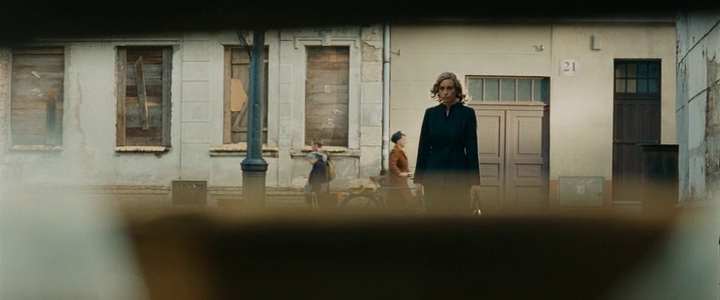
Phoenix


2014, Germany, directed by Christian Petzold

Christian Petzold's body of work over the last fifteen years or so is among the finest in European cinema, and one of the more remarkable aspects of his past two films is the seamless transition from largely contemporary themes to fine-grained explorations of the past that are nonetheless the polar opposite of most period pieces. There's nothing airless about these films despite the meticulous recreation of setting (though they share with most Petzold films that sense of being quite deliberately under-populated: Berlin is no teeming city here, but rather a specific time and place sketched in with exceptional economy both in narrative and demographic terms). It's no great surprise that a filmmaker as strong as Petzold was eventually going to turn fully toward some of the great historical questions of his society, dealing with the past and its weight -- quite literally in the case of Nelly in this film, but of course construed more broadly by Petzold. 


I was struck, not for the first time, by the director's ability to take material that could appear quite melodramatic and treat it in a non-histrionic way -- it's precisely the refusal to engage in melodramatics here that lends the narrative its power, the quiet accumulation of details that is so neatly and poetically turned on its head in the final, wonderful scene. Nina Hoss is, as ever, quite remarkable, creating a fully-realized person with the most delicate shades of nuance, steadfastly refusing the "big" acting that many others would bring to a part like this. Other notes: the du/Sie nature of German adds a whole other layer to the interactions between Nelly and her former husband, one which the subtitles struggled awkwardly to convey in the early going with the occasional use of "Miss." The sound design is also quite wonderful: the sounds of (different) clocks in each location, the creak of floorboards, the way that sounds which seem so loud at night (like those clocks) fade into the background in the bustle of the day. Impeccable detail and yet all in service of the bigger picture.


Friday, April 24, 2015

Hitch


2005, US, directed by Andy Tennant

A com-rom rather than a rom-com, in the sense that the first half is much more focused on the comic setup with the second half squeezing in the hitherto undernourished romantic plotline. The problem is that despite the romantic partners being absolutely charming, they can't hope to compete with the comic chemistry generated between Will Smith and Kevin James, so everything afterwards seems like a bit of a disappointment. Still, there are enough laughs in the first half to just about sustain the momentum when James goes offscreen for an extended period.

Les Reines du ring


2013, France, directed by Jean-Marc Rudnicki

Feather-light, entirely predictable, often very silly and yet also quite agreeable, mostly for its cast. Audrey Fleurot was a touch OTT for my taste, playing what at first seems like a kind of amped-up version of her Engrenages character, although with a good deal more humour, but Nathalie Baye and André Dussollier both had some nice moments and Corinne Masiero made sure she stole a good deal of the show despite being the theoretical support (she too, plays a character not a million miles away from that she essayed in Engrenages). 

Wednesday, April 22, 2015

Die Angst des Tormanns beim Elfmeter


1972, West Germany/Austria, directed by Wim Wenders (aka The Goalkeeper's Fear of the Penalty)

I first saw this in my mid-teens when it played on TV, before I had seen any other Wenders films, and I was pretty nonplussed -- although intrigued enough to stay with it. It's a pretty significant step up from here to Alice in den Städten and yet this film is still an impressive work in terms of Wenders' intent and ability to deliver thereon. I recently watched an interview with Wenders, filmed much more recently, in which he spoke of his youthful sense of an absence of history, or at the very least an absence of the discussion of history, in postwar Germany, with its literally unspeakable acts. I can't help but hear an echo of that broader need for confrontation with the past in this early film: the central character's own terrible act colours everything that comes afterwards and yet he simply goes on living. Of course, that's only one reading of the film -- it's a film that practically invites you to project your own viewpoint, though it's become remarkably hard to see the film these days.

Wednesday, April 15, 2015

La Gueule ouverte


1974, France, directed by Maurice Pialat

The more I watch and re-watch Maurice Pialat's films, the more I'm convinced that he belongs in the very first rank of directors of the past forty years or so. Whether he's working with major stars or non-professionals he extracts performances of a rare conviction and humanity, and his observational skills are peerless. It sounds like his rough cut for this film was far, far longer so the final product is the result of he paring down a tremendous amount of material, including snipping away more or less any reference to Philippe Léotard's professional life (in contrast, say, to the constant references to work in Nous ne vieillirons pas ensemble -- though no-one actually works that much onscreen!). The rhythm of the film is quite similar to its immediate predecessor, constantly moving back and forth toward the central narrative of the decline of a seriously ill parent, and there are other connections with earlier Pialat films, most notably the wonderful final shot taken from a departing car -- clearly referencing one of the best moments in La Maison des bois. Like that film/series and Nous ne viellirons pas ensemble, Pialat spends a great deal of time exploring the deep tension between Paris and the provinces, one of the great oppositions in French life, though here he chooses to make Paris a virtual absence in terms of its onscreen depiction. The image above is from one of the film's most remarkable sequences, an early scene that runs an uninterrupted eight minutes or so: it's a notable technical accomplishment but also provides exceptional insight into the relationships between the film's four central characters and most particularly the mother-son pair. Filmed from a slightly elevated perspective, the two actors never directly face each other yet the scene is a kind of final confrontation as they lay bare their lives together, no subject off limits now that cancer has reared its head. 

Monday, April 13, 2015

The Horse's Mouth


1958, UK, directed by Ronald Neame

A terrific portrayal of the artistic temperament that's surely one of the best films on the creative/destructive potential of art and its makers, and yet one which resists the temptations of cliché. Alec Guinness's characterization of Gulley Jimson is quite wonderful -- apparently the actor had been fascinated by the story for years, and ended up writing the script -- capturing an entirely convincing amalgam of genius and (sometimes inadvertent) rogue. It's not hard to see some of the makings of his later Fagin, either, both in voice and gesture. I found the soliloquies on the meaning of art genuinely moving and the film's ability to transition smoothly between the (sometimes broadly) comic and the profound reminded me of some of the best of Leo McCarey.  

Tuesday, April 07, 2015

La Clé sur la porte


1978, France, directed by Yves Boisset

Though it caught me eye because it features Patrick Dewaere, this is very much Annie Girardot's film -- as enlivening as Dewaere is, he doesn't appear for a good half hour, by which time we're deeply invested in Girardot's character, a lycée teacher who also functions as a kind of de facto youth leader for the various local teens friendly with her daughter. It's a very affecting portrait of a woman trying as hard as she can to create a reasonably sane space for her adolescent charges, whether formal or informal, and the sense of the shared bonds of community is both effectively sketched and quite convincing. Boisset wisely resists the temptation to portray Girardot in saintly terms: she's not immune to the errors of judgment, but she's also grounded by a strong ethical sense, and it makes for an compelling portrait of late-1970s French society, still negotiating between poles of adult authority and youthful liberation.


Wednesday, April 01, 2015

Adieu au langage


2014, France/Switzerland, directed by Jean-Luc Godard

A film that's very much in keeping with later-period Godard: dense, narratively confusing, potentially pretentious/infuriating/illuminating, visually magical (and certainly not populist: I was 50% of the audience for this screening). It certainly resists any easy categorization, and it's not a film that's going to please someone motivated by narrative progression and resolution more than anything else. For me, it's hard not to be impressed by the vitality of an artist constantly trying new things no matter what stage of his career he happens to be at: here, the experimentation is especially obvious on the visual level, with the director make intriguing use of a wide range of cameras. The different equipment generates a strikingly varied set of outcomes, from very grainy, almost lo-fi pictures to crisp and astonishingly detailed close-up shots depending on which camera he chooses. As David Bordwell suggested in a post recentlyGodard is interested here in visual texture in a way that seems more familiar from painting, and as such it's no accident that he includes a variety of shots of palettes, brushes and paint (and finds visual equivalents for these in other places, such as the coat of the dog we see throughout the film). Inevitably, Godard also uses 3D in ways that no commercial filmmaker would imagine, most notably when he splits the two cameras required for 3D filmmaking and has each follow a different bit of action (if you close one eye and then the other you can flip back and forth between the two images, editing them in whatever sequence you'd like yourself). The first of those instances was, to my mind, the most successful for a number of reasons: it worked quite naturally with the onscreen action as well as having the element of surprise, and it had me laughing with delight. 

Tchao pantin


1983, France, directed by Claude Berri

1983 was the high point of Coluche's not-all-that-distinguished cinematic career, between this film, which won him a César, and Bertrand Blier's La Femme de mon pote, loosely based on Coluche's own complicated private life (and particularly his relationship with Patrick Dewaere, originally supposed to play opposite Coluche in the latter film). Very few directors seemed to have known what to do with Coluche's raucous, populist comic persona -- while their comedy is quite different, it reminds me to some degree of the challenge that Robin Williams' manically energetic improvisation posed to directors right through the 1980s. Like Williams, Coluche could tone it down when required, sometimes to rather syrupy effect, but here the tone stays spare and generally unsentimental. Claude Berri is no cinematic innovator but the first half of his film is strong, sketching in the tentative and spiky friendship that develops between a night-shift petrol station attendant and a young North African (played by Richard Anconina). The second half proceeds in an increasingly obvious and rather less credible direction, despite the welcome insertion of Philippe Léotard, though this is partly due to the structure of the picture: we go through the first half of the film with essentially no information about Coluche's character except for a loose architecture that allows us to project a variety of troubles on him, and the second half fills in a good deal of the missing detail. Coluche doesn't have to display an enormous range but he does jaded very effectively, his downbeat demeanour well-matched with the overall vibe of Paris noir

Friday, March 27, 2015

Les Vécés étaient fermés de l'intérieur


1976, France, directed by Patrice Leconte

A fine example of a bad film that remains interesting for all kinds of extra-textual reasons, not least the list of collaborators (on both sides of the camera). For the most part, I'm a Patrice Leconte afficionado so there's some automatic interest in seeing where the director got his (feature-length) start, however inauspicious, though it took his career some time to recover after this débâcle. His next film, Les Bronzés, is no masterpiece but it is a good deal more coherent than Les Vécés, and is certainly a better reflection of the comic spirit of the times. 

In theory, the earlier film had many of the right ingredients -- co-written by a writer (Gotlib) from the comic book tradition, a key source for 1970s comic cinema, and very much anti-establishment in spirit; starring a new entrant on the acting front (Coluche), with his own anti-establishment credentials; and backed up by an experienced actor (Jean Rochefort) who was nonetheless very sympathetic to many of the emerging trends, but who ended up absolutely detesting the film (thankfully he forgave Leconte a decade later for Tandem and several further pictures).

Between them, though, they managed to deliver an extraordinarily flat, old-fashioned picture, with the blame very much on the writers/director. The jokes are often thuddingly obvious, and visually the film has very little to offer. Very, very occasionally, there's a brief snippet of some interest -- two or three shots in the early going that might well have been snipped from a Wes Anderson film, but that's about it.


The other big problem is Coluche, though I'm not sure if he himself is the problem or whether Leconte needs to take the blame here, too. Very, very few directors made good use of the actor in his relatively brief cinematic career, and almost no-one managed to make good comic use of him. My sense is that his persona was fundamentally much better-suited to sketch comedy rather than film comedy, where it frequently comes across as rather wearing. 

I'm indebted to a fascinating French-language blog post at Le Broccoli qui Tousse for some of the biographical details.

Thursday, March 26, 2015

Love Brewed in the African Pot

1980, Ghana, directed by Kwaw Ansah

Kwaw Ansah was the victim of some awful timing, starting his cinema career just as Ghana's cinemas went into terminal decline in the early 1980s: the arrival of the VCR combined with an extended curfew to close many of the venues that were already struggling after a decade of economic upheaval. There is almost no hint of that offscreen turmoil, though: the film is set at a vaguely-defined point shortly after independence and focuses on the confrontation of tradition and modernity (intermingled with issues of social class). Like Sembène, Ansah is blunt about the ways in which many leading figures in post-independence Africa echoed their colonial predecessors, even striving to emulate them (thus the tragi-comic figure of the father with his pith helmet and his insistence on certain forms of dress and address). For the most part, Ansah displays a fine observational eye for the tensions between different views of the world, zeroing in on the distaste of the educated elite for traditional observances (a theme that was common in Ghanaian newspapers of the 1950s), though the film shifts gears quite radically in the final twenty minutes, and the move to a more consciously Shakespearean/metaphorical register is jarring.

Sunday, March 22, 2015

Nous ne viellirons pas ensemble


1972, France, directed by Maurice Pialat

Pialat worked with major film stars for the first time on Nous ne vieillirons pas ensemble but the transition is seamless, and he extracts a performance of exceptional complexity and humanity from Jean Yanne, 
despite the character's overtly boorish aspects. Indeed, it's rare to see an actor embrace an unsympathetic part quite so fully: one scene of physical abuse is the more distressing for the sense that real people were hurt in the making. The filming process surely influenced Yanne's subsequent turn, at least in the films he made as a director, to a lighter register, quite a departure after a decade with Chabrol, Godard and Pialat. The rhythm of the film is beguiling despite the subject matter of an extended breakup: there's a sense of a pendulum swinging in ever smaller arcs as the inevitable outcome approaches, and yet there's no hint of the melodrama that often accompanies such a scenario. Indeed, the prevailing tone is one of deep melancholy, even tragedy for characters who struggle to communicate at the most fundamental level despite their constant verbal interactions. 

Friday, March 20, 2015

Une si jolie petite plage


1949, France, directed by Yves Allégret

I've little to add to David Cairns' excellent overview, which was prompted me to seek the picture out in the first place. It's another fine entry in the cycle of desperately downbeat films produced in post-war France, films that are impossible to read as anything other than part of the struggle to come to terms with the country's recent past. The conclusion here is especially bitter, though perhaps it's only from the depths of the abyss that renewal can come.

Mille soleils


2013, Senegal, directed by Mati Diop

A beautifully moving companion piece to Touki-Bouki, though it functions well in its own right even for those who haven't seen the Mambéty film as a kind of confrontation between a man's present and his past (though the context is very different, it occasionally made me think of Joshua Oppenheimer's The Act of Killing). The opening shot is especially good, bringing together a whole range of themes -- modernity/traditional culture, movie stardom/reality, a love and celebration of the cinema -- in one place, while the film as a whole provides a useful insight into current inter-generational tensions in Senegal. 

Thursday, March 19, 2015

Among the Living


1941, US, directed by Stuart Heisler


An entertaining genre mashup, blending horror plotting with noir-ish camerawork in a manner quite characteristic of the period -- Siodmak's Son of Dracula, for instance, has equally striking camerawork in certain passages. This film has some exceptionally vibrant scenes, and the tracking shots through town are especially good -- unusually mobile and quite effective as a means of dramatizing the mental state of the character they accompany. The extended bar/dancing scene put me in mind of another Siodmak film, Phantom Lady: Elisha Cook Jr's frenzied drumming seemed of a piece with the nightmarish vision of entertainment on offer here.

Wednesday, March 18, 2015

The Killing of Angel Street


1981, Australia, directed by Donald Crombie

Despite its flaws, Phillip Noyce's Heatwave is a much more interesting take on events surrounding and succeeding the disappearance of Juanita Nielsen in 1975: this a prosaic film, saddled with a dreadfully obvious soundtrack and a weak romantic subplot. However, Liz Alexander, in a very rare lead role, is generally strong as the primary character, growing in conviction as the film develops and proving very convincing at the finale.

Saturday, March 14, 2015

Frozen


2013, US, directed by Chris Buck and Jennifer Lee

The last remaining 4-year-old in America has now seen Frozen, and a lot of 2013/2014 Halloween costumes suddenly make much more sense.

Friday, March 13, 2015

Born to Kill


1947, US, directed by Robert Wise

As brisk and brutal as The Sound of Music is lengthy and overblown (which is not to say I don't like the latter film). Lawrence Tierney gets more screen time than usual even if his role is very similar to his standard tough guy fare and he's given a run for his cold-hearted money by Claire Trevor. They both watch Walter Slezak walk away with the film, though: he's quite brilliant as the self-interested detective quick to sense the chance to maximize his own opportunities. By contrast, as much as I enjoy his weaselly presence in other films, I couldn't quite figure out Elisha Cook, Jr's purpose here: his character seemed more narrative device than actual person and at times he comes across rather awkwardly as one of Tierney's inner voices, surely not the intended effect.

Thursday, March 12, 2015

Tangled


2010, US, directed by Nathan Greno & Byron Howard


Tuesday, March 10, 2015

Adieu poulet


1975, France, directed by Pierre Granier-Deferre

Pretty formulaic stuff that's beset by mismatches: Francis Veber is hardly the best candidate to script a gritty, ripped-from-the-headlines politico-police story, though why director Granier-Deferre didn't simply abandon some of the more slapstick elements is beyond me. Ventura is solid in a role that demands nothing of him -- he's far more interesting in L'Emmerdeur or Garde à vue, from roughly the same period -- but to my mind Dewaere, an actor I generally worship, is miscast. His energy works wonderfully well in other films but on this occasion it makes him seem as though he has breezed in from another picture entirely, one that's more satire and less exposé. The film's most enjoyable quality is the portrait of Rouen as political quagmire: there aren't many films set in the Normandy city, and for all of his conventional qualities Granier-Deferre is almost always strong on atmosphere and location.

Saturday, March 07, 2015

Garou-Garou, le passe-muraille


1951, France, directed by Jean Boyer

A routine 1950s Bourvil vehicle, taken from a Marcel Aymé short story that is heavily watered down in this telling -- the Occupation-era story finishes in literal suspense, of a deeply discomfiting nature, whereas this postwar version is a sometimes slapstick romantic comedy despite Bourvil's awkwardness around women. Some of the dialogue is zesty enough, most likely due to the presence of Michel Audiard, and Gérard Oury co-stars, years before he turned to directing.

Sunday, February 15, 2015

Crocodile Dundee


1986, Australia, directed by Peter Faiman

A textbook example of making a film for the global market while retaining some local colour, with everything that implies both negative and positive: Paul Hogan's script does a fine job of collecting and repurposing all manner of Australian tropes (the bushman, attitudes to the law, Aboriginals' status) without actually saying much about any of these subjects except lifting an amused eyebrow, while the film gleefully embraces the sexist/racist/homophobic asides so common in Hollywood cinema of the 1980s. The New York nightlife scenes, in particular, are cringeworthy, though the early going does retain a good deal of charm, especially when John Meillon is on screen.

Tuesday, February 03, 2015

Man in the Shadow


1957, US, directed by Jack Arnold

Jeff Chandler versus Orson Welles hardly seems a fair fight, but Chandler holds his own in this fine example of the politically-minded B picture (though it's a B purely in terms of the lack of top-shelf stars rather than in its ambition). The allegory isn't far beneath the surface, though the politics are still a touch muddled -- even the characters sympathetic to the investigation of a migrant worker's murder aren't quick to use disparaging terminology. The whole thing looks absolutely spectacular: the black and white CinemaScope is used to excellent effect, exploiting both the format's capacity to show the widescreen landscapes and to pack a good deal of information into the frame in sequences on the ranch sets where much of the action occurs.


Wednesday, January 21, 2015

The French Connection


1971, US, directed by William Friedkin

Interesting as a compare/contrast pairing with Serpico on New York police procedures of the 1970s, as well as the overall attitude to the law by those on the enforcement side. There's more than a little celebration of the vigilante in the film, and it's tough to know whether such tactics were a (legitimate?) response to the New York streets of the era, or very much part of what made them so dangerous in the first place. Hackman catches the eye, but Scheider is the unsung (acting) hero.

Lucy


2014, France, directed by Luc Besson

Hardly surprising that Besson takes the lessons of the Besson school and applies them with considerable force: fast plotting, breathless/kinetic action, a dash of humour, plus an engaging actress. It's everything you'd expect from a production line of considerable talent.

Friday, January 16, 2015

A Most Wanted Man


2014, UK, directed by Anton Corbijn

Absorbing, but all a little too obvious in the end: untrustworthy American spies, espionage agents with troubled personal lives (or no personal lives at all), deep cynicism as to the way of the world, wintry colour schemes are all present and correct. By contrast, the Hamburg location is distinctive and used with great skill -- there's a real sense of the events happening in a very specific place, while the contrast between neighborhoods and social classes is sketched in economically. It's hard to resist the temptation to see Philip Seymour Hoffman in his own final spiral given his character's physical state though I suspect that this says more about Hoffman's qualities as an actor than his actual situation during filming.

Thursday, January 15, 2015

Hunted


1952, UK, directed by Charles Crichton

A fine postwar thriller, with Crichton showing himself at least as adept at atmospheric material -- the nighttime scenes in and around Bogarde's flat are especially good -- as he was with comedy. The narrative moves along very briskly, with the central section a kind of proto-road/buddy movie. Bogarde moved with extraordinary ease between genres in the 1950s, equally convincing as a former sailor, doctor, colonial farmer or war hero.

Monday, January 05, 2015

Serpico


1973, US, directed by Sidney Lumet

Watched as a companion piece/complete contrast to The Parallax View: visually and performatively the films are worlds apart even if they share a strong sense of place (New York here, the Pacific Northwest there). I've never been the world's greatest Pacino fan as his tendency to go big always seems to be present just under the surface, though this is a performance of considerable commitment and conviction with no attempt to smooth out Serpico's contradictions and confusions.

Thursday, January 01, 2015

Duck Soup


1933, US, directed by Leo McCarey

A nice way to start the New Year, but a better way to start a life at the movies: this was Shay's first full film at the cinema and he loved it. Of course, when you're not-quite-four it's hard to figure out whether it's the popcorn, the funny seats, the evening out, the soda, the film itself or a bit of everything that is most important but for the most part Shay was an attentive audience member and had plenty of questions afterwards about the onscreen action. He thought the ending was completely crazy -- well, it was -- but his favourite scene was the wonderful "mirror" sequence, clearly a hit with the rest of the crowd too based on the laughter I heard behind me.

Wednesday, December 31, 2014

Silver Linings Playbook


2012, US, directed by David O. Russell

A film antic enough that we could almost believe we had a wild New Year's Eve instead of packing the kids off to bed so we could watch a rare full-length film without getting up exhausted; wonderful chemistry between the leads, though, of that real movie-star wattage.

Tuesday, December 30, 2014

The Hobbit: The Battle of the Five Armies


2014, US/New Zealand, directed by Peter Jackson

A fairly satisfying conclusion -- although the title pretty much describes what happens, even if we had a hard time keeping track of the exact number of armies involved -- to a somewhat unsatisfying trilogy. Still, it's hard to imagine going back to the well to watch this set of films again.

Tuesday, December 23, 2014

The Parallax View


1974, US, directed by Alan J. Pakula

Impossible to imagine this being made in anything like the same fashion forty years on -- there's no way the combination of downbeat tone, paranoia, and astonishing visuals would emerge from the studio system these days. Still one of the most unsettling films of the 1970s, even if much-imitated.

Love Affair


1939, US, directed by Leo McCarey

Most of the films I watched over the past few months are getting short shrift, though I feel a bit more guilty about not giving my full attention to this one: I can't figure out if that's the reason why the film didn't sing for me nearly as much as other McCarey films from the same time period. The stars are charming and the plot complexities quite satisfying but the downbeat tone was a little wearing at times in comparison to the lightness of touch on offer in other films, even those with a poignant overall message.

Monday, December 22, 2014

Mission: Impossible


1996, US, directed by Brian De Palma

Seen again for the first time since the cinema release, as a follow-up to reading David Bordwell's excellent blog post on visual storytelling. I'm not a big De Palma fan but for the most part the film remains quite fresh nearly twenty years on, unlike many of that year's other big hits (Independence Day, TwisterJerry Maguire, The Rock, all of which seem more and more obviously formulaic); the set-piece above is especially good, though the TGV-set finale shows its age a good deal more.

Wednesday, December 17, 2014

The Desert of the Tartars


1976, Italy/France/Germany, directed by Valerio Zurlini

A viewing inspired by Judy Dean's excellent consideration of the film as part of David Cairns' 2014 Late Films Blogathon. It has mythical-colonials aspects that pair it very well with the near-contemporaneous Le Crabe-tambour, also featuring Jacques Perrin, though few films can compete with the astonishing locations of Zurlini's film. The picture is imbued with a profound sense of the absurd, with the protagonist discovering that his longer-for escape from the stifling life of the provincial nobility is, if anything, even more constricted with rules. It's also an exceptionally subtle work, with the days becoming months and perhaps even years through a very careful, discreet use of elision; the same discretion marks the film's attitude to death, generally turning away and allowing the characters to their own fates. The cast is quite remarkable, and Vittorio Gassman looks more than ever like something hewn from a Roman coin.

Tuesday, December 09, 2014

The Awful Truth


1937, US, directed by Leo McCarey

Just as perfect as on many previous viewings, with the exception of the very final shot, which comes in sharp contrast to the resolutely non-mechanical interactions of the rest of the film.

Sunday, December 07, 2014

The Babadook


2014, Australia, directed by Jennifer Hart

I spent the three months from December 2014-March 2015 making a final push to finish my PhD. In had little time to watch films and even less time to blog about them -- and I suspect that for want of brain space, many of the films I saw during that period will be too quickly forgotten, though director Jennifer Hart's supreme control over her material, and her film's extraordinary soundscape, will linger for quite some time.

Thursday, December 04, 2014

He Walked By Night


1948, US, directed by Alfred L. Werker (and Anthony Mann, uncredited)

A fine procedural, in that 1940s docu-fiction mode that came complete with narrator, although the staging by Werker, Mann and cinematographer John Alton is more than strong enough to stand on its own, especially the atmospheric sequences in unusual, semi-desolate Los Angeles locations. The minutiae of the police investigation is fascinating and conveyed very crisply: Jack Webb has an especially nice part as the key tech man, but the scenes of interrogation also have a brisk rhythm that still allows time for the minor performers to sparkle. There's no mystery to the identity of the criminal: we spend a great deal of time in his company, with the tension coming instead from the gradually closing net. The template was, of course, carefully followed by television in the 1950s, including Webb's Dragnet, but it's also the skeleton for big-budget fare like The Day of the Jackal a quarter-century later.

Tuesday, December 02, 2014

Un Singe en hiver


1962, France, directed by Henri Verneuil

A meeting-of-the-generations picture, the only time that Gabin appeared with Belmondo, the most iconic actor of the New Wave, and their distinctly different styles work very well here: Gabin's mostly disciplined technique -- there's a good deal to Farran Smith Nehme's comment that Gabin lets the action come to him, both in the film she's discussing and in his broader career -- contrasts with Belmondo's bundle of nervous energy, although one of the film's great pleasures is the way that the two quite different actors move toward the centre as their characters develop an unlikely friendship. The pair seem to have an entirely unforced camaraderie onscreen, though Belmondo suggested in an interview that Gabin barely spoke to him when he wasn't delivering a line; the magic of the movies, indeed. Verneuil is not an especially innovative director, but he did have a fine sense of how long to allow a scene to play out, and the set pieces are especially well-calibrated -- drunken antics can easily become tiresome, whether onscreen or off, and Verneuil knows just when to cut away to the next scene while still indulging our desire to see the actors play broad strokes. After the fun, the ending is surprisingly poignant -- something of a rueful hangover and yet invested with a great deal of affection.

Index

List of all movies

Most of the images here are either studio publicity stills or screen captures I've made myself; if I've taken your image without giving you credit, please let me know.

About Me

Boston, Massachusetts, United States